

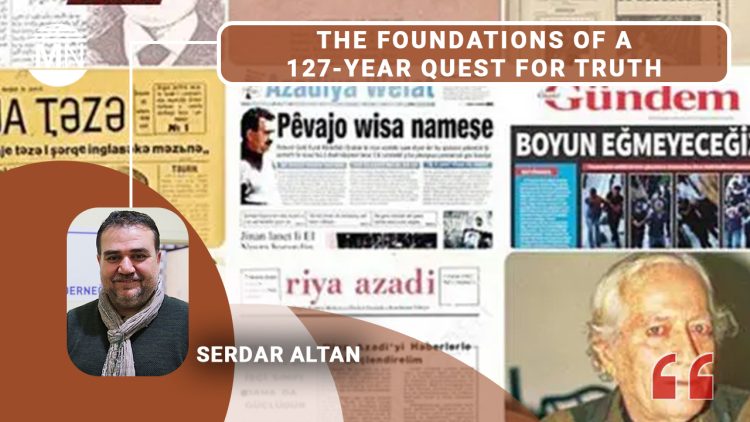
On 22 April 1898, Miqded Mîdhed Bedîrxan launched the Kurdistan newspaper in Cairo. On Tuesday, journalist Serdar Altan wrote an article for Yeni Yaşam, reflecting on how this historic act laid the foundation for a 127-year tradition of Kurdish journalism—rooted in exile, resilience, and resistance.
Serdar Altan
The story of Kurdish journalism begins in exile 127 years ago. Exile carries many meanings for Kurds, but above all, it signifies a life lived far from one’s homeland. For this reason, there is a constant rush and effort to do many things.
The journey of Kurdish journalism, too, is in fact a quest and a struggle to hold on to life. On 22 April 1898, the Kurdistan Newspaper began publication in Cairo with content in the Arabic alphabet, Kurdish, and Turkish. In other words, the birth of Kurdish journalism was also a milestone in the Kurdish awakening and the start of the national struggle. With the launch of Kurdish newspapers and magazines, we can observe a new enlightenment, the accumulation of knowledge, and cultural development on a national level. This historical progress managed to reach the present day despite facing many challenges. The celebration of 22 April as Kurdish Journalists’ Day today is a result of that journey. In this four-part series, we will try to take a comprehensive look at the long-standing journey of Kurdish journalism.
Exile, massacres, censorship, shutdowns, lawsuits, and countless forms of pressure… None of them could end Kurdish journalists’ pursuit of truth. On the contrary, the Kurdish press grew ever more determined. 127 years have passed; the foundation laid with the Kurdistan Newspaper continues today with dozens of media outlets, and Kurdish journalism still carries on its quest for truth.
Of course, we will occasionally address the historical process in our series, but we will focus more on interpreting it. For this reason, we had a long conversation with one of the doyens of Kurdish journalism, our esteemed teacher Hüseyin Aykol. Rather than a classic interview, it was more an effort to understand and explain. While shaping our series, we tried to approach it in this manner and interpret Kurdish journalism, which has developed along with the historical process, to the best of our ability.
Undoubtedly, journalism is known and seen as a challenging field worldwide. The reason lies in the journalist’s pursuit of truth. And of course, the attacks and repressive policies against this pursuit are systematic. In an era where capitalist modernity has taken deep root and enslaved the entire world, governments naturally dislike journalists. Especially those seeking the truth—they aim to eliminate them altogether. As a result, journalists around the world are among those most frequently subjected to pressure and attacks. The place of Kurdish journalists in this oppressive and tyrannical order undoubtedly deserves special emphasis. The publication journey of Kurdish journalism clearly reflects this reality.
The quest for truth, initiated 127 years ago by Miqded Mîdhed Bedîrxan with the Kurdistan Newspaper, has grown steadily. With the continuation of Hawar magazine and many other publications, the past century opened the door to success for Kurds. Even though this journey of Kurdish journalism has taken place in exile, it became a symbol of truth.
Throughout this long journey, Kurdish journalism has endured constant oppression and persecution. The main reason for this was, precisely, its pursuit of truth. It was Kurdish journalism that shattered the silence against the attempted erasure of the Kurdish language, culture, and identity.
Now, once more, let us return to the formation and development of this 127-year history of Kurdish journalism…
Kurdistan Newspaper
“(…) With God’s permission, I will publish the newspaper every fifteen days. I named it Kurdistan. I will speak of the goodness and truth of knowledge and art in the newspaper. I will show the Kurds where people are learning, where there are schools and madrasas. Where wars are breaking out, what the great powers are doing, how they are fighting, and how trade is conducted. (…)”
With these words of Miqded Mîdhed Bedîrxan begins the 127-year journey and story of Kurdish journalism. These words are also a note etched into history. The Kurds would now take to the stage of history in a more active literary sense.
Professor Hüseyin Aykol says, “Yes, this step was taken in 1898, and we know this history. One must also not forget that the actual date was 22 April. On such a 22 April, on an anniversary, we’re once again having this conversation,” but he then suddenly jumps from 127 years ago to 35 years ago, sharing a story. At a point when I thought we had reached the 1990s too soon, the reason behind this story was revealed in his final sentence.
Let’s listen:
“When we began the 35-year tradition of the Free Press, we started our work in the early months of 1990. There was a group in the Middle East called Revolutionary Unity, and as participants in this unity, we gathered in Istanbul to establish a legal initiative. Editors from various circles came, an office was rented in Istanbul, and we began our work. This was in the early months of 1990, around January. When we were ready, the weekly newspaper was to be named Halk Gerçeği (The People’s Truth). If we had managed it, we could have published it on 15 January. We didn’t make it in time for January. It could have been February or March, but we had all come from different disciplines. Also, aside from me, none of the others had any real experience in journalism. But we needed to publish the paper as soon as possible. By mid-April, we were ready. We prepared the paper to publish the first issue on 15 April and went to the printing press. That week, something negative happened in Turkey in terms of developments: a decree was issued. We called it the Censorship and Exile Decree. It was the first version of today’s Anti-Terror Law. We had an agreement with Hürriyet Newspaper—we were going to use their printing press and distribution network. It was a serious deal; we were going to print 50,000 copies. The week we brought the paper, this decree was issued, and Hürriyet said, ‘We won’t print it. We can’t.’ Why? They claimed the decree allowed the government to seize the printing press, so they refused to print it. We searched for other presses. So we couldn’t publish that week. In the end, we found a press, paying a very large sum of money, and we were only able to print it the following week. That date was 22 April!”
As Hüseyin Aykol recounted this striking anecdote about the major newspaper initiative of the Kurds and socialists 92 years after the Kurdistan newspaper’s first issue in 1898, he was, in fact, telling an extraordinary piece of history.
Historical process…
As mentioned earlier, the Kurdistan Newspaper launched by Miqded Mîdhed Bedîrxan began its life in exile, in Cairo, the capital of Egypt. Due to pressures from Ottoman authorities, after its sixth issue, the newspaper continued publication in Geneva. Some issues were entirely in Kurdish; others included both Kurdish and Turkish. Between 1898 and 1902, it circulated through Cairo, Geneva, London, and the town of Folkestone in the United States. In total, 31 issues were published before it ceased publication in 1902. This cessation also marked a long pause in Kurdish journalism.
Although several publications appeared on the historical stage in Istanbul in the 10 to 12 years after 1908—such as Kurd Teavun ve Terakki, Şark, Kurdistan, Amid-i Sevda, Rojî Kurd, Hetawî Kurd, Yekbûn, and Jîn—no significant sustained development occurred in Kurdish journalism until the 1930s.
A 73-year persistence: Riya Teze
In 1930, Riya Teze began publication in Armenia, marking its place in history as the longest-running Kurdish newspaper. As the first Kurdish-language newspaper published within the borders of the Soviet Union, it endured many hardships but managed to continue publishing until 2003.
Professor Hüseyin Aykol often refers to Riya Teze in journalism workshops, particularly emphasizing its longevity. He highlights its importance in the history of Kurdish journalism.
In our interview, I also mentioned the village after which the newspaper is named. During a trip to Armenia years ago, we discovered that one of the Yazidi (Êzidî) villages clustered at the foot of Mount Alagyaz was named Riya Teze, and the newspaper took its name from this village. This region has significantly contributed to the development of the Kurdish language, culture, and literature, producing many important poets, writers, and artists. The fact that it holds a place in the history of Kurdish press under such a name adds to its significance.
Yes, Riya Teze had a long life, but it was forced to close in 2003 due to economic reasons.
These years marked an important period in the growth and development of Kurdish publishing. Following this, other notable publications appeared: Hawar in Damascus in 1932, Gelawêj in Baghdad in 1941, Ronahî in 1942, Roja Nû in Beirut in 1943, and Jiyan in Sulaymaniyah (Silêmanî).
A milestone: Hawar magazine
The publication of Hawar magazine by Mîr Celadet Elî Bedîrxan in 1932 was, like the Kurdistan newspaper, a historic turning point for the Kurds. In addition to being in Kurdish, Hawar was the first Kurdish magazine to use the Latin alphabet. With a political perspective rooted in art, literature, and research, Hawar featured Kurdish poems and stories on its pages and became a pioneer of modern development in Kurdish literature. This pioneering role continued until 1943. The magazine’s publication date, 15 May, is now celebrated as Kurdish Language Day.
Hüseyin Aykol highlights the contributions of the Bedîrxan family to the Kurdish language and publishing journey, underlining the value they created:
“When it comes to Kurdish press, the Bedîrxan family immediately comes to mind. In fact, their influence, in my view, extended as far as the 1990s, into our era. Why? Because one of the most dedicated contributors to this cause in our country, Apê Musa, was also a son-in-law of the Bedîrxan family. So you see, their influence reached our generation.”
In the following years, Kurdish efforts to be present in the literary field continued. Although the magazines published by Musa Anter and some Kurdish intellectuals in the late 1950s and 1960s were short-lived, intolerance towards the Kurdish language and literature increased significantly. Musa Anter’s famous poem Kımıl (Aelia rostrata) stands out in the pages of history as a stark example of this repression and violence.
The politically dynamic 1970s represented a new crossroads for the Kurdish press. With Kurds separating from the Turkish Workers’ Party (TİP) and forming their own leftist-patriotic organisations, the number of Kurdish publications also increased.
Aykol evaluates this period in parallel with the influence of socialist revolutions:
“In Turkey, we see certain transformations during every significant historical period. For example, the Second Constitutional Era, then the 1946 period and the transition to a multi-party system, the 1970s, the pre-12 September coup era… In all these phases, we see the rise of the left. Alongside the rise of the left, we also observe the rise of Kurdish movements. The state has always perceived these periods as dangerous, as a threat—sometimes even as a disaster. These processes usually end with military coups anyway.”
During this period, publications such as Özgürlük Yolu, Heval-Yoldaş, Xebat, Rizgarî, Rêya Sor, Pêşeng Bo Şoreş, Kawa, Dengê Kawa, Ala Rizgarî, Şoreş, Serxwebûn, Têkoşîn, Tîrêj, and Yekbûn were among the key publishing outlets.
These were also the years when Hüseyin Aykol’s own journalism career began:
“Yes, I couldn’t contribute much to those publications back then, but many of the friends who worked there used to come to Ser Publishing in Ankara, where I worked, because they couldn’t find another printing press. That’s when I first met people like İsmail Beşikçi and others from Ala Rizgarî and Özgürlük Yolu. My connection to the Kurdish press also dates back to those times.”
The struggle for freedom and the Kurdish press
In this long and arduous journey, there are certain periods that hold vital importance in the history of Kurdish journalism. Without a doubt, the most prominent of these is the era coinciding with the birth and development of the Kurdish Freedom Movement. With the beginning of the struggle, these years also marked the start of a new phase for Kurdish journalism. The significance that Kurdish People’s Leader Abdullah Öcalan placed on agitation and propaganda accelerated this process further. The period that emerged with the magazine Serxwebûn would, in the following years, give rise to a more active Kurdish press.
Hüseyin Aykol reminds us of Berxwedan magazine alongside Serxwebûn, pointing out that Berxwedan—more so than Serxwebûn—placed a greater emphasis on journalism in the conventional sense.
He also shares an early agency experience in Europe that dates back to the 1980s. Speaking about a news agency established in cooperation with the Germans, he says:
“The agency was founded together with the Germans. At first, they were interested because they wanted to understand what the Kurdistan Workers’ Party (PKK) was doing, where it was headed. So they valued the agency we founded together. But when things started to grow, they got scared, and we had to shut it down. And that pushed us toward needing a weekly and eventually a daily newspaper in Turkey.”
Before the era of newspapers, it’s also important to recall the prison journalism experience of the Kurdish movement—something that cannot be overlooked. One could say that the Freedom Movement’s first publishing endeavour began not outside, but inside the Amed (Diyarbakır) prison, with the fanzines produced by Mazlum Doğan and others—prototypes of future magazines. In that sense, Mazlum Doğan can also be considered one of the first Kurdish journalists. I remind Hüseyin Aykol that this prison-based journalism, which began in the 1980s, has continued uninterrupted to this day.
He agrees:
“Even if not in Amed, I was also imprisoned during those years. That’s when I first met many names from the Kurdish movement. Aydın Prison, for instance. Also, after being convicted in trials in Amed, the first group to be exiled was sent to Eskişehir Prison. While I was in Aydın Prison, a group of 20 to 30 Kurds were brought in. Meeting them, having long conversations, and seeing the publications they produced—those moments stayed with me. It was incredible, actually. Every month, without fail, they would produce a 20–30-page publication written entirely by hand. It was, of course, a valuable endeavour.”
By the 1990s, a new tradition referred to as the “Free Press” would take root. This tradition was established on a foundation that developed a form of journalism committed to truth, one that resisted all instruments of oppression with a defiant spirit and elevated the struggle to a higher level. The fight for truth, standing against the narratives that distorted or concealed Kurdish history and reality, became a complement to the broader Kurdish freedom struggle. Until then, the occupation and destruction policy imposed on Kurdistan and the Kurdish people had either been completely ignored or the facts had been twisted and presented to the global public in a distorted way. Clearly, there was a serious gap in this area—and Kurdish journalism had to fill it. Of course, this would not be easy. There would inevitably be a price to pay for this pursuit of truth.


