

Sütun 1
Sütun 2
Sütun 3
Medya News
Daily News
Breaking News
Subscribe
No Result
View All Result
  • Home
  • All News
  • Opinion
  • Kurdistan
  • Women
  • Politics
  • Human Rights
  • INTERVIEW
  • More
    • SPECIAL REPORTS
    • ECOLOGY
    • WORLD
    • AUDIO ARTICLES
    • JOURNALISM
    • ECONOMY
    • CULTURE & ART
    • LONG READS
    • NEWSLETTER
    • DAILY NEWS
MULTIMEDIA
PODCAST
LIVE BLOG
  • Home
  • All News
  • Opinion
  • Kurdistan
  • Women
  • Politics
  • Human Rights
  • INTERVIEW
  • More
    • SPECIAL REPORTS
    • ECOLOGY
    • WORLD
    • AUDIO ARTICLES
    • JOURNALISM
    • ECONOMY
    • CULTURE & ART
    • LONG READS
    • NEWSLETTER
    • DAILY NEWS
MULTIMEDIA
PODCAST
No Result
View All Result
Medya News

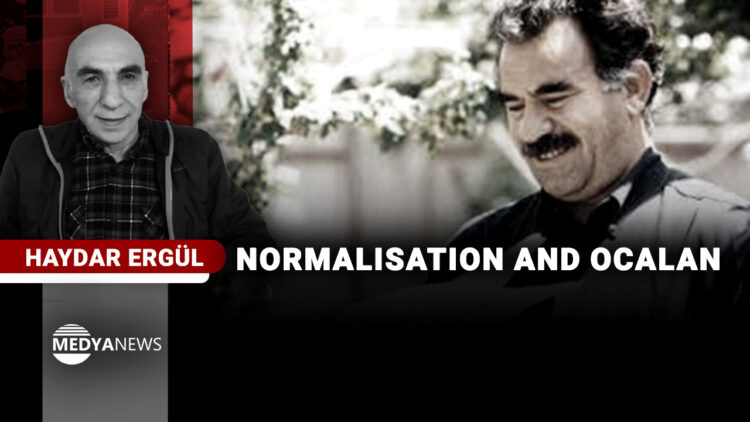
The deliberate isolation of Öcalan: silencing a leader and its impact on democracy in Turkey

Journalist Haydar Ergül highlights the severe and deliberate isolation of the jailed Kurdish Abdullah Öcalan and its implications, questioning the state's motives and the broader impact on democracy and societal norms in Turkey.

3:31 pm 18/06/2024
A A
The deliberate isolation of Öcalan: silencing a leader and its impact on democracy in Turkey
Share post

Haydar Ergül

It has been thirty-nine months since the total isolation and incommunicado detention was imposed on PKK Leader Abdullah Öcalan. This state of isolation and incommunicado detention is not only applied to Öcalan. It is also applied to Veysi Aktaş, Ömer Hayri Konar and Hamili Yıldırım, who are detained alongside Öcalan.

We should think of it this way: For thirty-nine months no news has been received from the three prisoners, especially Öcalan, who are imprisoned according to the laws of a structure called the state. This lack of communication and news brings to mind many different thoughts.

What is the state aiming to achieve by eliminating all transportation and communication channels? Are there things it wants to keep unknown or unheard, something it feels the need to hide? How important are the objectives or targets for the state that it disregards its own laws and enforces a state of absolute communication blackout in İmralı Island Prison? These questions can be multiplied with further inquiries.

In order to find answers to some of these questions, we can look at the identities of the prisoners, especially Öcalan, who are kept together but in different cells. Öcalan is a figure well known and recognised by the public. He is the founding leader of the PKK [Kurdistan Workers’ Party]. He has been imprisoned for 25 years in İmralı Island Prison. His influence is especially high among Kurds, and there is sympathy for him. The lack of communication and isolation are related to Öcalan’s position.

Öcalan is being deliberately forgotten. His voice is being silenced and his name is being erased. Is it thought that if Öcalan is forgotten and his name is not mentioned, the Kurdish question will disappear? Is it possible for this plan to succeed? If it were possible, wouldn’t his 25 years of imprisonment in an island prison have been enough? Moreover, for the last 39 months, more than three years, Öcalan and the three prisoners with him have had no communication with the outside world.

Their families are not allowed to visit. Despite the families efforts, the authorities rarely feel the need to respond to visit requests. Nor are the prisoners allowed to meet with their lawyers. The prisoners’ legal right to weekly phone calls and correspondence with their families has been effectively banned.

Veysi Aktaş recently completed his 30-year sentence. According to the law, he should have been released. However, his release has been postponed for one year by extending his sentence. Will Veysi Aktaş be released in a year’s time? If the current situation continues, his release is highly unlikely. Similarly, Nasrullah Kuran and Çetin Arkaş, who were once with Öcalan in İmralı, were sent to Marmara (Silivri) Prison in 2016. They are still being held there. Both have completed their 30-year sentences, but their release has been delayed and it is uncertain when they will be freed.

This issue of extending sentences is also linked to Öcalan. It is believed that if they are released, they could provide information about Öcalan’s life in prison, which is why their sentences are being extended.

In summary, we are faced with a strict prohibition that does not even allow Öcalan’s name to be mentioned. Imagine a state that is afraid of the mere mention of Öcalan’s name because it is afraid that it will endanger the state. How should we evaluate this situation? I leave it to the reader to decide.

If Öcalan’s isolation was limited to the prison on İmralı Island, it might be considered less severe. But this is not the case; the isolation goes beyond İmralı and reaches a level that criminalises the whole society. The recent appointment of a trustee for Colemêrg is directly related to this isolation.

The isolation imposed on Öcalan has now become a problem for democracy and freedom in Turkey. It has reached a point where it affects not only the Kurds but also the Turks.

The CHP [Republican People’s Party] became the leading party in the local elections. After the elections, Özgür Özel introduced the concept of normalisation. This concept is indeed important. But why is Turkey not normalising? In reality, Turkey has been searching for its norms for a century. Turkey’s norm begins with the recognition of differences and the granting of their rights.

The Republic was founded on denial. That is why it contains abnormalities. The construction based on the principles of one nation, one language, one religion has paved the way for a century of pain, oppression and exploitation by denying differences and enabling all anti-democratic practices.

True normalisation, therefore, begins with the rejection of denial and, above all, with the genuine recognition of the Kurds. This can be achieved by securing their natural rights through legislation. Consequently, the first step towards normalisation should be to courageously oppose the isolation imposed on Öcalan.

The prominent Kurdish politician and journalist Haydar Ergül was a member of a peace group organised in 1999 as part of a symbolic gesture initiated by the jailed Kurdish leader Abdullah Öcalan, as a part of his tireless efforts for pushing a negotiation process on resolution for the decades-long Kurdish question. In response to Öcalan’s call, Ergül travelled with other Kurdish activists from Europe to Turkey to support the peace process. After 13 years in prison, Ergül was released. He was later put on trial in a case known publicly as the ‘KCK Academy’ case, referring to the Kurdish umbrella organisation KCK (Kurdistan Communities Union), recently acquitted in the case. He is currently the chef editor of Democratic Modernity journal, a two months published periodical on Öcalan’s philosophy of liberation. Haydar Ergül also writes columns for the Yeni Yasam newspaper.

This article was originally published in Yeni Yaşam.


Share post
Tags: Abdullah ÖcalanHaydar ErgülNormalisation in TurkeyopinionTrending

Related Posts

Sayın: Only Öcalan’s model can resolve war driven by corridor competition

Sayın: Only Öcalan’s model can resolve war driven by corridor competition

June 29, 2025
Kurdish politician says regional unrest urges Turkey to resolve internal conflicts

Kurdish politician says regional unrest urges Turkey to resolve internal conflicts

June 29, 2025
British lawmakers urged to back Kurdish peace efforts

British lawmakers urged to back Kurdish peace efforts

June 28, 2025
Daily News : 27 June 2025

Daily News : 27 June 2025

June 27, 2025
A century later, Sheikh Said’s rebellion echoes in the struggle for a democratic republic

A century later, Sheikh Said’s rebellion echoes in the struggle for a democratic republic

June 27, 2025
DEM Party İmralı delegation meets Parliament Speaker to advance peace process

DEM Party İmralı delegation meets Parliament Speaker to advance peace process

June 27, 2025

The news content on our website cannot be quoted without permission, even by citing the source. It cannot be copied or published elsewhere, contrary to the law or without permission.

Follow Medya News

Categories

  • All News
  • Politics
  • Human Rights
  • Opinion
  • Kurdistan
  • Human Rights
  • Interview
  • Women
  • Audio Articles
  • Special Report

Quick Menu

  • Daily News
  • Live Blog
  • Podcast
  • Videos
  • Breaking News

About

Impressum

About us

Privacy Policy

Welcome Back!

Login to your account below

Forgotten Password?

Retrieve your password

Please enter your username or email address to reset your password.

Log In
We use cookies on our website to give you the most relevant experience by remembering your preferences and repeat visits. By clicking “Accept All”, you consent to the use of ALL the cookies. However, you may visit "Cookie Settings" to provide a controlled consent.
Cookie SettingsAccept All
Manage consent

Privacy Overview

This website uses cookies to improve your experience while you navigate through the website. Out of these, the cookies that are categorized as necessary are stored on your browser as they are essential for the working of basic functionalities of the website. We also use third-party cookies that help us analyze and understand how you use this website. These cookies will be stored in your browser only with your consent. You also have the option to opt-out of these cookies. But opting out of some of these cookies may affect your browsing experience.
Necessary
Always Enabled
Necessary cookies are absolutely essential for the website to function properly. These cookies ensure basic functionalities and security features of the website, anonymously.
CookieDurationDescription
cookielawinfo-checkbox-analytics11 monthsThis cookie is set by GDPR Cookie Consent plugin. The cookie is used to store the user consent for the cookies in the category "Analytics".
cookielawinfo-checkbox-functional11 monthsThe cookie is set by GDPR cookie consent to record the user consent for the cookies in the category "Functional".
cookielawinfo-checkbox-necessary11 monthsThis cookie is set by GDPR Cookie Consent plugin. The cookies is used to store the user consent for the cookies in the category "Necessary".
cookielawinfo-checkbox-others11 monthsThis cookie is set by GDPR Cookie Consent plugin. The cookie is used to store the user consent for the cookies in the category "Other.
cookielawinfo-checkbox-performance11 monthsThis cookie is set by GDPR Cookie Consent plugin. The cookie is used to store the user consent for the cookies in the category "Performance".
viewed_cookie_policy11 monthsThe cookie is set by the GDPR Cookie Consent plugin and is used to store whether or not user has consented to the use of cookies. It does not store any personal data.
Functional
Functional cookies help to perform certain functionalities like sharing the content of the website on social media platforms, collect feedbacks, and other third-party features.
Performance
Performance cookies are used to understand and analyze the key performance indexes of the website which helps in delivering a better user experience for the visitors.
Analytics
Analytical cookies are used to understand how visitors interact with the website. These cookies help provide information on metrics the number of visitors, bounce rate, traffic source, etc.
Advertisement
Advertisement cookies are used to provide visitors with relevant ads and marketing campaigns. These cookies track visitors across websites and collect information to provide customized ads.
Others
Other uncategorized cookies are those that are being analyzed and have not been classified into a category as yet.
SAVE & ACCEPT

Add New Playlist

Contact

[contact-form-7 id=”18690″ title=”Contact form 1″]

[email-subscribers-form id=”1″]

No Result
View All Result
  • All News
  • Kurdistan
  • Women
  • Politics
  • Human Rights
  • Interview
  • Long Reads
  • World
  • Journalism
  • Ecology
  • Economy
  • Culture & Art
  • Daily News
  • Breaking News
  • Newsletter
  • Opinion
  • Authors
  • Podcast
  • LIVE BLOG

© 2020 Medyanews. All Rights Reserved