

Sarah Glynn
Judge him by his actions, they said.
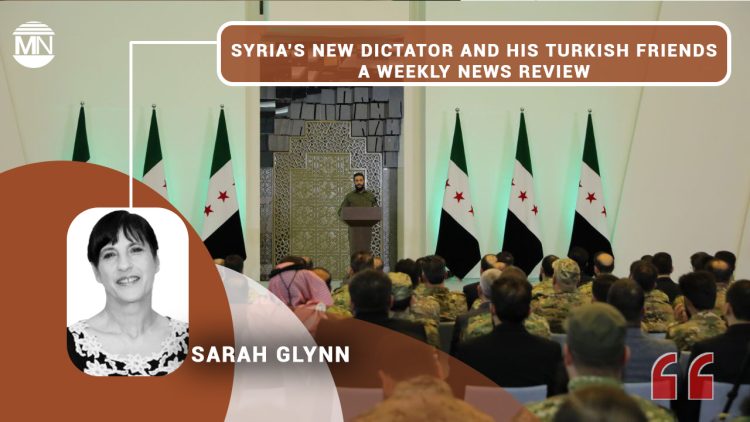
On Wednesday, Ahmed al-Sharaa, leader of the al-Qaeda offshoot, Hay’at Tahrir al-Sham (HTS), stood in front of rows of men, mostly in military fatigues, for a Victory Declaration at which he had himself named president of Syria. The declaration took place in private, and the gathering consisted of Islamist military commanders who had allied with HTS in the ousting of President Assad, along with some members of HTS’ interim government. Included in the room were men known for human rights abuses and extreme violence – among them leaders of Turkish mercenary groups sanctioned by the US for their involvement in killings, abductions, torture, rape and looting. Concern has especially focussed on the presence of the leader of the group that carried out the brutal murder of Kurdish politician, Hevrîn Xelef.
For this historical moment there was no attempt to include other groups or civilian representatives, and the Syrian people were simply informed by the HTS military spokesman of what had been announced. The female half of the population might as well not have existed.
Officially this is a temporary presidency, but there is no time set for its end. Al-Sharaa has already warned that two or three years will be needed to write a new constitution, and that it will take four years for the country to be ready for an election. Many doubt if that election will ever take place. Al-Sharaa is the new dictator of Syria in all but name, and, like Assad, he is insisting on strong centralised control. Despite al-Sharaa’s references to a national conference and inclusive government, Reuters quotes Fawaz Gerges, Professor of International Relations at the London School of Economics, who told them that the Victory Declaration had “formalised his status as the strongman ruler…My take is that HTS and Sharaa intend to consolidate single-party Islamist rule.”
It was also announced that all Syria’s existing state structures would be dissolved, and that the different groups involved in the ousting of Assad would also be dissolved and would merge into new state structures and the new Syrian Army. In line with Turkish Government wishes, Turkey’s mercenary militias – the so-called Syrian National Army (SNA) – are also dissolving themselves into the new Syrian armed forces, which raises many further questions.
The day after his appointment, the new president, tall and severe in a dark suit and Islamic green tie, addressed the nation, repeating his promise of a national dialogue conference, and his intention to “impose sovereignty under one authority” across the country.
The “Syrian National Army”
When HTS was routing Assad’s hollowed out Syrian Arab Army, Turkey’s SNA, backed by Turkish air power, launched an attack on the Autonomous Administration of North and East Syria and the Administration’s Syrian Democratic Forces (SDF). The SNA occupied al-Shahba and Manbij, and, in recent weeks, they have been focussing their attacks on the Tishreen Dam. These attacks have deprived hundreds of thousands of people of electricity and of pumped water, and threaten major catastrophe if the dam is breached. They include repeated targeted attacks against civilians. In the early stages of their taking of power, HTS kept SNA forces away from the Kurdish neighbourhoods of Aleppo, and negotiated with the SNA to allow the safe passage of people displaced from al-Shahba, but HTS have refrained from intervening in the attacks by Turkey and their SNA on North and East Syria.
If the SNA becomes part of the HTS-led Syrian Army, then the attacks on North and East Syria become the responsibility of that army, and the new Syrian president will have to decide if they will continue to fight Turkey’s war against the Kurds and the SDF.
The Syrian Democratic Forces
Talks are ongoing about how to incorporate North and East Syria and the SDF into the new Syria, but al-Sharaa’s insistence on centralisation provides a major stumbling block to any agreement, just as Assad’s similar insistence prevented earlier attempts to make an agreement that could help democratise Syria. The autonomous administration wants to preserve its autonomy – and spread it to other Syrian regions – and argues that it needs its own self defence. Discussions about the possibility of integrating the SDF into the Syrian army tend to regard it in a similar way to a business merger; but the men and women who serve in the SDF are not there simply as a job. They are there specifically to defend their region and its freedoms, especially women’s rights and the rights of its different peoples.
Sectarian violence
Meanwhile, there have been numerous reports of sectarian attacks and murders committed by people with links to HTS, especially attacks against the Alawite community, of which Assad was part. The Syrian Observatory for Human Rights documented over 200 deaths in January resulting from such “retaliatory actions”. Some of these have targeted former regime leaders, but by no means all, and – anyway – action that claims to be against such people should be proportionate and allow for the possibility of legal defence, not take the form of vigilante “justice”. While attacks of this kind might have been expected, al-Sharaa’s muted response has belied his rhetoric on intercommunity peace.
The Cradle claims that, according to their sources, Al-Sharaa “is well informed of the massacres and killings of Alawite and Shia citizens,” with one source reporting that al-Sharaa had told him, “This [the killings] is normal and may continue for two or three years.” The Cradle observes, “The [security] campaign’s chaotic nature raises serious questions about the chain of command. Are these rogue elements acting on their own, or is leadership deliberately turning a blind eye – or even sanctioning these acts? The excuse of ‘individual misconduct’ has become a convenient cover for widespread atrocities, from execution-style killings to the ransacking of homes and businesses.”
Privatisation and job losses
True to the statements of their “Foreign Minister” at Davos, the interim government is also steaming ahead with its programme of privatisations and public sector layoffs, which are set to affect a third of state employees. There is no doubt that Assad’s public sector was grossly inefficient and corrupt, but that does not mean that privatisation is the answer, while job loss in Syria’s struggling economy will be crippling. There have already been protests.
Turkish intervention
While Europe watches and waits – making visits and provisionally easing sanctions in the hope that this time regime change will have been a success – and while the United States is largely transfixed by Trump, Turkey has been using every opportunity to draw Syria into its web of control and to put pressure on the Autonomous Administration and on the Kurds more generally.
Last Saturday, the head of Turkish intelligence, İbrahim Kalın, was with al-Sharaa in Damascus to influence him against the Kurds. They discussed integration of the SNA with HTS, which Turkey wants in order to pit HTS against the Autonomous Administration and their SDF, and also to make up for SNA losses.
Pro-Government Turkish journalist, Ragip Soylu, explains in Middle East Eye that Turkey wants the complete disarming of the SDF, and that they are seeking a “nuanced solution” in which the United States would limit support for the SDF in exchange for Turkey not carrying out large scale operations. Their continual low-level war of attrition is not most people’s idea of nuance.
Also last Saturday, Turkey’s Foreign Minister, Hakan Fidan, was in Bagdad to meet with his Iraqi counterpart, Fuad Hussein, who had recently expressed fears that Turkey’s attacks in Syria would bring refugees to Iraq. The day before their meeting there was a fatal confrontation between PKK guerrillas and the invading Turkish army in the Heftanin region of Duhok. Turkey requested assistance from the Kurdistan Democratic Party (KDP) peşmerga who were acting as Iraqi border guards, and two of the peşmerga were killed, reportedly by Turkish bombardments. Fidan used these deaths to support his argument that the PKK was a shared threat – leading to suggestions that the deaths might not have been accidental.
The two foreign ministers reiterated their commitment to work together economically and for “security”, though Hussein continues to reject Turkish demands to label the PKK as terrorists.
Turkey has also intensified their ground and air attacks on the Kurdistan Region of Iraq, and have been accuse of deliberately targeting civilians to drive away the local population. On Monday, they hit a civilian vehicle, killing four occupants.
Turkey has also been targeting civilian areas in North and East Syria. On Tuesday, a drone attack on a market in the town of Sirrin killed 12 civilians including two children.
Ilham Ahmed, Foreign Relations co-chair for the Autonomous Administration, has given an interview to JINHA where she warned, “Turkey has placed advisors in HTS ministries. This is a clear move to dominate northern Syria, but their ultimate aim is to control the entire country.”
Despite Turkish pressure, HTS and the SDF are still negotiating. The SDF is ready to become part of the new Syrian army, but only as an independent block that can continue to defend the interests of the peoples of the Autonomous Administration.
Inside Turkey
Turkish intervention in Iraq and Syria is linked to the talks that have taken place with Abdullah Öcalan in Turkey itself. Leading members of the pro-Kurdish DEM Party have twice had long visits to Öcalan in İmralı island prison, and there is growing expectation that he may give a public statement on 15 February, the 26th anniversary of his abduction and imprisonment. Öcalan has long said that it is time for political discussion not military action and the PKK has long been ready to end the armed struggle in exchange for a peace deal that addresses the concerns that drove them to take up arms in the first place. There is hope that the situation in Syria will provide new options and pressures that will make a deal more likely, though the rhetoric coming out of Ankara, and the behaviour of the Turkish Government, give little suggestion of readiness to make concessions.
The government’s official talk is only about the PKK disarming and the end of “terrorism”. And, while Öcalan has made clear that democracy is a vital Kurdish demand, the government continues to dismiss and arrest elected politicians. This week the DEM Party mayor of Siirt, Sofya Alağaş, was sentenced to six years three months in prison in a case that relied on a secret witness who had previously admitted to working for the state. Although she will appeal her case, she was replaced the next day by a government appointed trustee. This move has become so routine that the trustee arrived with a preprepared nameboard.
The removal of further DEM Party mayors is in the offing, and the government also have their eyes on Ekrem İmamoğlu, the Republican People’s Party mayor of Istanbul, who is regarded as a future challenger to Erdoğan for the presidency. Yesterday he was called to court on two separate investigations that could see him banned from politics on charges that are widely regarded as completely political and without legal basis.
Europe
The relative lack of international engagement on all these issues is frightening. There are some notable exceptions, such as the delegation of European politicians, including two French deputies, that has been visiting North and East Syria; the meeting at the European Parliament hosted by the Rapporteur on Syria; the new report by Human Rights Watch criticising Turkey and its SNA for attacking civilians and the Tishreen Dam; and individual parliamentarians who raise questions in their parliaments. However, my observations at the Council of Europe only reinforce my concern.
Turkey is a member of the Council and committed to obeying the rulings of the European Court of Human Rights, but when they don’t obey those rulings, the Council is reluctant to apply any meaningful pressure, and Turkey knows they can exploit this weakness. Last week was the quarterly Parliamentary Assembly, but there was no debate on Syria, where attacks are being carried out by a council member. Although the Council is an organisation whose role is to protect universal values of human rights, democracy, and the rule of law, their choice of issues to pursue is clearly dictated by political considerations.
America
In the Middle East, it is still the United States that can call the shots, and as Senator Tom Cotton, chair of the Senate Intelligence Committee, spelled out this week, “No question, stable democracies make the most stable friends. But what matters, in the end, is less whether a country is democratic or non-democratic, and more whether the country is pro-American or anti-American.” While he described this view as “may be unconventional”, it is nothing new. The survival of a regime or the support for opposition forces depend to a large extent on their ability to persuade the US Government that this will be of benefit to the United States. Of course, real world consequences are hard to predict, and the disasters of today’s Middle East suggest that America may not be very good at understanding where their best interests lie; but the endless wars feed the military industrial complex, so this key component of “US interests” is satisfied.
Cotton’s comments were made as part of his introduction to the Senate Confirmation Hearing on Trump’s nomination of Tulsi Gabbard as Director of National Intelligence.
In her opening statement Gabbard said, “I have no love for Assad or any dictator. I just hate al-Qaeda. I hate that our leaders cozy up to Islamist extremists, calling them ‘rebels’, as Jake Sullivan said to Hillary Clinton: ‘Al-Qaeda is on our side in Syria.’ Syria is now controlled by al-Qaeda offshoot HTS, led by an Islamist Jihadist who danced in the streets on 9/11, and who was responsible for the killing of many American soldiers.” In response to a question at the end of the hearing she talked about the CIA’s Timber Sycamore Programme that was “working with and arming and equipping al-Qaeda in an effort to overthrow [the Syrian] regime, starting yet another regime change war in the Middle East.” And the Department of Defence’s Train and Equip Programme that “ultimately resulted in over half a billion dollars being used to train who they called moderate rebels but were actually fighters working with and aligned with al-Qaeda’s affiliates on the ground in Syria.” Gabbard explained that she herself joined the military in response to al Qaeda’s 9/11 attack, but she received significant help earlier in her political career from Hindu nationalists, so her concern about Islamism may also have some more troubling roots. Nevertheless, it was refreshing to hear criticism of the dangers of external regime change being so publicly aired.
Sarah Glynn is a writer and activist – check her website and follow her on Twitter or bluesky


