

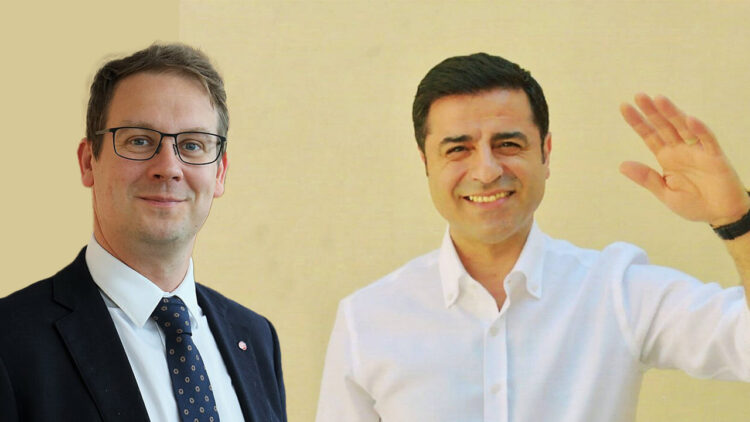
Swedish MPs strongly criticised Turkey’s human rights violations in parliament on Tuesday, demanding the immediate release of Kurdish politician Selahattin Demirtaş, who faces a 42-year prison sentence despite a European court ruling for his release.
Ola Möller, a Social Democrat MP and head of the Kurdistan-Sweden Friendship Group, called the situation in Turkey “democratically alarming” and condemned the ongoing repression of opposition groups, particularly Kurds. He highlighted that “6,000 political prisoners are currently held in Turkish jails,” with widespread reports of torture and human rights abuses.
The debate also touched on Sweden’s recent accession to NATO, where Turkey plays a critical role. Möller stressed the importance of holding Turkey accountable within the alliance, noting that NATO membership offers Sweden a platform to advocate for human rights and democratic values. “As allies, we must have high expectations of each other, and what’s happening now in Turkey is unacceptable,” he stated.
Kadir Kasırga, another Social Democrat MP, underscored the significance of Demirtaş’s case, stating that Turkey’s actions signal a collapse of democratic hopes. “Demirtaş’s imprisonment, despite clear European court rulings, should lead to concrete consequences for Turkey, an EU candidate country,” he said.
Sweden’s Foreign Minister, Tobias Billström, responded by emphasising Sweden’s commitment to raising human rights issues with Turkey through bilateral and international forums. “Sweden will continue to advocate for the release of Selahattin Demirtaş and Osman Kavala,” he noted, reaffirming that respect for human rights is non-negotiable for European Council members.
Swedish MPs are now urging their government to take a firmer stance within NATO and the EU, stressing that Turkey’s human rights record should influence its relations with the West.
Sweden’s recent accession to NATO has been significantly influenced by Turkey’s demands, particularly concerning Sweden’s Kurdish population and its stance on Kurdish groups. Turkey, under President Recep Tayyip Erdoğan, leveraged its power to veto Sweden’s NATO membership, demanding that Sweden address what Ankara perceives as support for Kurdish militants, specifically the Kurdistan Workers’ Party (PKK).
As part of its bid to join NATO, Sweden made several concessions to appease Turkey. These included lifting an arms embargo imposed on Turkey following its military operations in Kurdish-controlled areas of Syria and tightening its anti-terrorism laws.
These legal changes have raised concerns among Sweden’s Kurdish community and human rights advocates, who fear that these measures may lead to the suppression of Kurdish political activities and the extradition of Kurdish dissidents to Turkey. This situation has placed Sweden in a difficult position, balancing its domestic values of supporting Kurdish rights with the geopolitical necessity of joining NATO.


