

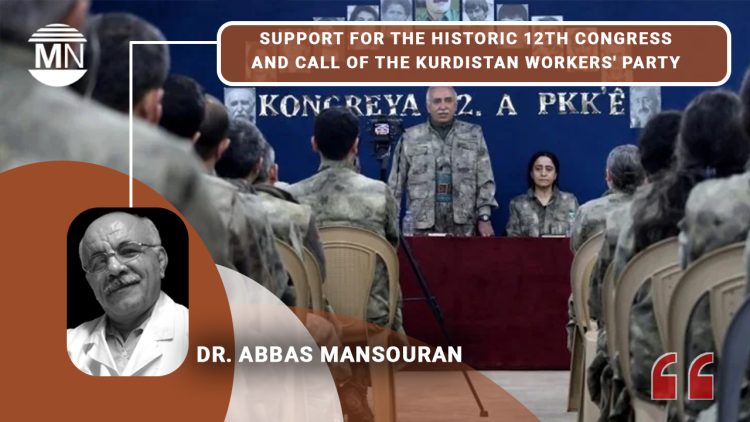
Dr Abbas Mansouri
All freedom-loving forces worldwide are called upon to support this call and the historic efforts of the 12th. I declare my practical support for the second paradigm and the process rooted in choices of struggle, organisation, and a horizon focused on the new life.
In 1978, under the oppressive regime of Turkey’s military rule, where even uttering the words “Kurd” or “Kurdistan” was criminalised, and prisons were filled with freedom-seekers, workers, and the impoverished, the PKK emerged. This emergence was both a practical and theoretical response, stepping boldly into the arena of struggle. Throughout history, the only refuge for the Kurds has been the mountains, as denial, repression, and systemic violence sustained the pillars of the dominant class-based political order.
The founders of this party, led by the esteemed Abdullah Öcalan, chose a sacrificial path, yet one grounded in the reality of the oppressed. They believed in transforming the impossible into reality, initiating a dynamic, deeply rooted struggle. Choosing this path was obligatory, as it was the only way to resist the overwhelming forces of oppression and injustice. The circumstances left no other option but to fight for the survival, dignity, and freedom of the Kurdish people, and to challenge the broader systems of denial, exploitation, and state control.
The PKK, standing in opposition to Soviet state socialism and its satellites, which it viewed as neither genuine socialism nor truly liberating, placed the Kurdish historical question at the heart of its paradigm amidst the Cold War era. Though repression, occupation, and the destruction of Kurdish society, cultural and ecological life continued, this resistance emerged as a fundamental response to the Sykes-Picot (1916) and Lausanne (1924) treaties—agreements that divided Kurdistan and laid the groundwork for a century-long project of assimilation and erasure.
From this perspective, the emergence of the PKK and the modern Kurdish movement can be understood as a historical dialectic between resistance, erasure, denial, and the reinvention of identity.
Achievements of the Kurdish Freedom Movement and resistance
Based on its documents, programs, and social praxis, the PKK has concluded that over these decades, by standing firm against cultural and social assimilation, the denial of women’s and oppressed people’s identities, and the domination of nation-states, it has developed new conceptual and ideological alternatives:
• Jin, Jiyan, Azadî (Woman, Life, Freedom): A slogan and guiding principle emphasising the centrality of women’s liberation to societal freedom.
• Jineolojî (Women’s Science): A discipline that seeks to reclaim and reconstruct knowledge from a radical feminist perspective, challenging patriarchal narratives and promoting women’s contributions to all fields of knowledge.
• Defense of the ecosystem: Advocating for ecological sustainability and the protection of natural resources as integral to community well-being.
• Struggles against modern forms of slavery and global capitalism: Opposing exploitative economic systems and advocating for equitable social structures.
These principles reflect a commitment to a holistic and inclusive vision of freedom, where the liberation of individuals is intertwined with the liberation of all society.
Rejecting the nation-state model, the freedom movement, particularly through the lived experiment of democratic self-governance in Rojava, has articulated a visionary alternative rooted in grassroots democracy, inclusive coexistence, and active popular participation. Central to this paradigm are the principles of co-management, the full and equal involvement of women and men, and the conviction that women’s liberation is inseparable from the broader liberation of all society.
These hard-won achievements have come at an extraordinary cost: the lives of hundreds of thousands of politically conscious, freedom-seeking individuals—including internationalists, socialists, communists, and anarchists—who sacrificed themselves in the struggle against ISIS and in defense of global security. Thousands more have been maimed or blinded, and hundreds of thousands displaced from their homes. Standing alongside them is the steadfast resistance of thousands of political prisoners in Turkish prisons—many of whom perish slowly behind bars—offering a powerful symbol of unbroken defiance against systemic oppression and fascism.
Leadership of the PKK and the historical transition
In this epoch, the Kurdistan Workers’ Party (PKK) leadership, reflecting on fifty years of struggle, achievements, hard-won experiences, and moments of trial, has now stepped into a defining historical phase—guided by a deep awareness of new socio-political necessities and a bold commitment to transformation. This moment marks not a tactical shift, but a fundamental rearticulation of resistance, power, and the vision of a just and dignified society. It is a vision in which woman, nature, and freedom become the central pillars of social structure, replacing the primacy of the state, borders, and systems of domination.
A new horizon
Contrary to widespread speculation and narrative framing, Öcalan’s recent call and decision issued during the 12th Congress of the PKK do not reflect a moment of failure or impasse and were not the reactive or spontaneous manoeuvres. Rather, they represent the historical crystallization of fifty years of collective resistance, critical engagement, and conceptual innovation. The resistance in the free mountains and Rojava, along with Newroz, the Newroz fire, and 8 March—International Women’s Day—became a festival of strength and popular empowerment in 2025.
The 12th Congress is best understood as a strategic inflection point: a moment of synthesis born from enduring struggle, and the opening of a new political horizon.
During the 12th Congress, Cîdem Doğu, a female member of the Executive Council of the KJK (Koma Jinên Kurdistanê / Kurdistan Women’s Communities), honoured the “martyrs” of the movement, highlighting the enduring ethical, cultural, and philosophical values the struggle has produced. In her words:
“Undoubtedly, we will not abandon these values. The PKK created this ethic of freedom, the philosophy of freedom. It cultivated within us the character and culture of freedom. The first fundamental critiques and evaluations by the leadership regarding socialism, the perspective on women and the family, date back to 1987, the time of the 3rd Congress. When we examine all of this, we realize that these achievements go beyond real socialism. A vision that looks toward women, nature, internationalism, and global socialism is no longer confined to a national framework but opens a global horizon.”
Through the statement lies the essence of the PKK’s evolving paradigm: an ideological transformation that challenges the hegemony of nation-state structures and capitalist modernity but also proposes a transnational, ecologically conscious, and gender-liberated model of democratic life. The movement’s trajectory reflects a commitment to constructing a political alternative that extends beyond Kurdish liberation toward a universal politics of freedom.
Thus, the proposal to dissolve the party and abandon armed struggle does not mean the end of the historical struggle or the surrender of weapons to the enemy. Rather, it signals the end of a former phase and the beginning of a new one, aimed at building new structures. This new era finds its foundation in the material force of women, the organised masses aware of their rights and identities, self-organised, autonomous, and vanguard, armed with the accumulated experiences and sacrifices of the past fifty years.
The call of Abdullah Öcalan: A transition from the 20th to the 21st Century
On 27 February 2025, Abdullah Öcalan issued a historic and transformative call, rooted in five decades of resistance, organisational experience, critical reflection, and revolutionary thoughts. In this strategic message, Öcalan introduced a seven-point framework followed by a fundamental guarantee clause, laying the groundwork for transitioning from armed struggle and regionally-bound party structures toward a transnational, democratic political model.
Öcalan stated unambiguously:
“A congress of the PKK should be convened, it should dissolve itself, and the armed struggle should end.”
Yet, in a crucial addendum, he emphasised that such a transition is contingent upon formal political and legal recognition:
“Undoubtedly, for the weapons to be laid down in practice and the PKK to dissolve, the democratic and legal aspects must be recognised.”
This guarantee clause is not a marginal note, it is a central political condition. The late Sırrı Süreyya Önder, a prominent figure in the Peoples’ Equality and Democracy Party (DEM Party) and a committed peace advocate who passed away under unclear circumstances following visits to Imrali prison, rightly placed the responsibility on the Turkish state. As Önder highlighted, the realisation of Öcalan’s call requires concrete political guarantees and the establishment of a legitimate political process capable of replacing armed resistance.
Öcalan clarified that the PKK was formed in response to unique historical conditions, emerging in a political vacuum shaped by repression, denial, and colonial fragmentation. Through a distinctive analysis of the Kurdish question, the PKK redefined it not merely as an ethnic or national issue, but as a core dimension of the broader crisis engulfing the Middle East.
Today, Abdullah Öcalan’s vision connects the Kurdish struggle to the broader resolution of regional and global conflicts. No longer a marginal or isolated issue, the Kurdish question has emerged as a central axis for addressing the structural crises of the modern nation-state, authoritarian governance, and regional militarism. Öcalan’s proposal represents not a retreat but a strategic avant-garde—a deliberate shift from the logic of war to one of peace, justice, and participatory democracy.
The movement’s growth and expansion beyond the Kurdish question
Today, drawing upon its organisation, awareness, and fifty years of experience, the movement has evolved into a formidable transnational force. The resistance of the Kurdish people across the four parts of Kurdistan, coupled with robust support from the diaspora, constitutes the foundation of this social power. Over 70 million Kurds are dispersed across Turkey, Iran, Iraq, North-East Syria (Rojava), and in exile, from Armenia to Europe. This vibrant and conscious force, in solidarity with internationalist supporters worldwide, has emerged as a strategic actor.
In an era marked by the declining legitimacy and efficiency of traditional nation-state structures—and as the Middle East stands at the threshold of a new geopolitical reorganisation—the freedom movement has evolved beyond its original local framework. No longer confined to its Kurdish area, it has emerged as a pivotal force in shaping social solidarities, advancing grassroots democratic politics, and envisioning a participatory and inclusive future for the region.
The message of the PKK leaders and the 12th Congress
According to its 12th Congress, the PKK recognises the necessity of evolving in response to the demands of the epoch. Like a mother, the PKK has given birth to and nurtured its progeny—new movements, ideas, and structures that carry forward its foundational values while adapting to contemporary challenges.
Now, the values acquired during this process form the fundamental pillars of a transformation aimed at structural renewal, replanning, and paradigm rethinking essential for the future. This paradigm seeks to provide adequate responses to the challenges and needs of the 21st century.
The 12th Congress statement, reflecting the voices of over 50 members from the Central Committee, Executive Council (KJK), and 232 participating representatives, emphasises that the values and experiences emerging from the struggle and its global existence constitute the theoretical and practical foundations for a new future. A future where concepts such as self-management, direct participation by the governed, equality, sustainable living, and cultural coexistence among all ethnicities—especially Kurds, Turks in Turkey, and various faiths—are central themes of the ongoing transformation. This process of reconstruction is a comprehensive effort to create a new program capable of providing rooted and far-reaching solutions to the challenges of the current century.
The future outlook: Transition from the first paradigm and materializing the second paradigm
According to the movement’s leaders, thousands of conscious guerrillas, engaged in direct battles and sometimes fighting mere meters from the enemy, while facing aerial bombardments and the destruction of people’s shelters in the area are defending the values achieved and strengthening their unbreakable will through communal leadership. This steadfast resistance underscores the commitment to the principles of democratic confederalism, a model that emphasises grassroots democracy, ecological sustainability, and gender equality.
This evolution reflects a commitment to addressing the root causes of oppression and fostering a society where justice, equality, and freedom are not merely ideals but lived realities.
A new era of resistance and transformation
Now, rather than being a local party with cadres and guerrillas, the movement has transformed into a society-wide organisation with an accumulated awareness and understanding far beyond what existed 50 years ago. It has created freedom of thought and awareness, moving forward with inherent dynamism. This society has moved from the risk of assimilation to one of strong identity, demanding its rights and its truth.
In the current conditions, the party is fully integrated into a society of millions, no longer separate from the people but fully embedded within a multinational society, growing beyond its previous local boundaries. The meeting between the DEM Party delegation and Abdullah Öcalan on 18 May, following the 12th Congress, at the high-security prison, carries a profound and enlightening message from the leadership. Despite enduring 26 years in solitary confinement, Öcalan continues to drive forward the resistance, symbolising the unyielding resolve of the oppressed ethnicities and peoples in their ongoing struggle for freedom.
In his 18 May message, Öcalan emphasised the need for a new agreement based on equal rights, brotherhood, and sisterhood. He asserted: “What we are currently achieving is a profound transformation within the framework of a new paradigm.”
The advancement and success of this transformation depend on a conscious struggle, multi-dimensional resistance, and the full utilization of all available tools and means—intellectual, organisational, and both the visible and hidden capacities that stand firm in the fight for a free and liberating life. A new paradigm is an emerging one that is transnational, with principles based on internationalism, councilism, socialism, equality, self-management, for the oppressed, women’s leadership, and an organic connection with all oppressed forces through the creation of a communal society.
Declaration of support
Given this profound shift, all freedom-loving, socialist, communist, and internationalist forces worldwide are called upon to support this call and the historic efforts of the 12th Congress. Achieving the shared goals of this human endeavour is only possible through the support, active presence, and solidarity of freedom-loving and equality-seeking individuals.
In this spirit, I declare my practical support for the second paradigm and the process rooted in choices of struggle, organisation, and a horizon focused on the new life. Only through social organisation, class-based and historical awareness, and the active participation of the oppressed can we build a new and equitable structure and relationships, centred on socialism and humanity.
Dr. Abbas Mansouran is an Iranian-born epidemiologist based in Sweden. He began his humanitarian work during the 1980s Iraq War and now conducts independent research on conflict-related health issues in northern and eastern Syria.


