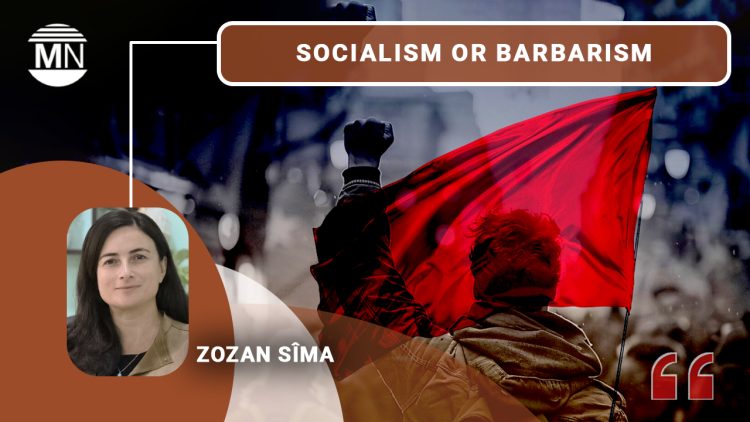
Zozan Sîma
The phrase “socialism or barbarism”* is no longer just a warning or statement of intent — it has become a compass for life. Without it, we are condemned to barbarism: forced to endure the capitalist system in its rawest, most unmasked, and most grotesque form.
Simply stating the obvious does not spark hope in society. The revolutionary must not act as a petitioner airing grievances against the system, but as a builder — someone responsible for advancing stateless, grassroots organisation.
1 May is not just a workers’ holiday. It is a revolutionary rallying cry — a moment to reignite the socialist spirit and take action for all oppressed peoples. It is, as the May Day anthem declares, “the holiday of peoples advancing on the glorious path of revolution”: Kurds, Palestinians, the peoples of Abya Yala (Latin America), Africa, Asia — all those resisting colonial oppression. Anti-system movements that fight against imperialism and neoliberal exploitation. Women, the first colonised class and nation, rising in rebellion. Youth declaring “we will succeed” as their futures are stolen. Ecologists battling climate catastrophe. Anarchists resisting every form of domination. Artists, writers and journalists risking all to speak truth to power. Intellectuals advancing free thought. In short: the 80 percent of the world that refuses to compromise with capitalism, does not benefit from it, and holds the potential to resist it.
Yet, anti-system movements — including the women’s freedom movement — are not equipped to organise this 80 percent. A one-sided strategy focused on exposing injustice, demanding accountability, and raising awareness cannot deliver transformative results.
Struggle is meaningful only when it is rooted in an organised, self-sufficient, self-defending social structure. To generate hope, revolutionaries must take on the role of construction — not complaint. This is why those of us outside the system must revisit the question of socialism, and deepen it. Socialist society cannot be engineered — it must grow from the democratic traditions of each people, land and culture. Even when suppressed, these traditions endure and transform. Society itself survives through these social “stem cells”. A 21st-century socialist movement must recognise and be rooted in them.
One of neoliberalism’s greatest achievements has been to conflate society with the state, isolating anti-system movements and painting them as anti-social. In the West especially, this has resulted in an increasingly individualist revolutionary identity. Rather than building mass movements, groups have retreated into small autonomous clusters of like-minded individuals. Society has thus been abandoned to religious fundamentalists, fascists, and misogynists.
This must be analysed alongside the rise of fascism in Europe. As fascism has strengthened, revolutionaries have become further disconnected from society. The critique of 19th- and 20th-century socialist parties’ hierarchical and power-centred forms was valid — but the question of what revolutionary forms and identities are needed in response remains unresolved.
In the context of World War III, we need the spirit of 1 May more than ever — a renewed socialist vision, and shared struggle. “Struggle is both an opportunity and a school,” as the authors of Feminism for the 99% remind us. “Those who join it may transform, challenging their old assumptions and reshaping their view of the world.” As students of that school of struggle, we say: Bijî Yekê Gulanê — long live the 1st of May — with the determination to build a socialism fit for the 21st century, free of dogma, and grounded in what works.
Zozan Sîma is a journalist and researcher based in North and East Syria (Rojava). She writes regularly on Jineolojî and Kurdish feminism, with a focus on oral history and gender equality in Kurdish society.
(*) The phrase “socialism or barbarism” was first popularised by revolutionary Marxist Rosa Luxemburg in the early 20th century, warning that humanity faced a choice between democratic socialism and the collapse of civilisation amid capitalist-driven imperialist wars.
This article was first published in Yeni Özgür Politika. It has been translated and lightly edited for clarity.