

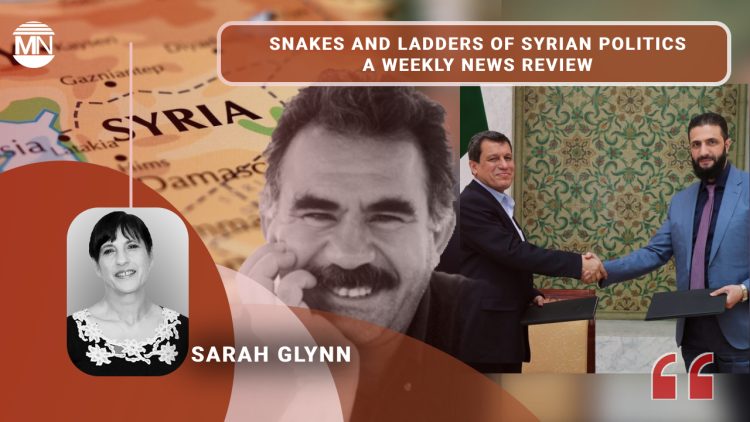
Who could have predicted, four months ago, that Hayat Tahrir al-Sham (HTS), an offshoot of al-Qaeda, would take control in Damascus, and that they would subsequently sign an agreement with the Syrian Democratic Forces (SDF) that stipulates constitutional recognition of the Kurds as an integral part of Syria? When I learnt about the agreement on Monday evening, I immediately contacted a Kurdish friend in Qamişlo (Qamishli), who admitted that it was “bloody confusing” before describing how people everywhere were letting off fireworks and shooting into the air to celebrate the prospect of peace. But by the end of the week, the snakes and ladders board of Syrian politics had produced another long snake in the form of an Islamist and authoritarian draft constitution, which has raised fears, within the Autonomous Administration of North and East Syria, of the country being taken “back to square one”.
An agreement and hopes of peace
Monday’s agreement, signed by Syria’s interim president, Ahmed al-Sharaa, and the Commander in Chief of the SDF, Mazloum Abdi, is effectively a memorandum of agreement that leaves crucial details to be debated in the coming months; but veteran Kurdish politician, Salih Muslim, of the Autonomous Administration of North and East Syria’s dominant Democratic Union Party (PYD), welcomed it with the comment, “We are partners in everything about this state. We are partners in its administration, constitution, life, economy, everything.”
The document does not include anything that the SDF had not previously agreed to, but a lot will hinge on the interpretation of what is meant by “integration of institutions”. The text calls for “merging civil and military institutions in northeastern Syria into the Syrian state’s administration, including control over border crossings, airports, and oil and gas fields”. The Autonomous Administration insists and expects that integration will take place at an institutional level, whereas al-Sharaa, and Turkey, as HTS’s powerful backer, have always insisted that North and East Syrian institutions, and especially their military, are dissolved, with people integrating into the state as individuals. Turkey’s ministers of foreign affairs and defence, and their chief of intelligence were in Damascus on Thursday to reinforce Turkey’s view.
While Turkey expressed cautious optimism at the signing, they have emphasised the need to focus on how the agreement is implemented in practice. From a Turkish perspective, a peaceful and stable Syria would allow them to use their connections and influence to create opportunities for Turkish business, as well as enabling the return of refugees, which has become an incendiary populist demand.
The agreement calls for the establishment of committees to work on the different areas of concern, and the final agreement is projected to be in place by the end of the year. We are just at the beginning of a long period of negotiation. Many obstacles will be put in the way of reaching mutually acceptable arrangements, but hope can be found in the agreement’s potential to benefit both sides, which may yet outweigh other interests.
Massacre of Alawites
This has all taken place under the black cloud of massacres in western Syria, in which one and half thousand civilians – some claim several thousand – have been killed solely for following the Alawite faith. Ingrained religious prejudices were stoked by deposed President Assad’s membership of the Alawite community, and these massacres have been portrayed as revenge for attacks on the new Syrian security forces that were carried out by fighters described as Assad loyalists. The worst violence appears to have been the work of members of Abu Amsha’s Suleiman Shah Brigade and of the Hamza Division. Both brigades and their leaders are sanctioned by the United States for serious human rights abuses, and they were already infamous for unlawful killings, abductions, torture, extortion, sexual violence and property seizures. These are mercenary militias in Turkey’s so-called Syrian National Army (SNA). When their leaders visited Turkey last July, they posed for a photograph with Devlet Bahçeli, chair of the far-right Nationalist Movement Party (MHP) and President Erdoğan’s coalition partner, who has become the surprise leading voice in the Turkish government’s new dialogue with Abdullah Öcalan. The SNA militias are now officially under the Syrian interim government umbrella, and Amsha was appointed by al-Sharaa as head of the Military Division in Hama. Rahaf Aldoughli recently reported in New Lines Magazine that this appointment was made to bring Amsha’s large tribal support into the government orbit.
The Autonomous Administration and the SDF have always emphasised and practised multicultural coexistence, and have argued that North and East Syria can provide a model of coexistence for the rest of the country. Salih Muslim described the agreement as a great gain for Alawites and other minorities, though it won’t be easy for the SDF to make their moderating influence felt, especially as the murdering militias hate the SDF as much as they hate the Alawites, and the violence and racist agitation have not stopped. For al-Sharaa, HTS implication in the massacres – which demonstrated his lack of control, and badly damaged his credibility – will have served to underline the need to seal the agreement and not to insist on prerequisites that the SDF regard as unacceptable. In making an agreement with the SDF, he has aligned HTS with a large well-disciplined force, which is untainted by ethnic violence and is backed by the United States and European countries. The agreement boosted hopes for a peaceful transition, and made it more likely that these countries will lift sanctions and enable the recovery of Syria’s economy.
Problems for the agreement
Hopes have been raised, but the difficulties ahead are already making themselves felt. The agreement calls for a Syria-wide ceasefire; however, Turkey and their SNA militias are still attacking North and East Syria with airstrikes and shelling. There has never been any justification for these attacks as the SDF has never been a threat to Turkey; but now the attacks should also pose a dilemma for Turkey’s allies in HTS, as they risk destroying the agreement. The agreement also calls for the safe return of displaced Syrians to their hometowns, which in the Kurdish case means the return of IDPs to Efrîn (Afrin), Serêkaniyê (Ras al-Ayn) and Girê Spî (Tell Abyad) – all currently occupied by Turkey and controlled by Turkey’s SNA militias. Turkey’s responses are crucial.
There are further questions concerning the responses of Iran and Israel, neither of whom want to see greater Turkish influence. Israel would be expected to welcome any restraint on HTS’s Islamism, but they have also been working to produce a divided and weak Syria. They don’t hesitate to carry out targeted bombings, and they are still attempting to seduce one part of the divided Druze community in the south.
An Islamist constitution
On Thursday, almost as soon as the celebrations for the HTS/SDF agreement had died down, al-Sharaa was photographed signing another important document. This was a draft interim constitution drawn up by his hand-picked constitutional committee, which had no representation from North and East Syria. It poured cold water on the earlier optimism and sent people back out onto the streets, this time in protest. (There have also been protests against the Alawite massacres.)
The interim constitution has been publicly rejected by the Autonomous Administration and by the Syrian Democratic Council, the highest political organisation in North and East Syria. Bedran Çiya Kurd, a prominent figure in the Administration, described al-Sharaa’s ratification of the constitutional declaration as being “in clear contradiction to the agreement reached just days earlier”.
This constitution, which is stipulated to last for an interim period of five years, states that “The religion of the President of the Republic is Islam, and Islamic jurisprudence serves as the primary source of legislation.” It also gives enormous power to the president, who would appoint the temporary legislative authority and also have veto powers over their laws. The state language would only be Arabic, and the name Syrian Arab Republic has been retained. Political parties would be suspended pending new legislation. Its import is made clear in the headline from Associated Press, “Syrian leader signs constitution that puts the country under an Islamist group’s rule for 5 years”. Although the Islamist clauses were already there in the previous constitution, that does not make them acceptable, especially as they allow the possibility of much stricter interpretation than in the past.
The Syrian Democratic Council (SDC) had welcomed the SDF/HTS agreement as representing “a fundamental step toward building a new Syria—a democratic, pluralistic state that respects the rights of all its components, is based on a constitution that expresses the will of Syrian men and women, and establishes a modern republic commensurate with the aspirations and sacrifices of the Syrian people.
In their statement of rejection of this new document, the SDC explain “This draft constitution reproduces authoritarianism in a new form. It entrenches central rule and grants the executive authority absolute powers. At the same time, it restricts political activity and prohibits the formation of parties. These measures directly obstruct the path of democratic transition.” The SDC calls for a “genuine national consensus” and for a “complete reformulation of the declaration”.
Öcalan’s peace call
An important factor in all these developments is the new dialogue with Abdullah Öcalan and his call for peace and democracy through dissolving the PKK (Kurdistan Workers’ Party). This has opened up new possibilities for major changes in the region’s politics and made it politically easier for Turkey to disengage militarily from Syria. There is the potential for a new approach, a resetting of Turkish-Kurdish relations. However, the Turkish government’s response to this opportunity for peace has been riven with contradictions. Erdoğan has stated, “we always keep our iron fist ready in case the hand we extend is left in the air or bitten”, but this iron fist is not being held in reserve, it is constantly hitting out, blocking any opening through which peace could emerge.
The PKK have made clear that in order to dissolve they need security guarantees and a proper legal framework. They have called a ceasefire, but the Turkish military is continuing to attack them, making any moves towards dissolution impossible. Yesterday evening, the need for Turkey to play their part was again underlined in a television interview with Cemil Bayık, co-chair of the Kurdistan Communities Union, the umbrella organisation that includes the PKK. Turkey’s actions in Syria are similarly belligerent – with their attacks on North and East Syria all being portrayed as being against the PKK.
External influence
The United States, together with some European countries, is understood to have played a significant part in facilitating the agreement between HTS and the SDF. Those countries also need to put pressure on Turkey to stop their attacks, and on Turkey’s HTS allies to make room for concessions and democracy. But when it comes to relations with Europe, putting pressure on Turkey seems to be the last thing in the mind of most governments. In Europe’s rush to turn themselves into a new military force, Turkey, with their large armed forces, successful arms industry and strategic geography, is being treated as the new best friend. For the United States, Turkey is an important counter to Iran. Long term vision that can understand the value of peace for everyone seems to be an increasingly rare attribute.
Sarah Glynn is a writer and activist and permanent columnist for Medya News – check her website and follow her on Twitter or bluesky


