

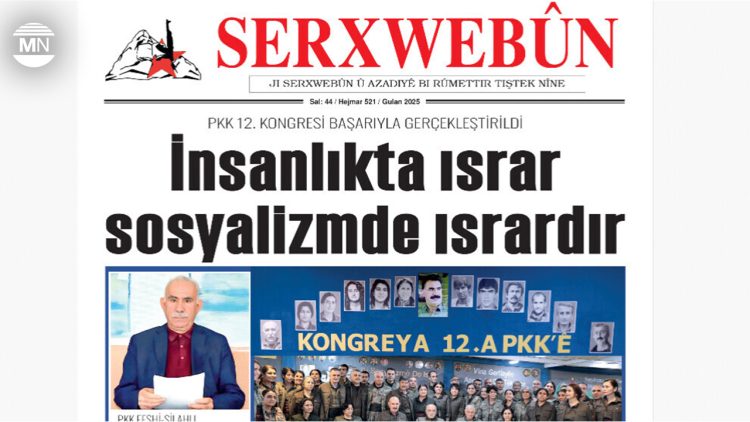
In its latest issue, the Kurdish monthly magazine Serxwebûn (Independence) has published all the documents from the 12th Congress of the Kurdistan Workers’ Party (PKK), including, for the first time, the programmatic perspectives sent by Abdullah Öcalan from the Turkish island prison of Imrali. With issue no. 521, the magazine is also ending its 44-year uninterrupted publication history.
The PKK held its 12th and final congress from 5-7 May, where it decided to dissolve itself and end its armed struggle, signalling a new chapter in the pursuit of a solution to the Kurdish question in Turkey.
"Our perspective for the coming period is based on the approach of reshaping society on the basis of the concept of the democratic nation, the ecological economy and communalism. The responsibility for developing the necessary conceptual and theoretical framework – including its philosophical foundation, ideological dimensioning and structural embedding in a differentiated social fabric – lies directly before us."
Furthermore, Öcalan stressed that the central political aim within the peace negotiations held in Turkey should be organising a “democratic society”, which “unfolds through a form of democratic politics”, putting emphasis on the concept of the commune which he sees as the basis of deSerxwebûn’s latest edition contains the full text of the opening and closing speeches of the PKK congress, all resolutions passed and delegates’ votes. It also includes biographical texts on fallen PKK figures such as Ali Haydar Kaytan and Rıza Altun, as well as contributions commemorating Pelin Yılmaz (Pelîn Zozan), Gurbet Aydın (Hozan Mizgîn) and the leaders of the Turkish 1968 movement Deniz Gezmiş, Yusuf Aslan and Hüseyin Inan.
Published with the title ‘To insist on humanity means to insist on socialism’, the edition starts with imprisoned Kurdish leader Abdullah Öcalan’s perspectives sent to the congress, in which he develops a comprehensive vision for a post-national society. In his twenty-page essay and a separate four-section letter, Öcalan analyses the development of the Kurdish movement, reflects on the desired organisational change and outlines the main features of a new socio-political vision. The seven central themes he has developed for a reorientation are:
▪ Nature and meaning
▪ Social nature and problem history
▪ Dualism of state and communism in historical society
▪ Modernity
▪ Realities of Kurds and Kurdistan
▪ The PKK and the question of dissolution
▪ Perspectives for the new phase
Öcalan emphasises that the question of the dissolution of the PKK is not a new issue. It is not just a matter of organisational form, but of a profound change in mentality and personality structure, stressing that “serious restructuring can only take place in this way.”
Basis of transformation is the ‘Democratic Society’
According to Öcalan, at the heart of the proposed transformation is the establishment of a society based on the principles of ‘democratic socialism’, itself based on the concept of the ‘democratic nation’, an ecological economy and communal self-government. He sees this ‘democratic modernity’, which he had previously introduced in his defense writings, as an alternative to the nation state, capitalism and industrial modernity:
mocratic organising.
Öcalan explained his understanding of the concept of commune as follows:
"Just as the state has a historical line of development, the commune also has its own historical tradition. The free existence of peoples can only be realised through the commune. While the nation state functions as an instrument of capitalism, the commune is the constituent principle of peoples. This communal model of society can also be institutionally anchored through communal self-government in cities and municipalities. Both theoretically and practically, this appears to be feasible – but only on the condition of consistent, substantial anti-capitalist practice."
Regional and international implications
According to Abdullah Öcalan, a successful transformation would be decisive not only for Kurdistan, but for the entire region: “Success here will have repercussions for Syria, Iran and Iraq. It will also open up the possibility for the Republic of Turkey to redefine itself, renew itself through democratic reforms and take a leading role in regional development.”
Furthermore, the Kurdish leader made an explicit appeal to both opponents of the current transformation process and the actors involved. Opponents of the process, he explained, have no viable perspective in terms of content and are doomed to failure in the long term. However, overcoming this resistance implies a considerable responsibility on the part of the constructive forces of the process. The desired political restructuring is not only significant at the national level, but also has regional and international implications.
In this context, Öcalan emphasised the need for regional confederalism, which he describes as an ‘absolute necessity’ for the future stability and democratic constitution of the region. This model of cooperation and power sharing across national borders is not only seen as a solution to internal conflicts, but also as a starting point for a new international order. Such a process also requires the emergence of a ‘new international’ that can integrate the emancipatory movements of the region and beyond into a global coordinate system.
Evaluations on gender
In the political perspective, Öcalan also shared his evaluations on the LGBTI+ community, which he sees a “major topic of debate”. Öcalan stresses the dialectical nature of the gender issue, saying that as shown by the existence of hermaphrodite people, who “possess both male and female characteristics” and people undergoing surgery to “become either male or female”, there is no “insurmountable gap between female and male”.
“Of course, the philosophical and sociological aspects of this are very different. There is a moral dimension to this, and it has an impact on society,” Öcalan emphasised.
Öcalan explained that the distinction between women and men is “not something miraculous, it is something required by the dialectic of nature”, so it does “imply superiority” of one of the genders.
“The feminine has meaning, and the masculine has meaning. This has also taken shape in society, and the important thing is not to make them opposites. Pitting them against each other is where the problem begins,” the Kurdish leader stated, sharing his ideas on relations between men and women that can complement each other instead of being at odds.
‘Democratic socialism’ as a break with the nation state
In a separate letter sent to the congress, dated 27 April 2025, and entitled ‘Democratic Socialism’, Öcalan takes stock of the Kurdish movement’s history to date. After 52 years, he says, the aim is to initiate a “transition from the state-socialist national model to a democratic-social society.”
Farewell to Serxwebûn magazine after 44 years
Serxwebûn newspaper announced that its May issue would be the last in its 44 years of uninterrupted publication. Its first editor-in-chief was Mazlum Doğan, a Kurdish revolutionary who set his prison cell in the infamous Diyarbakir No. 5 prison on fire and hanged himself on 21 March 1982 in protest against Turkish policies towards Kurds and the inhumane conditions he and other prisoners were facing.
The editorial team bid farewell with the words: “Serxwebûn was the voice of the contemporary Kurdish struggle for freedom, forged in the blood of the fallen, shaped by the women’s freedom movement in the 21st century. It was more than a newspaper – it was a school of revolution.” The symbolic closing line stresses that “Serxwebûn’s spirit and consciousness will live on”.


