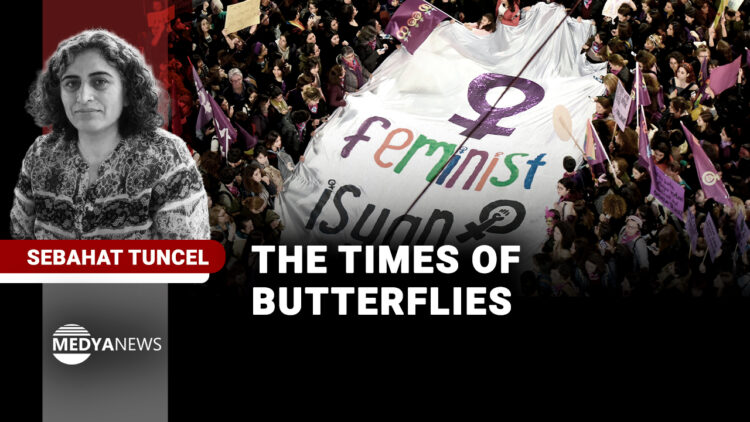
In a powerful statement ahead of the International Day for the Elimination of Violence against Women, former Peoples’ Democratic Party (HDP) MP and former Democratic Regions Party (DBP) Co-chair Sebahat Tuncel reflected on the struggles and victories of women around the world in the fight against male state violence. Tuncel’s message honoured the legacy of the Mirabal sisters, whose resistance to the Trujillo dictatorship in the Dominican Republic inspired the establishment of 25 November as a global day of action. Drawing parallels with contemporary struggles in the Middle East, Tuncel highlighted the enduring importance of women’s resistance in shaping a just, democratic and equal society. Her words are both a tribute to the past and a call for continued solidarity.
The times of butterflies
Sebahat Tuncel
For the past eight years, I have written my messages from prison, trying to connect with women and my sisters on the outside on the common ground of resistance and struggle. This time I am on the streets, side by side with women. However, dozens of our women comrades remain behind bars and prisons continue to be places of oppression and violence under a policy of segregation. On this occasion, I send my greetings and love to all women in prison.
As women, we are not only fighting against the violence of the male state, but we are also discussing how to achieve a life without violence – a life that is democratic, peaceful and rooted in freedom. As you know, 25 November, the International Day for the Elimination of Violence against Women, was proclaimed in memory of the Mirabal sisters, whose courage and sacrifices made them symbols of resistance to dictatorship and male state violence, and icons of women’s struggle for freedom. Today, on 25 November, millions of women take to the streets to say “no” to violence, harassment, rape and war against women and children.
What is the reality that has created this day?
The Mirabal sisters, as subjects of political struggle, fought against the dictatorship within the revolutionary movement of 14 June. Minerva, an active member and leader of the movement in the Dominican Republic, played a prominent role in the struggle against the Trujillo dictatorship. Together with her sisters (Patria and María Teresa) and her husband, she led an intense political struggle within the movement.
The movement aimed to put an end to the dictatorship by fighting against oppression, violence, corruption and human rights violations, and by fighting for democracy, freedom and human rights. The 14 June Revolutionary Movement and the Mirabal Sisters played a crucial role in the collapse of the Trujillo regime in 1961. Members of the movement were constantly targeted by Trujillo’s regime; many were imprisoned, tortured and killed.
Minerva and María Teresa were frequently imprisoned and threatened for their involvement in the movement. On 25 November 1960, while returning from visiting their imprisoned husbands, Minerva, Patria and María Teresa Mirabal were ambushed, brutally tortured, raped and murdered by Trujillo’s soldiers. The massacre marked the beginning of the end for Trujillo, whose 31-year dictatorship ended with his assassination six months later.
The Mirabal sisters packed a significant and meaningful resistance into their short lives (Patria was 36, Minerva 34, and María 25 at the time of their assassination). Minerva’s first act of defiance against the dictator came at a party when Trujillo made inappropriate advances towards her. Minerva slapped him, an act of courage that made her a symbol of resistance among the people, but also put her family in the crosshairs of the regime. From then on, the family faced constant harassment. Minerva was barred from attending law school, but her determination to fight against injustice and lawlessness only grew stronger, paving the way for the resistance that would eventually lead to the downfall of the dictatorship.
Minerva’s courage and leadership resonated deeply with society, and she became known as “The Butterfly”. The Mirabal sisters became famous as “Las Mariposas” (The Butterflies), the code names they used during their resistance to the Trujillo regime. For Minerva, the butterfly symbolised fragility, transformation, rebirth and hope.
The Mirabal sisters – Minerva, Patria and María Teresa – became not only resisters of Trujillo’s oppressive regime, but also sources of hope and inspiration for the people of the Dominican Republic, especially women. In 1981, the United Nations declared 25 November the International Day for the Elimination of Violence against Women in honour of the Butterflies.
Today, ‘The Butterflies’ are remembered not only in the Dominican Republic, but around the world as a symbol of resistance to oppression, tyranny and violence.
A global struggle against masculine violence
Women in different parts of the world continue to resist tyranny and male state violence. In Iran, the international women’s uprising that emerged around the slogan “Jin, Jiyan, Azadî” (Woman, Life, Freedom) following the assassination of Jîna Mahsa Amini has illuminated the path to equality and freedom for women around the world. The fire of freedom ignited in Iran continues to burn brightly in women’s resistance. Recently, a young woman’s naked defiance against slavery, oppression, attacks on womanhood and violence has fanned the flames of resistance.
In Iran, Palestine and the prisons and streets of Turkey, women are fighting for their existence against the violence of the male state and war. The resistance and struggles of women in the Middle East are shaking the foundations of capitalist modernity and patriarchal regimes. Building global solidarity against the war, slavery and exploitation imposed on women in the Middle East is now more urgent than ever.
For Kurdish women resisting male state violence, Sakine Cansız is a symbolic figure akin to Minerva. Her defiance in the notorious Diyarbakır prison during the 12 September military regime, known for its brutal repression of Kurds and Kurdish women, is a testament to her courage. Her act of spitting in the face of the torturer Esat Oktay was not only an example of bravery, but also a cry of defiance from an indomitable spirit. Sakine Cansız, a symbol of resistance and women’s struggle for freedom, was murdered in Paris.
In recent years, many women have been murdered in Iraqi Kurdistan and Rojava, including Nagehal Akarsel and Hevrin Xelef. These murders have not deterred the struggle for women’s freedom and equality, but have increased the anger and rebellion. Let us not forget the women who resisted the barbarity of ISIS in Rojava, who made immense sacrifices and ultimately gave the people a women’s revolution.
In conclusion, on this 25 November, we stand against the violence of the male state, exploitation, war, the trustee regime, the torture system in İmralı, poverty, corruption and injustice. We know that a different life is possible. Women who resist and fight are the butterflies of their time. Yes, the life of a butterfly is short, but politically it is a symbol of transformation, rebirth and freedom.
Even with their short lives, they create a butterfly effect that sparks new and powerful beginnings that lead to long-term change – just like the Mirabal sisters.
*Sebahat Tuncel is a former MP for the pro-Kurdish Peoples’ Democratic Party (HDP) and a former co-chair of the Democratic Regions Party (DBP). She was imprisoned as part of the controversial Kobane Case, and was released in 2024, after spending more than seven years in prison.