

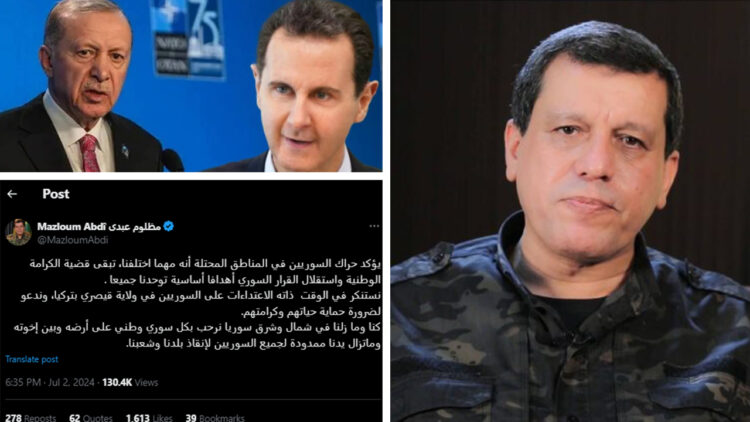
On 19 July, Mazloum Abdi, the Commander-in-Chief of the Syrian Democratic Forces (SDF), marked the 12th anniversary of the Rojava revolution of 19 July 2012, asserting the revolution’s enduring impact and expressing readiness for dialogue with all parties involved in the Syrian crisis, including Turkey.
Abdi stated that the expansion and increasing influence of the revolution are rooted in its principles, goals and the truth of its origins. He noted, “Based on this truth, all forces that opposed and attacked the revolution were defeated and failed, regardless of their names and colors, such as the Free Army, Al-Nusra Front, ISIS, and finally the Turkish occupation state and its mercenaries. Anyone who opposed this revolution faced failure. Just as the previous groups failed to fight the revolution, the fate of the Turkish occupation and all its linked mercenaries will be the same, forcing them to change their policies towards our people and all components of North and East Syria.”
Abdi reaffirmed the SDF’s commitment to dialogue, saying, “We are ready for dialogue with all forces, including Turkey, and we will support any dialogue that leads to the cessation of fighting and a political solution to the crisis.” He added, “We have always worked for the unity of Syrian geography and to prevent its division, and we will continue this struggle and work today and tomorrow. Our policy today preserves the unity of Syrian territory.”
He also emphasised the need for internal unity and to strengthen the SDF to address external threats, while acknowledging the ongoing challenges faced by the region due to opposition from regional and international forces and the Syrian regime.
Turkey’s President Recep Tayyip Erdoğan announced a significant policy shift towards Syria on 28 June, indicating openness to restoring diplomatic channels with Syria, a country with which Turkey severed ties at the onset of the civil war in 2011.
Erdoğan’s declaration, however, was met with criticism and concern from various Syrian groups. The Democratic Autonomous Administration of North and East Syria (AANES) condemned the move, labelling it a ‘major conspiracy’ against the Syrian people and an attempt to legitimise Turkish occupation. The AANES argued that this potential reconciliation could also embolden groups supported by Turkey, such as ISIS, exacerbating the chaos in the region.
In response, the Syrian Democratic Council (SDC), which governs the northern and eastern regions of Syria, expressed solidarity with protests against Erdoğan’s overtures towards Syrian President Bashar al-Assad. The SDC highlighted the need for unity among Syrians and stressed that any resolution to the Syrian crisis must consider the rights and aspirations of the Syrian people. They criticised Turkey’s efforts at normalisation with Damascus, suggesting that it would disregard the sacrifices made by and the desires of the Syrian populace.
Endorsing the protests that erupted following Erdoğan’s remarks in Turkish-controlled northern Syrian cities, Mazloum Abdi reinforced the call for national unity and extended an invitation to all Syrians to join in efforts to safeguard the nation.
However, Abdi is not categorically against normalisation per se. In April 2023, he expressed readiness for dialogue with Turkey on condition that Ankara were to end its occupation of Kurdish-majority northern Syrian territories, which he described as a Turkish colonisation project. “Turkey is occupying our lands and has displaced our people from Afrin (Efrîn), Ras al-Ayn (Serêkaniyê), and Tell Abyad (Girêspî), but if it is ready to enter into dialogue with us regarding ending the occupation and demographic change, and stopping its attacks against our people, then we are ready for dialogue with Ankara,” he told Al-Sharq at the time.


