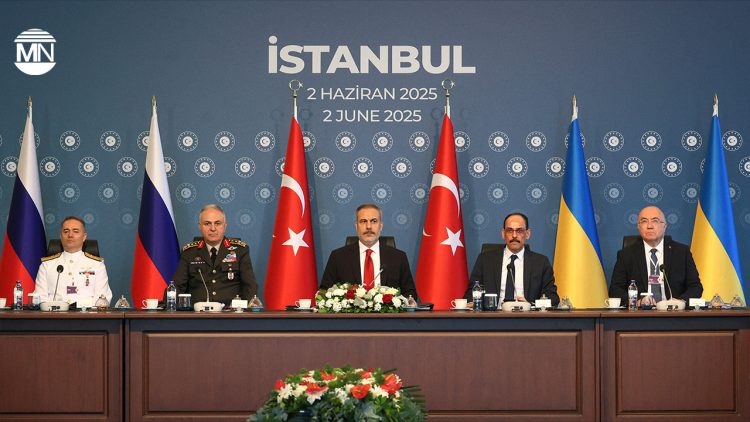
Efforts to end the war in Ukraine showed little sign of progress on Monday, as Russian and Ukrainian delegations met in İstanbul for direct peace talks that ended without a ceasefire agreement.
The hour-long meeting, hosted by Turkey and brokered by the United States at the Çırağan Palace, resulted in a limited agreement to exchange up to 1,200 prisoners and repatriate the remains of some 6,000 fallen soldiers. However, stark differences over territorial control and military terms prevented any advancement toward ending the three-year conflict.
Ukrainian President Volodymyr Zelenskyy confirmed that preparations were underway for the prisoner swap. Russian state outlets also acknowledged the agreement but offered few details. Despite this humanitarian step, the broader dialogue remained deadlocked.
Russia presented a memorandum demanding Ukraine cede control over four regions annexed in 2022—Donetsk, Luhansk, Zaporizhzhia and Kherson—while also accepting restrictions on its military capacity. Ukraine rejected the proposal, instead calling for a roadmap to peace that includes full sovereignty, no military limitations, and reparations from Russia.
“The talks brought no real change because Russia is not seeking peace,” said Zelenskyy’s chief of staff, who also urged the international community to impose further sanctions on Moscow.
Russian media emphasised the Kremlin’s demands as a basis for a ceasefire, describing Ukraine’s position as unrealistic. State-backed outlets such as RT and Sputnik also underscored that the talks were held in Russian and chaired by Turkish Foreign Minister Hakan Fidan—likely to highlight procedural influence.
The talks followed a weekend of heightened military activity, including a major Ukrainian drone strike dubbed ‘Operation Spider Web’ on Russian territory, which further strained the atmosphere. Russian negotiator Vladimir Medinsky dismissed Ukraine’s proposals and suggested the Ukrainian side was escalating the conflict.
President Recep Tayyip Erdoğan, whose government continues to position Turkey as a mediator, was reportedly in contact with both Zelenskyy and Russian President Vladimir Putin during the discussions. Ankara has offered to host future meetings, possibly involving both leaders and US President Donald Trump.
Zelenskyy, speaking separately from Lithuania, warned that Russian stalling could force Ukraine and its allies to apply more pressure. He also raised concerns over the fate of 400 Ukrainian children allegedly abducted by Russian forces—an issue Moscow said it was willing to discuss only partially.