

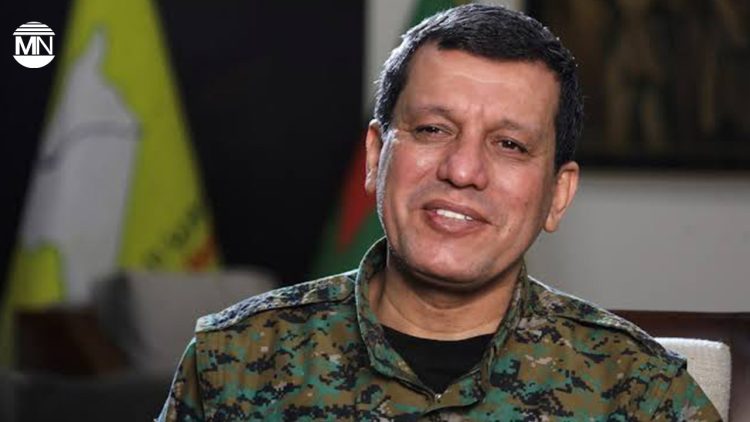
Mazloum Abdi, the commander of the Syrian Democratic Forces (SDF), has stressed the critical importance of the civil tribunal set to take place in Brussels on 5-6 February 2025. In his interview with journalist Rim Bougamra of Al-Arabiya, Abdi discussed the significance of the tribunal and revealed that the Democratic Autonomous Administration of North and East Syria (AANES) has provided extensive evidence to support the proceedings.
“There is solid evidence on Turkey’s involvement in these crimes, including documentation of displacement, attacks on civilian infrastructure, and testimonies from witnesses.” He also mentioned that civilian witnesses and video footage have been shared with the tribunal organisers. “One does not need much evidence, as Turkey often provides the evidence themselves through their official declarations targeting infrastructure and energy facilities,” Abdi added.
He confirmed that the SDF has already provided substantial evidence, including documentation, testimonies, and video footage, to ensure a robust case.
The proposed tribunal, scheduled to convene on 5-6 February at the Vrije Universiteit Brussel (VUB) in Brussels, Belgium, represents a critical opportunity to hold Turkey accountable for war crimes and crimes against humanity in northeast Syria, also known as Rojava. Abdi highlighted the documentation collected by civil society organisations and legal teams, which includes evidence of forced displacement, destruction of infrastructure, and the targeting of civilians. He explained that the findings would be shared with international judicial bodies such as the International Criminal Court (ICC) and the International Court of Justice (ICJ) to ensure global accountability. “This is an accurate and critical process,” Abdi stated, referring to the initiative led by civil society groups to bring Turkey’s actions to light.
Documenting crimes and presenting evidence in tribunal
The upcoming tribunal, hosted by the Permanent Peoples’ Tribunal (PPT) at the VUB, aims to present a comprehensive case against Turkey for its alleged war crimes and crimes against humanity in Rojava. According to Abdi, the SDF has worked closely with civil society organisations and legal experts to compile extensive documentation and eyewitness accounts.
The Permanent Peoples’ Tribunal (PPT) is set to convene on 5-6 February 2025 at the Vrije Universiteit Brussel (VUB) in Brussels, Belgium, to examine allegations of severe human rights violations and war crimes committed by Turkey and its allied forces in North and East Syria, known as Rojava
Among the crimes to be addressed are forced displacement from Afrin (Efrîn) and Ras al-Ayn (Serêkaniyê), the use of prohibited weapons such as white phosphorus, targeted assassinations like the killing of Hevrin Khalaf, and the destruction of cultural heritage sites. Recent escalations, such as Turkey-backed mercenaries and drone strikes targeting civilians in larger Manbij (Minbîc) area, and repeated attacks on the Tishreen (Tişrîn) Dam since December 2024, have added urgency to the tribunal’s mission. “We have documented these violations thoroughly,” Abdi explained, adding that the evidence will play a pivotal role in the tribunal’s deliberations.
“This tribunal will provide irrefutable evidence of Turkey’s involvement in these crimes,” Abdi stated. He also underscored that the findings would be presented to major international judicial bodies, including the International Criminal Court (ICC) and the International Court of Justice (ICJ).
Broader context: The Rojava Tribunal
The Rojava Tribunal, part of the Permanent Peoples’ Tribunal framework, is a pivotal initiative aimed at investigating Turkey’s actions in northern Syria. Established to address the systematic violations stemming from Turkey’s aggression, the tribunal also examines how these crimes undermine Rojava’s democratic revolution—a socio-political model rooted in self-governance, women’s liberation, and inter-ethnic unity.
This tribunal is not only about documenting crimes but about amplifying the voices of victims. Supported by NGOs, academics, and human rights organisations, it represents a vital effort to hold Turkey accountable for crimes that include the displacement of over 400,000 civilians, the destruction of cultural heritage, and attacks on civilian infrastructure such as schools, hospitals, and energy facilities. According to Abdi, the Tribunal’s broader goal is to create a precedent for international accountability in ongoing conflicts worldwide. Supported by NGOs, academics, and legal experts, the Tribunal aims to hold Turkey accountable for crimes against humanity. These include the displacement of over 400,000 civilians, systematic torture, the looting and destruction of cultural heritage, and targeted attacks on civilians and critical infrastructure such as schools and hospitals.
The tribunal’s organisers have already submitted complaints to courts in Belgium and are working to establish a legal framework that will pave the way for international trials. “This effort is not just about justice for Rojava,” said Abdi, “but about setting a precedent for accountability in conflicts worldwide.”
International support and challenges
While the Tribunal has garnered significant backing from human rights organisations, its mission faces challenges, including Turkey’s geopolitical influence as a NATO member. However, recent Turkish aggressions, particularly the destruction of critical infrastructure and attacks on civilians, have drawn increased global attention to the need for accountability. Abdi noted, “This tribunal is not just about Rojava; it’s about setting a global standard for addressing crimes against humanity.” He expressed hope that the tribunal’s findings would galvanise international efforts to ensure justice for victims of these violations.


