

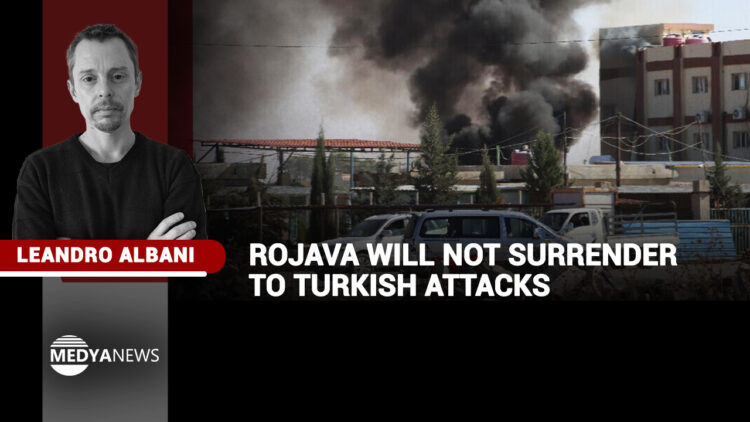
Leandro Albani
Bombs have been raining down on West Kurdistan (Rojava), located in northern Syria on the border with Turkey, since 23 October. Each of the missiles has a clear signature – that of Recep Tayyip Erdoğan, the Turkish president, who doesn’t waste time when it’s about persecuting and repressing the Kurdish people.
The intensity of Turkey’s attacks against Rojava has increased in recent days, though they have been continously ongoing since 2018. The Turkish government claims that the bombing is justified after members of the People’s Defence Forces (HPG) conducted a military action against the Turkish Aerospace Industries (TUSAŞ) near Ankara. This attack, which involved two elements, left five people dead and 19 wounded.
Before the HPG claimed responsibility for the attack, the Turkish government had already decided on its response: indiscriminate bombing of the territory controlled by the Autonomous Administration of North and East Syria (AANES). But the AANES has been governing Rojava and other regions of northeast Syria since 2012, when the peoples of these territories, led by the Kurdish political movement, declared autonomy and began to replace the then state administration, which had been controlled centrally from Damascus.
By the first week of November, the Turkish attacks had led to 17 people being killed, including three minors, and 65 being injured. In addition, health and education centres, bakeries, flour and grain warehouses, wheat silos, power plants, factories, telephone networks and water and fuel stations were hit by the bombardments. As a result of the attacks in northeast Syria, 120 thousand citizens have been left without water and electricity in the cities of Amuda (Amûdê), Al-Qahtaniyah (Tirbespiyê) and Kobani (Kobanê). According to the AANES, the damage caused by Turkey amounts to over five million dollars, a very substantial figure for the region, considering that the territory is under economic embargo, and under attack not only by Turkey but also by remnants of the Islamic State (ISIS, or Daesh).
AANES sources state that Turkey launched a total of 1031 attacks, including aerial bombing and artillery shelling, before 29 October. The administration warned of the development of an “economic and humanitarian catastrophe” in Rojava and that “efforts to eradicate terrorism” were endangered by Turkey’s aggressive policies. They made clear that “the lives of five million people are under threat” because of shelling by Ankara, and for this reason asked the USA and Russia to intervene to stop the Turkish government, something on which the two powers never agree.
These military developments in Rojava have come against a backdrop of great internal turmoil in Turkey. In addition to the attack on TUSAŞ, we learned that the Kurdish leader Abdullah Öcalan was visited on the prison island of İmralı by his nephew Ömer Öcalan, a Peoples’ Equality and Democracy (DEM) Party MP, on 23 October. Abdullah Öcalan, founder of the Kurdistan Workers’ Party (PKK), has been imprisoned since 1999, and the prison authorities have denied him any contact with the outside world for the last 43 months. This violates not only international law but also Turkey’s own domestic laws.
Protests have been multiplying in Turkey and northeast Syria in recent days in response to the military operations ordered by Erdoğan. The demonstrations have also been demanding an end to the isolation imposed on Öcalan in order to bring about a peace dialogue between the Turkish state and the Kurdish people living in the southeast of Turkey, some twenty million inhabitants whose political and cultural rights have been curtailed for decades.
On the last Sunday of October, DEM Party Co-Chair Tuncer Bakırhan denounced the Ankara government for the bombing of Rojava and increasing repression in Turkish Kurdistan [Kurdish-majority regions of southeast Turkey, known as Bakur]. The representative of the third-biggest political force in the country also denounced the Turkish state for “wasting” three billion dollars on defence. He summarised by saying, “This amount, with which the workers and the oppressed would otherwise be able to live humanely, has landed on the Kurdish people in the form of bombs and bullets.”
The Kurdish freedom movement, which brings together hundreds of organisations from the four divided parts of the Kurdish territory, has made it clear that the peace in the region will only come through dialogue in which [Abdullah] Öcalan is an active participant, and when Turkey stops the gears of its war machine.
*Leandro Albani is an Argentinean journalist specialising in the Middle East and Maghreb. He is the author of several books, among them Revolution in Kurdistan (2014) and ISIS: The Army of Terror (2016).


