

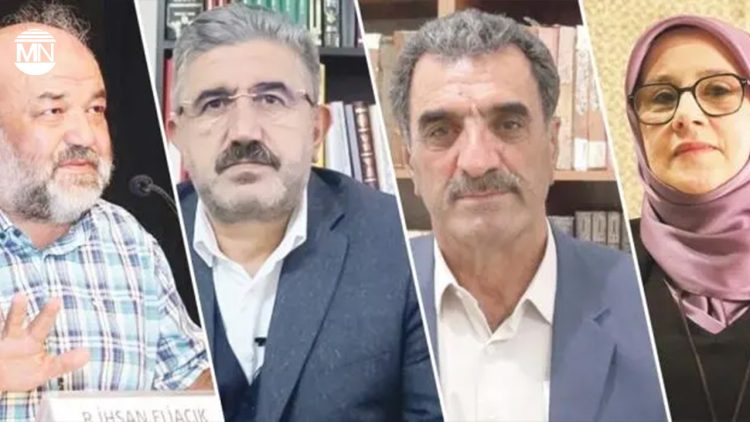
Several religious scholars in Turkey have publicly commented on Abdullah Öcalan’s recent call for peace, stressing that his proposals represent a critical opportunity for a democratic solution to the Kurdish question. Among them, Hüda Kaya, İhsan Eliaçık, Yusuf Andan, and Ekrem Baran stressed that ignoring Öcalan’s message would mean turning down a key opportunity for peace and stability in Turkey and the wider region.
Their statements come amid renewed calls for peace by imprisoned Kurdish leader Öcalan and a unilateral ceasefire by the Kurdistan Workers’ Party (PKK), declared a ceasefire on 1 March. The PKK, which has been in armed conflict with the Turkish state for more than four decades, said it remained committed to a peaceful solution. Öcalan, who has been held in total isolation for almost four years, has called for the group to disarm and disband as part of a wider shift towards a political solution. His message has reignited debate about Turkey’s approach to the Kurdish issue and the possibility of a new peace process.
Among those responding, Hüda Kaya, a theologian, journalist and former Peoples’ Democratic Party (HDP) MP, underlined that Öcalan’s call for peace was genuine and not influenced by external pressure. She said the opportunity “should not be wasted”, warning of further instability should the call be ignored. A long-time advocate of human rights, gender equality and religious freedom, Kaya has previously faced political persecution for her views, particularly on the Kurdish issue.
"Let us not fall into great expectations that justice and rights will be fully restored, nor assume that everything has been resolved with a single call. However, the opposition, revolutionaries, all individuals and groups who dissent, democrats, anti-capitalists, and anti-imperialists now have much greater responsibilities. The path ahead is clearer. A period of struggle awaits us, where we will stand—stronger than ever—against injustice, for the poor, for women, and for nature."
Similarly, İhsan Eliaçık, an Islamic scholar, writer and leading figure in the anti-capitalist Muslim movement in Turkey, argued that Öcalan’s proposals were consistent with a broader democratic transformation. He pointed out that since the 1990s, Öcalan has been advocating a shift from armed struggle to political solutions, and that his vision of a ‘democratic republic’ and radical democracy could provide a framework for Kurdish rights.
"In prison, Abdullah Öcalan has continuously deepened his Democratic Republic perspective—he has been reading and studying for 25 years. There is no one in Turkey or the world who has read and researched as much as he has. From what I understand in his statement, he is calling for a comprehensive democratic transformation, which is referred to as radical democracy. Öcalan supports this, and he believes that Kurds can assert their existence within this radical democratic transformation."
Known for his opposition to the ruling Justice and Development (AK) Party’s authoritarianism and neo-liberal policies, Eliaçık has also faced government-imposed restrictions and bans on his public speeches.
Ekrem Baran, a founder of the Religious Scholars’ Solidarity and Cooperation Association (DİAYDER), has been a prominent voice for religious dialogue in Turkey, particularly in Istanbul and Kurdish-majority Diyarbakır (Amed). He was among the scholars targeted in the government’s crackdown on religious figures, which led to his imprisonment in 2021. Baran criticised the criminalisation of scholars who work for peace, arguing that Öcalan’s proposal must be taken seriously to resolve long-standing conflicts.
"As religious scholars, we believe that this project is well-suited for the peoples of the Middle East. Specifically, if Turkey and the Kurds adopt this democratic project as a foundation, it will eliminate a century of denial. Systems that pit peoples against each other and foster hostility will undergo change and transformation. If this project takes shape and the state fulfils its responsibilities, there will be no obstacles for the peoples. This project can also lead the way for rights and freedoms in Turkey and the Middle East. The centuries-old resentment, hatred, and wars in the region will come to an end."
Yusuf Andan, a scholar from DİAYDER, also supported Öcalan’s call. Öcalan’s vision of justice and peace is in line with Islamic moral and religious values, he stressed, adding that it would be a grave mistake to ignore a genuine opportunity for dialogue and resolution.
"Abdullah Öcalan should be in a free environment where he can make peace freely, communicate with his organisation, and talk to his people."
These statements by prominent religious scholars and political figures reflect a growing recognition of Öcalan’s role in any future peace process.


