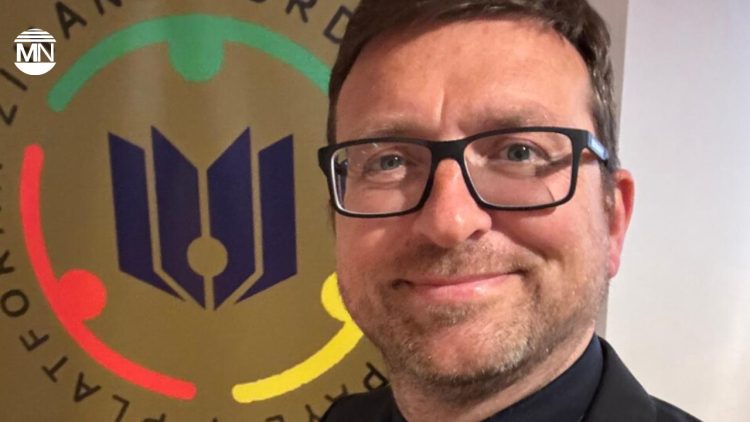
In a landmark development for Europe’s Kurdish community, Prof Dr Christoph Scholz* will serve as rector of the International Kurdish University, set to open its doors in Dresden, Germany, in 2026. This pioneering institution, the first of its kind in Europe, aims to provide Kurdish-language education and foster cultural and academic ties, marking a significant milestone for Kurdish identity and global higher education.
Inspired by the Rojava Revolution, which united women and men from diverse ethnic and religious backgrounds to fight for freedom and equality in northeast Syria, and driven by the vision of providing higher education for students from Kurdish-language schools in regions like North and East Syria and the Kurdistan Region of Iraq, the university will offer internationally recognised degrees in fields such as Kurdish language and culture, social sciences, engineering and literature. Instruction will be in Kurdish (Kurmanji and Sorani dialects) and German.
As preparations for the university intensify, with efforts focused on curriculum development, budget planning and establishing a robust governance structureScholz spoke to İshak Dursun of ANF. In the interview, on Saturday, he shared insights into the project’s academic ambitions, the potential of Kurdish as a language of science, and the university’s mission to serve as a beacon of cultural self-determination and academic excellence.
Dursun: What personal or academic factors motivated your decision to take on the role of rector at the first university outside Kurdistan to offer education in Kurdish?
Scholz: The historical significance of this initiative, combined with its academic challenges, inspired me profoundly. The idea of building a university that doesn’t just impart knowledge but also stands as a powerful symbol of cultural self-determination has captivated me from the start. The International Kurdish University in Germany will be academically free, independent and open-minded. Education and research here will be conducted in German and in the Kurmanji and Sorani dialects of Kurdish.
On a personal level, my past experience as a professor and rector drives me to create a structure that will empower the future of Kurdish students. Academically, I see this as an opportunity to develop an innovative, multilingual and values-driven institution with a strong international team. Our goal is to set new standards in global higher education through this university.
As a German academic, how do you view the potential of Kurdish becoming a language of science?
I see immense potential here. In truth, any language can become a language of science with enough investment. German itself wasn’t originally a scientific language; many widely accepted languages today have earned that status over time. Kurdish, part of the Indo-European language family, boasts a rich literary tradition, diverse dialects and a vibrant culture. What’s missing is systematic support, development of terminology and institutional strengthening. This is exactly where we step in. The International Kurdish University will invest heavily in the linguistic infrastructure. We’ll support this process through translation projects, Kurdish academic publications, the development of educational materials and the establishment of a linguistics centre.
The Kurdish people have long fought to establish their own educational institutions. As a non-Kurdish rector, how do you see your role in this context?
I see myself as a bridge-builder. With my experience in rectorial and educational leadership, I don’t view myself as an “outsider” but as part of a solidarity project alongside Dr Zerdest Haco, Dr Azad Ali, other Kurdish colleagues, students and international partners. My non-Kurdish background might even offer a symbolic contribution: it shows that this institution is being built with an inclusive rather than an exclusive ethos. This is a project of participation, recognition and collaboration. Freedom must be realised not in conflict with others but together with them. This university is not just an educational institution; it’s also a project of identity and freedom.
How does this awareness shape your academic responsibilities?
This awareness demands more from me than just academic excellence—it calls for integrity, sensitivity and courage. We’re not merely building an institution; we’re creating a space where people can fearlessly express their language, history and perspectives. Identity and science don’t have to be in conflict; on the contrary, they complement and enrich one another. I take this responsibility seriously, adopting a leadership approach grounded in equality, viewing diversity as a strength, and making academic freedom the foundation of all decisions.
What needs to happen in the first year for you to say “We’ve done it”? What are your concrete goals for the start?
If, within the first year, we’re ready to launch the educational process, have built a committed founding team, made the university’s existence visibly real, and—most crucially—secured the financial infrastructure and system of scholarship, then I’ll say “We’ve done it.” Concretely, this means the university and its initial undergraduate programmes are in the accreditation process, and the first students have enrolled in our language school, which will be part of the future university. We aim to establish partnerships with other universities and in particular, to produce the first Kurdish academic content.
Above all, we want to send a message of hope against despair. The first academic year should carry this message: the first Kurdish university is coming to life, and it’s here to stay.
(*) Prof Dr Christoph Scholz, a native of Dresden, earned his PhD in Economics from Ilmenau Technical University, graduating with the prestigious distinction of summa cum laude. His career took root at the same institution, where he served as a research assistant and in 2013 earned a teaching award for his exceptional instructional skills. Since 2016, Scholz has been a professor at Fachhochschule Dresden where he later took on the role of rector in 2017.