

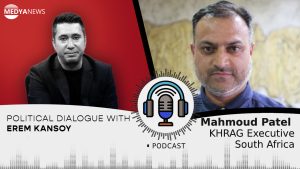
🎙️📹 #PODCAST | Medya News’s Erem Kansoy discusses the differences and similarities between the current moment in Turkey, and the end of apartheid in South Africa. Kansoy interviews South African activist Mahmoud Patel.
🎙️ @eremkansoy | @pat40569874#HistoricCall… pic.twitter.com/O8MOtGV7pG
— MedyaNews (@medyanews_) March 15, 2025
In the latest episode of the Medya News podcast, Erem Kansoy interviews Mahmoud Patel from the Kurdish Human Rights Action Group in South Africa. Patel discusses the end of apartheid in South Africa, and the parallels and differences between that era and the current historical moment. He highlights the lessons that can be learned, and the many challenges that lie in wait for the Kurdish people on their path to freedom.
Here is a transcript of the interview, lightly edited for clarity:
Dear Mahmoud Patel from South Africa, and a comrade of [the late anti-apartheid lawyer and Kurdistan solidarity activist] Judge Essa Moosa, thank you for accepting this important interview and for joining us.
Thank you very much, Comrade Erem. It’s a pleasure to be here with you.
As you follow the latest developments in Turkey, Kurdish leader Abdullah Öcalan has published a statement, and following that, the PKK declared a ceasefire. How do you evaluate these developments? How do you see all this?
What is important for us to understand without a shadow of a doubt is that what Comrade Abdullah Öcalan has presented to us is not only historical and groundbreaking, it is something that we can attribute to being seismic in the shift and change for a political solution based on democratic principles and values as well as constitutional guarantees that are now put in the court of the Turkish state. So the Turkish state now must act on what has come more than what has been expected to them.
Remember it was Mr Bahçeli from the very conservative ultra-nationalist (Nationalist Movement Party, or MHP) that made a statement last year that said if Mr Abdullah Öcalan were to give up the armed struggle or correctly declared a ceasefire, ceased the armed struggle and engaged in a political discourse, then the state is prepared to work towards a solution. That has been done now with that statement that has a profound impact on the way in which things will be changed. But we can see that to date the Turkish state has been very muted in the public domain with regards to what Leader Apo or Mr Abdullah Öcalan has given us to move forward to find a solution, with over four decades worth of struggle from his organisation and the people’s organisation, the PKK [or Kurdistan Workers’ Party].
The PKK itself has accepted what Leader Apo has said and more importantly for us it shows us that there is movement towards peace. Let’s give peace a chance because I want to just give a quotation of Leader Apo that’s very important. You know it says those who cannot read the spirit of the time may go to the wastebasket of history and I think that’s very crucial for us at this point to understand.
Let this moment be seized so that there can be peace for all peoples. The contextualisation given to us in the statement by Leader Apo that was read out to that international audience, local and global, is very clear and it resonates not with a capitulation or an abandonment of values and principles, but to harness the moment of the time so that both peoples in Turkey, I’m talking about the Kurdish people and the Turkish people, can move forward together in unity to find a solution like we did here in South Africa with our former oppressor and enemy, the white minority government. You have that moment now.
The field is clear. The Turkish state must take the next step.
Thank you, Mahmoud. You just mentioned about the process in South Africa, how was that process? What is the similarities with the Kurdish struggle now? What is the differences? Because of your experience with this kind of a process in South Africa at the period of [Nelson] Mandela with Judge Essa Moosa, we would like to hear your experiences.
Well fundamentally the apartheid state realised quite early on in the ‘80s that they could not continue militarily indefinitely because the international momentum and solidarity to support the anti-apartheid movement had gained a global standing and that shifted the thinking among some of the national party stalwarts who were very inimical to change at that time. Then PW Botha [who was] very forward thinking, although he was very conservative and reactionary, mandated his chief intelligence person at the time, Dr Neil Barnard, to make some kind of contact with Nelson Mandela on Robben Island. Of course it wasn’t acted in haste, it was very well thought out by the state itself. but more importantly Madiba [Mandela] made it very clear when those initial meetings took place in the ‘80s that “I cannot speak unilaterally except to speak for my people”, and with their mandate therefore the offer that was first given to Madiba was that he should, without any conditions, just abandon the cause that he was fighting for and what his people have stood for for decades, if not centuries from the colonial period and Madiba made it very clear… that I cannot do that.
If you look at what’s happening at the moment with the Kurdish process going forward, should the Turkish state seize this moment as well and act on what it has indicated it would then take that journey which cannot be realised in a day or a week or a month… once that commitment is made with sincerity by the Turkish state. Like the party and its authoritarian mindset in the military accepted then a political process and then the legalities that will determine that can then fit in.
So the context is not exactly the same like in South Africa. Remember it was the majority who were oppressed in South Africa. In the Turkish struggle and against the Turkish oppressive state the Kurdish struggle represents a minority of people in Turkey so it’s a minority group that is looking to assert its right of equality, human dignity, as well as seeking justice for what has happened to them for over a century. Whereas in South Africa it was the majority of the people that were excluded, so that is a difference. However the values of human dignity, equality, freedom, having a bill of rights or law that would ensure that Kurdish people are treated exactly like Turkish people – on the same level – would require constitutional changes in Turkey.
In South Africa what the apartheid state did by 1990 when [FW] De Klerk was in power – who shifted much more than PW Botha – he seized that moment as well and when he came to parliament in February of that year, 1990, he immediately declared that Madiba would be released unconditionally [along with] all other political prisoners. That was the first thing. Secondly, they started rescinding all apartheid era legislation because merely removing law is not enough because only free men can negotiate.
So at this stage, what Abdullah Öcalan or Leader Apo has done and the Kurdish movement has done is even much more than what we did in our struggle because we refused to negotiate for a political solution until our leader and leadership and political prisoners were released unconditionally. That is a major difference here and we have got to appreciate and understand that. So the Turkish state, unlike the National Party [in South Africa], is still holding back officially and publicly what’s happening behind the scenes, what’s taking place with diplomacy shuttling and so on to make it easier for Leader Apo on İmralı as well as the other political prisoners with him there. What about Selahattin Demirtaş, Leyla Güven and many other political prisoners who are incarcerated there indefinitely for a long period with no legal basis anymore.
What about them as well? So in South Africa there was that difference but I need to emphasise until that announcement was made in February 1990, people like the late Judge Essa Moosa, our former chairperson in the Kurdish Human Rights Action Group and a very strong supporter and person who did much for the Kurdish cause, what they really focused on was continuously engaging, pressurising and isolating that state until it had no choice but to come to the table and abandon its own military as well as authoritarian responses to overtures of peace of dialogue and so on.
There was an important aspect we must remember – the apartheid state also sent individuals or individuals from the elite of the community, the intellectuals and so on that met with our leaders who were in exile out of the country to find solutions. It had business people, it had academic scholars to understand how this process must take place. So in the Kurdish context with the Turkish state, much of that is not yet out there except what we get signals of in the media officially, or what the former HDP [the Peoples’ Democratic Party] the DEM party [the Peoples’ Equality and Democracy Party] will announce time and again or what Salih Muslim [a member of the Executive Council of the Democratic Union Party in northeast Syria] and others speak as to what’s happening in Syria and so on, and you can see the consequences of Leader Apo’s statement although he said I’m speaking only for the people in Turkey [and] the PKK, I’m not speaking for others – the SDF [the Kurdish-led Syrian Democratic Forces] acknowledged that including the leadership in Rojava, but we can see already they have a commitment and an agreement now with the new authority and president in Syria and that augurs well, although there will be time by which those commissions and committees will thrash out and flesh out how they’re going to work together in a unified Syria, while there’s a lot of atrocities taking place in the western part of Syria in Latakia and so on.
So in Turkey itself, has the state come forward? No, it hasn’t. We have heard what President [Recep Tayyip] Erdoğan said at the Iftar program. He was very belligerent, very much like PW Botha. He needs to become like FW de Klerk and go further than him by embracing this opportunity so that the spirit of the time is there for now and in the future. Remember, there has to be pragmatic solutions to real problems and one has to understand that you cannot abandon something that so many have sacrificed because ultimately the sustainability of this process going forward will be determined by meaningful democratic reforms by the Turkish state expanding cultural and political rights, by the Turkish state safeguarding civil liberties and paving the way for a new democratic constitutional framework as a foundation of a more inclusive political order. On the side of the Kurds they have done everything at this stage, more will be required going forward – so this is what we expect to see from the Turkish state. It needs now to grasp what it has said it intends to do.
Thank you dear Mahmoud. You put all the facts and light on the process of South Africa, the differences with the Kurdish struggle, and the process as well. Can you wrap all these up – what else needs to be done from now on? And also, Öcalan and the PKK are now expecting a move from Turkey in a positive way, a step forward, so what is your call to Turkey? What is your message for Öcalan and his workspace to be prepared freely so he can participate in the process?
My call to the Turkish state would be please release Mr Abdullah Öcalan and all political prisoners unconditionally so that you can with sincerity work towards a united Turkey where all peoples of Turkey or whatever the future holds in terms of calling your nation state that would be going forward, because it is a state that you are negotiating with for a better future. May it be based on constitutional principles and values of equality human dignity because Leader Apo and the PKK have already been exonerated by history and their conduct as principled individuals who uphold the values of humanity and the ideals that we all search for and so yearn for. The Turkish state sees the spirit of the time and rise to the occasion because you may never get this opportunity again. That is my message to the state of Turkey, and to the PKK and Mr Abdullah Öcalan, we salute you for being resolute for almost going on now for as long as our leader in South Africa was in prison, and others too like comrade Jeff Masumela Madiba and so on. Twenty-six years going on for 27 years, your strength, your courage, your sharpness and your worth. When we saw your picture it gave not only Kurdish people encouragement, it also gave all revolutionaries and activists throughout the world strength and courage to continue until you are free and your people are free so that we can celebrate our freedoms together. But the path to achieve that is a long one and a lot of work has to be done. Thank you, comrade Erem.
Comrade Mahmoud Patel from South Africa, also comrade of Judge Essa Moosa, thanks for joining us and thank you for sharing your experience about the South Africa peace process.
Thank you, comrade Erem.


