

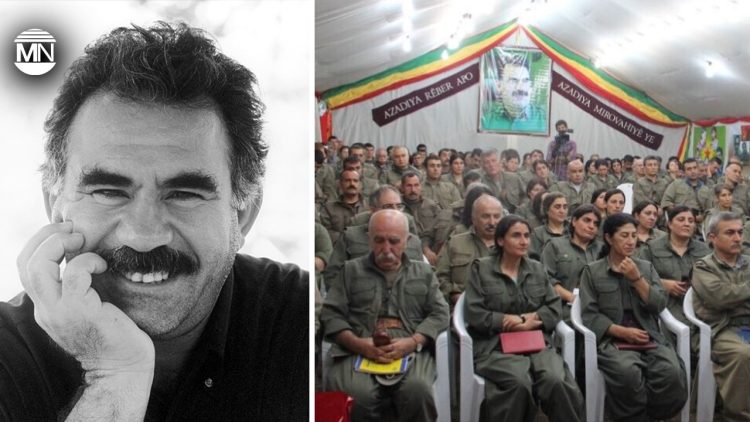
The Kurdistan Workers’ Party (PKK) has reiterated its call for its imprisoned leader Abdullah Öcalan to be allowed to participate freely in a proposed party congress, following his earlier appeal for “peace and a democratic society” made on 27 February.
In a new statement published by the Fırat News Agency (ANF) on 28 April, the PKK’s Executive Committee said it hoped Öcalan would “achieve conditions where he can live and work freely, and lead the party congress”. The group also criticised the Turkish government for failing to take steps towards creating a safe environment for such a congress to take place.
The new statement follows an earlier announcement on 1 March in which the PKK declared a unilateral ceasefire in response to Öcalan’s February appeal. The group stressed that the holding of a congress was contingent upon Öcalan’s direct involvement and an end to his solitary confinement.
However, the PKK then went on to accuse the Turkish government of stalling. “Weeks have passed without any concrete steps [being taken],” the Executive Committee said, noting also that the pro-government media was continuing to speculate about possible congress dates without any official developments taking place.
The statement linked broader peace efforts to the approach of 1 May International Labour Day, a significant date for leftist and workers’ movements worldwide. The PKK said that May Day should be observed through the lens of Öcalan’s call for peace and democratic transformation. It added: “There can be no peace without freedom and democracy, either in Kurdistan or across the Middle East and the world.”
Addressing the global context, they argued that the oppression of Kurds was part of a larger system of global capitalist modernity, and that true peace in the Middle East would only be achieved through freedom for the Kurds. It described a “democratic society” as one based on economic, environmental and gender equality principles.
The statement also urged supporters, particularly women and the youth, to internalise the significance of Öcalan’s appeal and to use May Day activities to promote democratic consciousness and action, stressing that the call of 27 February was not a plea to the state for concessions, but a mobilisation appeal for societal transformation from below.
The Executive Committee concluded by framing the current period as one of irreversible change, stating:
“The time is now the time for change and transformation towards peace and a democratic society.”
The PKK’s remarks come amid cautious optimism from figures linked to the pro-Kurdish Peoples’ Equality and Democracy (DEM) Party, whose İmralı shuttle delegation recently reported that Öcalan was “hopeful and continuing his work,” although no concrete developments had been made public.


