


Fréderike Geerdink
Ahmet Türk, veteran Kurdish politician, has given Nationalist Movement Party (MHP) leader Devlet Bahçeli an amber-coloured rosary, the media reported. Türk is part of the Equality and Democracy (DEM) Party delegation that is meeting with all parties in the Turkish parliament to talk about the visit the Kurdish party paid to imprisoned Kurdistan Workers’ Party (PKK) leader Abdullah Öcalan in Imralı Prison. Türk is also the elected co-mayor of the city of Mardin, who was removed from his post on trumped-up terrorism charges last year, an anti-democratic practice fully endorsed by Bahçeli. Awkward, awkward, even more so because in Bahçeli’s universe, anybody else accepting a present from a terrorism suspect would be deemed ready for prosecution themselves on terrorism charges.
Anyway, they are talking, there were handshakes, there were smirks that could be interpreted as smiles and there was a gift. Is this one of the indications that are supposed to make us optimistic for peace, or..? Because frankly, I can’t really find those indications.
Credit
To be more precise, I can see the steps the DEM Party is taking. It is the persistence of the whole Kurdish mass movement on Öcalan’s role in any solution process and his ultimate freedom that made the current developments possible in the first place. Without that, Bahçeli would never have suggested that Öcalan should be addressed. So let’s not give Bahçeli credit for that. All he has done in his life when it comes to Kurds is equate them with terrorism and act accordingly.
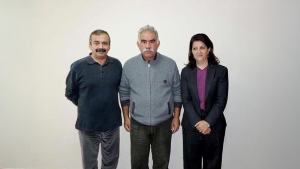
The Imralı delegation, consisting of Pervin Buldan and Sırrı Süreyya Önder (who are also in the DEM Party delegation with Türk), came back with seven points that Öcalan wanted to convey. Each of these points are contributions. But can they be considered indications that peace is truly in the air? They could be. However, despite the mention of current events like Gaza and Syria, these are the points that Öcalan has been making for years. He is ready for peace. The whole Kurdish movement is ready for peace, and has long been ready. But not in exchange for nothing, hence point six: ‘All these efforts will elevate the country to the level it deserves and will also serve as a valuable guide for democratic transformation.’
Sensitivity
Sırrı Süreyya Önder has also said that not everything is being shared. Not because they don’t want to be transparent, but because of the sensitivity of the issue. So we can assume that the government and the state may also be holding things back for the same reason. We will have to wait and see. But shouldn’t there be at least some sliver of a real, actual point articulated by the state that could serve as ‘indication’ that they are sincere? Okay, let’s put the bar even lower: Shouldn’t they be refraining from insisting the Kurdish issue doesn’t exist at all?
Because that’s all I am seeing. Bahçeli even said there is no ‘new solution or initiative’ and that ‘results should be staged step by step and announced without delay’, meaning, I think, that Öcalan should just quickly call on the PKK to lay down its arms.
Imperial
And then there is the statement of one of Erdoğan’s most important advisors, Mehmet Uçum, shared via X. It’s long, but everything he says is in fact the core of the Kurdish issue. Don’t be fooled by him referring to the Kurds as ‘sectors of society’ and ‘founders and permanent owners of the Republic of Turkey’. He’s right in establishing that, but he doesn’t connect it with Kurds having rights other than the right to be Turkish. He reduces the issue to an imperial one, which is a frame dating back to just after the First World War, when foreign powers divided Turkey. Turkey’s founding father Atatürk united the owners of the land and kicked the foreign powers out in Turkey’s War of Independence, and Turkey emerged. Ever since, the fear has been instilled in people that to this very day, the only goal of those foreign powers is to weaken and divide Turkey. This is what Uçum is referring to.
This is, all things considered, the ultimate denial of the Kurdish issue as a domestic problem. The PKK is reduced to an imperial project aiming to destroy Turkey, instead of recognised as an insurgency that started to secure fundamental rights. Initially it was indeed the intention to break Turkey up and establish a Kurdish state, but that is no longer the case. Democracy, justice, freedom and equality for all are the current goals. That is what young Kurds are still willing to fight for, including by taking up arms, because the oppression continues.
Aliens
These Kurds fighting with weapons come from inside Turkey’s borders, not from outer space, as Uçum still seems to believe. A tiny, mini hint that PKK fighters are daughters and sons of Turkey, now that would be an indication that something positive is brewing behind the scenes. They don’t even have to utter the word ‘Kurdistan’ yet, if that’s too difficult.
Related Articles
Turkish nationalist far-right leader Bahçeli dismisses ‘Solution Process,’ calls for ‘New Beginning’

More evidence surfaces of Turkey’s alleged chemical weapons use, Kurdish forces share video

Abdullah Öcalan: A catalyst for peace and democracy in Turkey and the larger region
Next weekend, on 11 October, Turkish President Recep Tayyip Erdoğan will be visiting Diyarbakır and speaking at a rally. Then he may say the word ‘Kurdistan’. He likes doing that in the Kurds’ political capital. But don’t be confused when he does: as long as only he can say it, with impunity, it doesn’t count as an ‘indication’ either. Your daughters and sons, he could say if he were sincere, are not aliens, they are the children of all of us, including those who went to the mountains. A phrase like that would indicate that he owns the problem, and is willing to act on it.
I don’t count on anything. Which is not the same as being hopeless. Of course there is hope – right there in the struggle.
Fréderike Geerdink is an independent journalist. Follow her on Bluesky (or X) or subscribe to her acclaimed weekly newsletter Expert Kurdistan.


