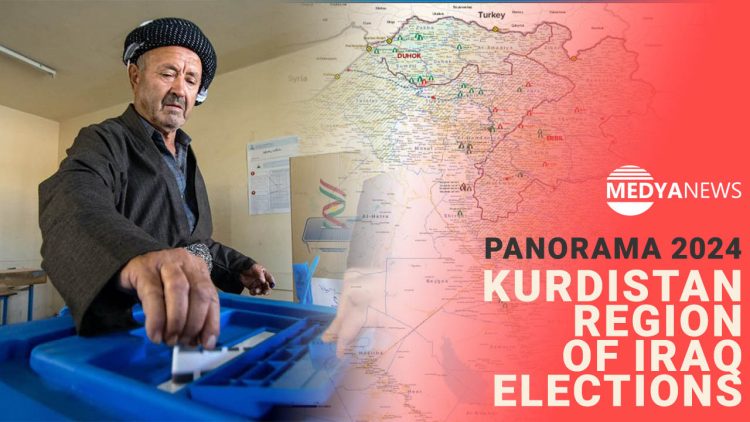
The Kurdistan Region of Iraq (KRI) faced a turbulent year in 2024, with its political and social landscape dominated by the long-delayed parliamentary elections. Initially scheduled for 2022, these elections were repeatedly postponed due to political deadlock between the region’s two dominant parties: the Kurdistan Democratic Party (KDP) and the Patriotic Union of Kurdistan (PUK). The elections were held on 20 October 2024, but the process was complicated by allegations of corruption, fraud, and external interference, leading to delays in forming the new government.
The years leading up to the 2024 elections were marked by increasing political discord in the KRI. The already strained relationship between Masrour Barzani’s KDP and Bafel Talabani’s PUK had worsened significantly. Central to the tension was a dispute over electoral laws and constituency boundaries, with the PUK accusing the KDP of manipulating these rules to solidify its control in Erbil (Hewlêr) and Duhok (Dihok), the party’s strongholds.
Economic challenges exacerbated by disputes with the Iraqi federal government over oil revenues and budget allocations also plagued the region, adding to the turmoil. Public discontent grew as the salaries of public servants were delayed and the region’s once-thriving oil sector faltered due to exports through Turkey being blocked, fuelling calls for political reform.
After prolonged negotiations and international pressure, including mediation from the United Nations Assistance Mission for Iraq (UNAMI), the KDP and the PUK finally agreed to hold elections in October 2024. The decision was seen as a critical to restoring public confidence in the region’s democratic process. However, the agreement did little to ease the tensions between the two parties.
The 2024 election campaign was one of the most contentious in the KRI’s history. The PUK launched direct attacks on the KDP, Talabani accusing them of “selling out Kurdistan” to its enemies through corrupt dealings and secret collaborations with Turkey. These accusations included claims that the KDP had provided Turkey with intelligence and access to the region, undermining Kurdish sovereignty, as reported by Medya News earlier in the year.
Masrour Barzani, incumbent Prime Minister and son of the influential former KRI President Masoud Barzani, dismissed these allegations as baseless. He accused the PUK of resorting to divisive rhetoric to mask its own shortcomings. Masoud Barzani has often been referred to as the patriarch of the Barzani dynasty, and he remains a central figure in the backdrop of the campaign. Critics from within and outside the region point to the nepotism of the Barzani dynasty as a core issue that stifles democracy.
The KDP’s collaboration with Turkey was another major point of criticism. Turkey’s military presence in the KRI, with over 50 military bases, has become a symbol of Ankara’s influence in the region. The Turkish government’s drone warfare, aimed at targeting Kurdistan Workers’ Party (PKK) fighters, also causes civilian casualties, further escalating tensions. Accusations that the KDP has been facilitating these operations by sharing intelligence with Turkish forces deepened the public perception that the party is complicit in undermining Kurdish self-determination. Critics have described this relationship as bordering on colonialism, with Turkey exerting de facto control over parts of the KRI.
The campaign also saw increased involvement from smaller parties and independent candidates, who sought to capitalise on public disillusionment with the KDP-PUK rivalry. The New Generation Movement in particular emerged as a vocal critic of both parties, calling for greater transparency and accountability.
The PUK’s campaign strategy was bolstered by its strong relations with the Syrian Democratic Forces (SDF), military forces defending areas controlled by the Autonomous Administration of North and East Syria (AANES). SDF Commander-in-Chief Mazloum Abdi publicly expressed support for the PUK, noting the importance of the shared struggle for Kurdish autonomy across borders, and securing logistical and moral backing for the PUK’s election campaign, the two Kurdish organisations displaying solidarity against common adversaries, including Turkey’s aggression.
Despite the heated campaign, election day on 20 October was largely peaceful, with a reported voter turnout of 61%. Observers from international organisations including the European Union monitored the process and praised the logistical conduct of the election. However, allegations of voter intimidation, ballot tampering and irregularities soon emerged.
Preliminary results indicated a strong showing for the KDP, which secured 39 seats in the 100-seat parliament. The PUK won 23 seats, while the New Generation Movement gained 15 seats, solidifying its position as a significant opposition force. Smaller parties and independents accounted for the remaining seats.
The results did little to resolve the political stalemate in the KRI. The PUK rejected the outcome, alleging widespread fraud orchestrated by the KDP. Talabani repeated his party’s claims of electoral manipulation, calling for an independent investigation. These allegations were amplified by media reports, including those from Medya News, which detailed instances of irregularities and questioned the transparency of the electoral commission.
Meanwhile, Masrour Barzani called for unity and urged all parties to respect the will of the voters. In a televised address, he stressed the importance of forming a stable government to address the region’s economic and security challenges. However, both the KDP and the PUK have been refusing to cede ground in negotiations to form a coalition government.
The political impasse has reflected on the KRI’s economy. The financial crisis continues, and the issues of the salaries for public servants, the dispute with Baghdad over oil revenues and the suspension of oil exports through the Ceyhan pipeline to Turkey all remain unchanged.
Protests have been erupting in various cities demanding political reform and economic relief. Analysts warn that the continued failure to address these issues will erode public trust in the region’s institutions and fuel further unrest.
The international community has expressed concern over the political situation. The US and the EU have called for dialogue and compromise between the KDP and PUK, stressing the importance of a functioning government to address the KRI’s needs. Regional actors with strategic interests in the KRI, including Turkey and Iran, are also closely watching developments.
KDP’s collaboration with Turkey, especially in military operations against the PKK, remains a contentious issue, representing a broader struggle for control over the region. The PUK’s alignment with the SDF and North and East Syria highlights an alternative path rooted in Kurdish solidarity. The coming year will be critical in determining whether the KRI can overcome its challenges and achieve stability. The the decisions made in the months ahead will shape the region’s future for years to come.