

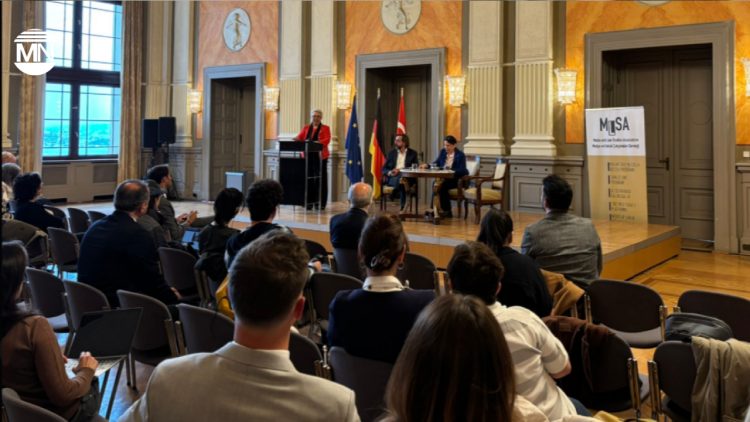
At a panel discussion held in İstanbul on Friday, legal experts and journalists warned that digital technologies, while expanding media reach, are also being used by governments to restrict press freedom and suppress dissent.
The event, titled “Press Freedom in the Digital Age: The Role of Article 10 on the 75th Anniversary of the European Convention on Human Rights”, was organised by the Media and Law Studies Association (MLSA) and the German Consulate General in İstanbul. Moderated by German Consul General Dr Regine Grienberger and MLSA Co-Director Veysel Ok, the panel featured former European Court of Human Rights (ECtHR) judge Rıza Türmen and economist and academic Nesrin Nas as speakers.
Addressing a room of journalists, Türmen emphasised the double-edged nature of technological change. “Technology itself is neither good nor bad,” he said, citing examples such as the textile industry’s impact on labour conditions and the development of nuclear power alongside atomic weapons.
Türmen argued that while digital tools help journalism reach broader audiences and operate more efficiently, they have also exposed journalists to new forms of pressure. He pointed to Turkey’s 2007 Internet Regulation Law, which was significantly expanded following the Gezi Park protests in 2013. “Because the government could not control the flow of news, the law was changed to allow blocking of content without a court order,” he explained.
He added that the post-coup state of emergency in 2016 led to a sharp increase in media restrictions through emergency decrees, and tighter control over social media. “Wikipedia was banned in Turkey—something not seen anywhere else in the world,” Türmen noted.
Nesrin Nas, speaking under the theme “Defending Press Freedom and Democracy in the Digital Age”, stated that the consolidation of media under government control is not only a tool of censorship but also a means to dominate the economy.
“In authoritarian regimes, media control serves multiple purposes. The conventional media was the starting point. Now, with the speed of the digital age and the pressure to generate clicks, the nature of media has shifted dramatically,” she said. “The digital media landscape of the early 2000s has evolved into one where governments use platforms to monitor society and marginalise opposition.”
Nas stressed the importance of safeguarding media independence. “The defence of a free media is vital for humanity,” she said. “We are living in a media world where truth is disappearing and transparency is declining.”
Christian Mihr, a journalist and final speaker at the panel, argued that journalism must evolve in tandem with societal and technological changes. “Censorship forces journalists to adopt new methods,” he said. “This reality must be acknowledged in discussions about the future of journalism.” He also praised the ECtHR for its role in defending press freedom.
The event concluded with a question-and-answer session between panellists and attendees.


