

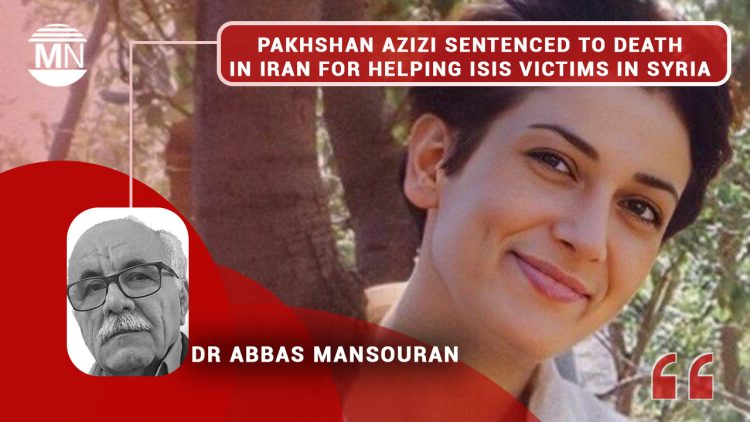
Dr Abbas Mansouran
Pakhshan Azizi is a woman of the “Jin, Jiyan, Azadi” movement. She is currently under the gallows of the Islamic government of Iran for the same crime. On Wednesday 9 January 2025, Amir Raisian, Pakhshan Azizi’s lawyer, announced the confirmation of the government’s murder verdict for Pakhshan Azizi in the Supreme Court, and reported on social network X that this verdict was confirmed even though Pakhshan Azizi “was neither a member of any military group nor had any military activity.”
Amir Raisian added: “This verdict was issued in conflict with a fair trial and disregarded the flaws in the case and was communicated to us today.” This inhuman verdict, in the continuation of the horrific massacres of the Iranian government, is full of contradictions and even the laws of the Islamic government.
Pakhshan Azizi, a social worker graduate like Warisheh Moradi, was arrested by the Islamic State’s Revolutionary Guard Corps in Iran on 4 August 2023, and has been tortured in Islamic State detention centres for more than a year. The crime of Pakhshan Azizi and Warisheh Moradi is providing aid to victims of ISIS crimes in Rojava, Syria. The Islamic State’s Supreme Judicial Court has sentenced both to death by hanging for this accusation. In a letter from Evin Prison on 20 July 2024, Pakhshan Azizi wrote, referring to his torture at the hands of the IRGC’s Intelligence and Security Organization: “I have been hanged many times by my interrogators.”

She continued: “…all my activities and efforts have been in the direction of serving and paying my historical debt to my lived experiences and historical repressions, and of course, I firmly believe that the right way to achieve a democratic society is also fundamentally through adopting a democratic method to build a moral-political society in which people themselves discuss social issues, concern themselves with them, and find solutions.”
After her arrest, Pakhshan Azizi was subjected to various tortures for more than four months in solitary confinement in Ward 209 of Evin Prison in Tehran (under the supervision of the IRGC Intelligence organisation) she went on a hunger strike for 36 days to seek the release of his family, who were arrested at the same time. She was hanged many times during interrogation, she was buried ten meters deep in the ground and then brought out again to break Pakhshan into a confession dictated by the interrogators.
According to reliable reports, the first investigator in the Pakhshan Azizi case after her arrest was a person named Mazloum, who at the end of the first month of her detention, after considering the case and documents of the Ministry of Intelligence, refused to extend the detention order and decided to issue a release order for Pakhshan Azizi.
The Ministry of Intelligence did not accept this issue and order, and the prosecutor’s office came under pressure from the IRGC Intelligence Organisation. By order of the Tehran Prosecutor’s Office, the case was taken from the first investigator and handed over to Ali Qanatkar in Branch 1 of the Evin Prosecutor’s Office. Qanaatkar also found no reason for Pakhshan Azizi’s case to extend her detention order and issued an order to release Pakhshan Azizi on bail. The text states: “Continuing detention is not expedient and I propose to lift the temporary detention order and issue a bail order.” The IRGC Intelligence Organisation, which has its own ward 209 and other secret prisons, did not accept this order and ordered Pakhshan Azizi to be sentenced.
Under torture to the edge of death, Pakhshan Azizi never gave in to forced confessions and cooperation with the Islamic State and insisted on her defense that the charges and claims of the Ministry of Intelligence were untrue and fabricated.
On 23 July 2024, Pakhshan Azizi was sentenced to death by the verdict of Iman Afshari (Death Judge), Head of Branch 26 of the Tehran Revolutionary Court, on the charge of “rebellion”.
Pakhshan Azizi had been providing aid to victims of ISIS rape and aggression for nearly ten years in camps for displaced people from the war in northeastern Syria (Rojava), including more than three years in the Nowruz camp in the city of Dirak. She had undertaken this task, like Warisheh Moradi and hundreds of other women who had come from all over the world, to help women and children affected by ISIS crimes and aggression.
The Kurdistan Red Crescent in the northeastern region of Syria and the Shams Rehabilitation and Development Organization have confirmed these activities in letters to Iranian government officials and international institutions. Maja Hess, president of the Swiss organisation Medico International, emphasised in a letter dated 19 September 2024, that Azizi had provided social services specifically to women and children who had been forced to flee their homes. These documents and organisations testify that Pakhshan Azizi helped victims of ISIS as a social workers.
Pakhshan Azizi’s accusation
Pakhshan and Warisheh rushed to help victims in northeastern Syria when ISIS was targeting the entire Middle East to establish its Islamic state in Iraq and Damascus. The fascist Turkish government has been providing military support to ISIS since 2012. Yazidi women in Shingal were brutally sold in slave markets in the cities of Raqqa, Sinjar, Tabqa, Manbij, Kobani, and other occupied areas for a few dollars by ISIS mercenaries.
The world owes this glorious resistance
At the cost of the martyrdom of more than fifteen thousand fighting and revolutionary people, Kobani, Raqqa, and other occupied areas were cleared of ISIS, and thousands of wounded women and girls were freed from ISIS chains. The cost of these heroic actions and liberations was the lives of more than fifteen thousand resistance fighters. The vast cemeteries in Kobani and other cities of Rojava stand as poignant testaments to this historical resistance and heroism.
Read more of Abbas Monsouran’s opinion pieces:
The systematic killing of journalists is a war crime
These precious lives and the glorious historical resistance were sacrificed not only to establish security in Syria and the Middle East but also to safeguard Western societies from the atrocities of ISIS and its supporters. The world owes a debt of gratitude to the resistance of the men’s and women’s units, the heroic resistance in Sinjar and the north and east, and the remarkable self-governance of this system.
The crime against Pakhshan Azizi and Warisheh Moradi stemmed from their unwavering belief in the philosophy of ‘Woman, Life, Freedom’ and their dedication to providing humanitarian aid to northern Syria. Like any compassionate human being, they recognised that humanity and human duty transcend borders and felt a moral obligation to assist those in need. Pakhshan and Warisheh returned to Iran with the conviction that they had never engaged in armed conflict and that their sole weapons were knowledge and a commitment to social responsibility.
Their selfless service and humanitarian efforts should have been celebrated and commended
However, the Iranian government, operating with a worldview akin to that of ISIS and the Taliban, arrested and subjected them to torture, culminating in the abhorrent sentence of death by hanging. This heinous act by the Iranian government constitutes an endorsement of ISIS’s ideology. The Iranian regime aims to instil fear within society and exact retribution against the activists of the ‘Jin, Jiyan, Azadi’ movement, particularly women who refuse to succumb to coercion. The sentencing of Pakhshan Azizi and Warisheh Moradi to death, instead of freedom and praise, clearly indicates that the Islamic government of Iran has planned such a crime on behalf of ISIS and is taking revenge on Pakhshan and Warisheh. The goal of the Iranian regime is to take revenge on the “Jin, Jiyan, Azadi” movement and on women who do not submit to slavery and coercion. The Islamic government of Iran is a government of massacre, genocide, and crimes against humanity.
Pakhshan Azizi stands on the precipice of execution. To avert this barbaric and ISIS-like verdict that defies all humanity and history, we must mobilise every available resource and exert all our power. Every freedom-loving individual must utilise every means possible to prevent the Iranian government from murdering Pakhshan Azizi, Warisheh Moradi, and countless other imprisoned political prisoners. We must demand their immediate and unconditional release.
Dr Abbas Mansouran is an Iranian-born epidemiologist based in Sweden. He has expertise in burn injuries, having worked extensively in this field during the Iraq War in the 1980s. Mansouran has also conducted independent research in Rojava Kurdistan-North and East Syria, investigating medical facilities and providing treatment to the wounded, amid allegations of chemical weapons use by Turkey.


