

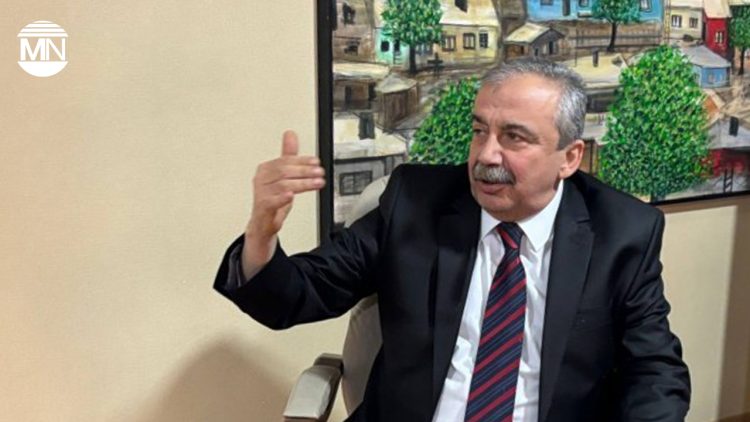
“Both society and we have a duty to build the garden of peace in the envisioned place,” Sırrı Süreyya Önder, a member of the delegation that met with Abdullah Öcalan, the imprisoned leader of the Kurdistan Workers’ Party (PKK), said in an interview with Mehmet Aslan, Mezopotamya Agency reported on Tuesday.
As Turkey grapples with a crackdown on opposition figures and the Turkish military’s attacks in Rojava continue, expectations are mounting over an anticipated call from Öcalan. A delegation from the Peoples’ Equality and Democracy (DEM) Party has been holding discussions with Öcalan at the İmralı Island Prison, where he has been under strict isolation. The delegation, which includes prominent Kurdish politicians Pervin Buldan and Democratic Regions Party Co-Chair Keskin Bayındır, is set to visit the Kurdistan Region of Iraq (KRI) this weekend to discuss the future of peace efforts with key Kurdish leaders.
Önder, a veteran politician and deputy speaker of parliament from the DEM Party, spoke about the challenges facing this process, particularly in light of increased government pressure. “On one side, there are calls for brotherhood; on the other, there are trustee appointments and military operations. These raise serious doubts about whether there is a unified will within the state to pursue peace,” he said. However, he emphasised that conflicts often go through difficult phases before reaching a resolution.
Öcalan’s last meetings with the delegation took place on 28 December and 22 January. While details of the discussions remain undisclosed, Önder described Öcalan as “extremely hopeful and enthusiastic”. “He is striving to realise the possibility of peace because he believes this process will allow all of us to live,” Önder said, indicating that the PKK leader remains committed to achieving a peaceful resolution to the Kurdish question.
The DEM Party delegation’s upcoming meetings on 16-17 February with Kurdistan Democratic Party (KDP) leader Masoud Barzani and Patriotic Union of Kurdistan (PUK) leader Bafel Talabani, are expected to focus on the broader implications of Öcalan’s anticipated statement. The content of these discussions will later be relayed to Öcalan, whose potential call is seen as pivotal for reigniting peace talks in Turkey.
Comparing the current situation to the failed peace process between 2013 and 2015, Önder warned against expecting immediate change. “We should neither have excessive expectations nor fall into deep pessimism. This is a slow and painful process,” he noted. He stressed that democratic solutions must address legal, cultural, and social dimensions of the Kurdish question, while also calling for open communication channels.
On the broader regional implications, Önder highlighted Öcalan’s view that “the collapse of the Sykes-Picot Agreement means the Middle East can no longer be what it once was.” He suggested that Öcalan’s approach aligns with a vision of coexistence among ethnic and religious communities in the region. “He places security alongside equality and freedom, seeing democracy as the key to maintaining Syria’s territorial integrity while ensuring Kurdish rights are respected,” he added.
With the expected statement from Öcalan, many are questioning whether the Turkish government is prepared for a new phase in peace negotiations. Önder referenced past political leaders’ engagement with Öcalan, pointing out that even nationalist figures like far-right Nationalist Movement Party (MHP) leader Devlet Bahçeli had previously suggested allowing him to address parliament. “If Öcalan is to play a role, he must be provided with the necessary conditions to hold discussions, access information, and communicate freely,” he asserted.
While it remains unclear what Öcalan’s message will entail, Önder described it as a potential turning point. “We are waiting with anticipation, just like you,” he concluded.


