

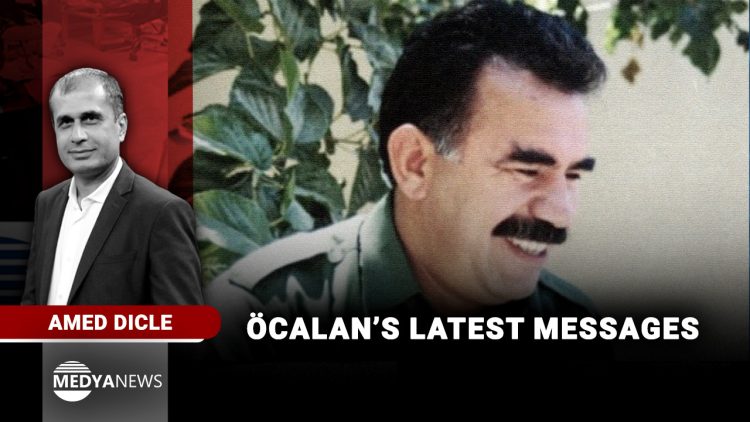
Amed Dicle
The message of Mr Abdullah Öcalan, released today, offers an important perspective on the search for a solution to the Kurdish issue and draws a clear road map in this regard. Öcalan’s message proposes a solution on the basis of democratisation and equality as an alternative to both the political deadlock in Turkey and the deepening crises in the Middle East. In particular, it is clear that the first comprehensive political meeting with him after an interval of nine years makes this message even more meaningful. Although the message is short, it is very clear and understandable for those who follow him closely and especially for those who read the interviews conducted between 2013-15.
This meeting shows that the state did not get the results it expected from the policies it has pursued in the last nine years and therefore had to return to the ground of meeting with Mr Öcalan. The state’s being stuck both in domestic politics and in the regional equation has made it inevitable to restart such a process. In this context, the perspective presented by Öcalan is not only a proposal for a solution, but also reflects the lessons learnt from previous experiences in this process.
While the message emphasises the importance of the Turkish Grand National Assembly, Öcalan does not consider it as the only ground for a solution, but as an important ground. This emphasis points to the fact that the solution cannot be limited to a parliamentary framework and that the active contribution of all social and political segments is required.
Mr Öcalan’s statement ‘I am ready to make the necessary contribution to the new paradigm that Erdoğan and Bahçeli are strengthening’ should be analysed carefully. Here, Mr Öcalan does not see the solution process as a political initiative of the government or the state alone; he considers the Kurdish Movement and the state of the Republic of Turkey as two equal parties to this paradigm.
It is not possible to consider Mr Öcalan’s message independently from his previous messages. This message is a continuation of the solution proposals he had previously expressed in the talks between 2013 and 2015 and can only be fully understood in this context. In each of Öcalan’s messages, it is clear that there are basic principles for a solution based on democratisation, equality and peace. In today’s message, in the light of these principles, he addresses both the historical dimension of the Kurdish issue and the structural obstacles to a solution.
The framework of the message can be summarised as follows:
1. Identification of the problem: The Kurdish issue is not only a security problem, but a historical, political and social issue. The solution must be built on the basis of democratisation and political equality.
2. Ground for the solution: The Parliament is an important ground, but not the only ground. Parliamentary processes and extra-parliamentary platforms should work in coordination.
3. Condition for success: A democratic and egalitarian constitution is the key to a solution. This process must proceed with mutual trust and contributions.
In his message, Mr Öcalan shows a clear determination about the future of the process and emphasises that a solution can only be possible with mutual trust, saying ‘I am ready to make the necessary call if the process is successful’. These statements make it clear that the solution depends on mutual steps and that it cannot proceed with a unilateral initiative.
Mr Öcalan states that democratisation and peace are urgently needed to prevent Turkey and the Kurdish people from being dragged into deep conflicts like Gaza and Syria. In this context, he calls for a reconsideration of the current constitution based on democratic, egalitarian and brotherhood law.
The emphasis on ‘Kurdish-Turkish brotherhood’ is not just an abstract bond, but points to a project of common life on the basis of political and constitutional equality. This message of Mr Öcalan offers a historical opportunity for the solution of the Kurdish question and invites the state and social segments to take responsibility. From this point onwards, the responsibility for advancing the process and taking a historic step lies on the shoulders of the state, the political and social actors in and outside the Parliament.
To summarise, Öcalan says ‘I am ready for a solution and peace, if you are also ready, this is the way forward’. Now we need to look at the promises and steps to be taken by the state.
Amed Dicle was born and raised in Diyarbakır, Turkey. He has worked for Kurdish-language media outlets in Europe, including Roj TV, Sterk TV and ANF. His career has taken him to Rojava, Syria, Iraq and many other countries across Europe. Follow him on Twitter.


