

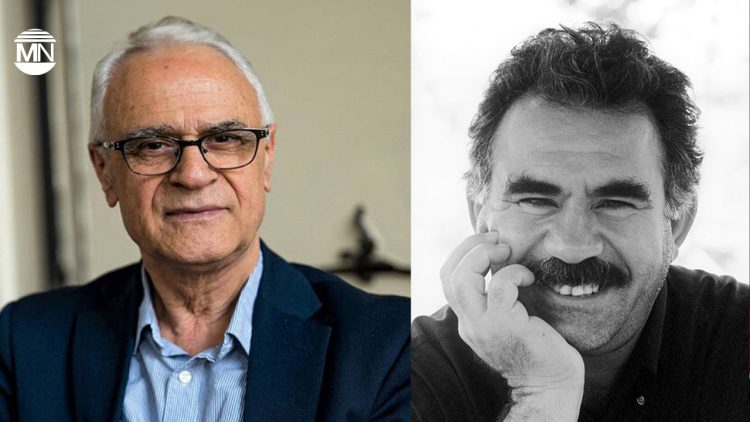
Imprisoned Kurdish leader Abdullah Öcalan’s call for the dissolution of the Kurdistan Workers’ Party (PKK) and an end to armed struggle marks “not an end, but a new beginning” for the Kurdish freedom movement, Remzi Kartal, co-chair of the People’s Congress of Kurdistan (KONGRA-GEL), has said.
KONGRA-GEL, a political umbrella organisation, was founded in 2003 as part of the PKK’s transition from primarily an armed group to a broader freedom movement. It functions as a legislative body for Kurdish political and civil engagement, advocating a peaceful resolution to the Kurdish issue.
Öcalan’s historic announcement, dubbed the ‘Call of the Century’, was made public on 27 February at a press conference in İstanbul by a seven-person prison İmralı delegation. The PKK has since responded positively, stating it will fulfil the requirements of Öcalan’s call.
“This historic call is directly connected to political developments in Kurdistan, the Middle East and worldwide,” Kartal told Yeni Özgür Politika on Monday. “Öcalan’s call for the PKK’s dissolution should be seen as a new beginning. The primary aim of the Kurdish freedom struggle that began in 1973 was to resolve the Kurdish issue and achieve national-social freedom.”
Kartal emphasised that Öcalan’s initiative comes amid what he describes as “World War III” in the Middle East, with conflicts in Palestine-Israel, Syria, Iraq and Iran reshaping the region. He suggests that a democratic solution to the Kurdish issue could become “a model for the entire Middle East”.
The KONGRA-GEL co-chair highlighted that no formal agreement or roadmap currently exists between the Turkish state and Öcalan. Instead, the focus is on creating suitable conditions for developing democratic and political struggle. Kartal said:
"The most critical issue is improving Öcalan's physical conditions and providing him a free working environment. How the process progresses depends directly on his freedom, security and working conditions."
Kartal warned that the coming weeks will be decisive, as the Turkish state’s response remains uncertain. “If state repression continues, it will contradict the spirit of this process,” he stated, cautioning that internal state factions may attempt to sabotage any potential progress. “Some forces within the state may try to sabotage the process,” he said, adding that the struggle for democracy and freedom is a shared responsibility of all segments in Turkey seeking democracy, freedom and equality.
Regarding next steps, Kartal stated that securing Öcalan’s release should be prioritised, followed by bringing the issue to parliament. He also called for an end to military operations, political pressures and arrests targeting political parties, municipalities and journalists.
"When Turkey resolves the Kurdish issue democratically, it will have to abandon military pressure and attacks on Syria," Kartal said, suggesting that such a resolution could foster democratic processes throughout the region.
Kartal is a senior Kurdish politician and former member of the Turkish parliament for the pro-Kurdish Democracy Party (DEP), which was banned in 1994. Following his exile to Europe, he became a prominent figure in Kurdish political circles in diaspora, serving as a KONGRA-GEL co-chair.
The Kurdish diaspora consists of millions of Kurds living outside their historical homelands in Turkey, Iraq, Iran, and Syria. Many Kurds in Europe, particularly in Germany, France, Sweden, and the UK, have been actively involved in Kurdish political movements, advocating for cultural rights, political recognition, and a peaceful resolution to the Kurdish issue.


