

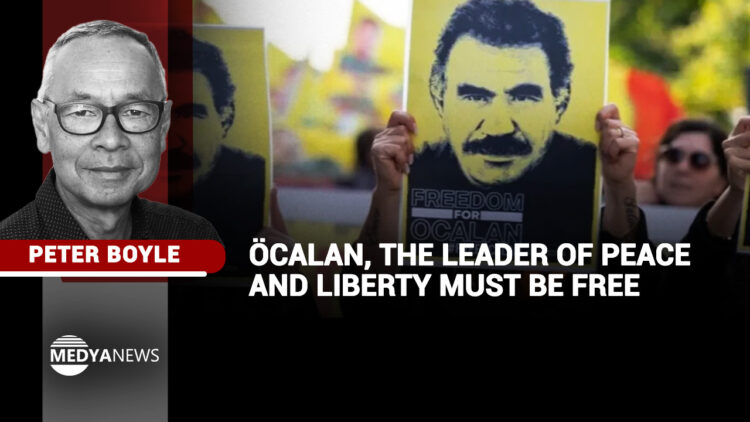
PETER BOYLE
I write today to join the global calls for freedom of Kurdish leader Abdullah Öcalan who has been imprisoned for more than a quarter of a century by the Turkish state.
Much of this in isolation — which is legally recognised as a form of torture. So, first of all, I make my call in the name of human rights. But secondly I do it rather more in the name of peace.
This is all the more profound and urgent when the entire Middle East is engulfed in brutal war on many fronts, as it is today.
Abdullah Öcalan wrote in ‘The PKK and the Kurdish Question in the 21st Century’ that making peace was “more difficult than waging war”.
“Peace based on the acceptance of different cultural identities will help to advance a renaissance of the region and further democratic progress in Turkey.
“Eventually, every war ends with peace. If we prove unable to end this war, we are doomed to be used for the purposes of our enemies. My efforts for peace received a wide variety of responses. Most of this was, however, opposition from various and even contrarian political circles.
“Some have not yet understood the relevance of the peace process for Turkey. The Kurdish issue has produced the longest and most severe crisis in the history of the republic. Without a just peace the crisis will continue.”
In this same book, Öcalan reminded us that so-called democratic governments of Europe and the US were responsible for the conspiracy that led to arrest and imprisonment.
“Their colonial understanding of foreign policy and the way they proceeded in my case have produced the present situation.”
Sadly, that has not changed and — like its counterparts in Europe and the US — the Australian government is still gripped by this same colonial and imperial mentality today.
Otherwise, surely it should heed that old saying: “Those who do not learn history are doomed to repeat it.”
History teaches us that the freeing of another liberation movement leader Nelson Mandela (after years of imprisonment in South Africa by the white supremacist Apartheid regime) was critical to the opening up of the road to peace and the end of Apartheid in that country.
The same is the case for Öcalan. His release will open the road to peace and justice in the region.
This not only because he has the standing and political authority to lead the Kurdish people through a new peace process, but also because his political ideas for human liberation can lay the basis for new systems of freedom and justice that must ultimately be the foundation of any lasting peace.
The liberation of women, grassroots democracy based on the inclusion of all ethnicities and religions and respect for nature — powerful ideas promoted by Öcalan are being tried and tested in the Rojava Revolution in North and East Syria — with inspiring results.
These same truly liberating and empowering ideas have also been implemented elsewhere around Kurdistan, even under conditions of severe repression.
These ideas have a global reach and relevance and this, in part, is why I am here with you today and why I was proud to be part of the Long March for Freedom for Ocalan and status for Kurdistan in February 2020. It is why the Kurds do have friends apart from the mountains.
They can imprison this great freedom fighter but they can never imprison the idea of freedom! That is why I will keep on chanting with millions of Kurds and global supporters: ‘Freedom for Abdullah Öcalan-Status for Kurdistan!’


