

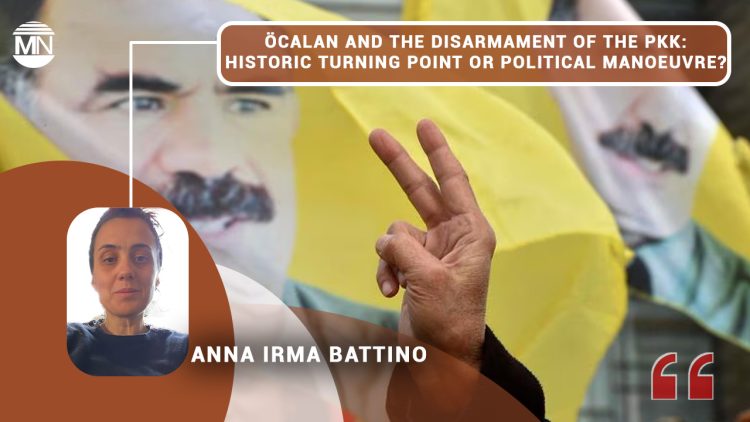
by Anna Irma Battino
In the heart of a Turkey in economic, political and social crisis, the message coming from İmralı prison has lit a light of hope and, at the same time, of scepticism, for a conflict that has lasted for over four decades. Abdullah Öcalan, the founding leader of the Kurdistan Workers’ Party (PKK) and a symbol of the Kurdish struggle, launched what some call a “historic appeal” for the disarmament and dissolution of the party. An initiative that could mark a turning point in relations between Ankara and the Kurdish people, but remains suspended between the possibility of peace and the fear of a political trap.
The international context is also decisive. [President] Recep Tayyip Erdoğan, aware that the escalation of conflicts from Gaza to Lebanon to Syria – with the overthrow of the Assad regime – could destabilise Turkish borders, has started to ventilate the possibility of a new peace process. Continuing the war against the Kurdish movement would entail significant losses and a decline in political consensus, a risk that Turkey seems to want to mitigate by considering a change of strategy.
Öcalan, in his speech read out by members of the Peoples’ Equality and Democracy (DEM) Party delegation who met him three times in recent months, said: ‘The second century of the Republic can only guarantee fraternal continuity if it is crowned by democracy.’ Words that challenge Turkey to a radical transformation and call into question the future of the state if no concrete steps towards democratisation are taken.
The Turkish-Kurdish conflict has its roots in the early years of the Republic, when the modernisation process initiated on the rubble of the Ottoman Empire resulted in a systematic attempt to erase Kurdish language, culture and identity. Every form of resistance was brutally repressed. In 1978, in a highly polarised climate, Öcalan founded the PKK with the aim of creating an independent Kurdish state. Over time, not without internal tensions, the movement abandoned this aspiration, moving towards a model of democratic self-government aimed at guaranteeing political rights and cultural protection for the Kurds.
Since 1984, the armed conflict has caused tens of thousands of deaths and billions of dollars of damage, destabilising entire regions and souring international relations. The PKK’s unilateral peace attempts and ceasefires have never produced lasting solutions. Öcalan’s statement, released on 27 February, is not only a call for peace, but a clear message to Turkey and the international community. ‘What Öcalan is calling for is not surrender,’ clarified Havin Güneşer, an exponent of the International Initiative ‘Freedom for Abdullah Öcalan – Peace in Kurdistan’, in an interview with Radio Wave, emphasising the need to address the roots of the conflict.
The Kurdish leader pointed out that ‘our history is made up of centuries-old alliances and cooperation against the forces that have always tried to divide us’, recalling the long and troubled relationship between Turks and Kurds. But without concrete guarantees, the dissolution of the PKK risks remaining an illusion or even a political defeat for Erdoğan. Öcalan has called for a truth and reconciliation commission, an amnesty law and political reform. Without the involvement of the Turkish parliament, the peace process will remain incomplete.
The PKK Executive Committee responded by declaring an immediate ceasefire and announcing a congress to discuss the future of the movement. But it set a clear condition: Öcalan must be allowed to participate freely in the negotiations. In the communiqué, dubbed ‘the manifesto of the era’, the PKK declared: ‘With this call, a new historical process begins in Kurdistan and the Middle East, which is destined to influence freedom and democracy on a global scale. Everyone must take responsibility.’
With this it is sanctioned that the fighters in Turkey will not resort to arms, except in self-defence. ‘The call of the leader Apo [Öcalan] is not the end, but a new beginning. We must understand it thoroughly, take responsibility and implement it with determination.’
According to Güneşer, Öcalan could be granted house arrest. However, the risk of a political stalemate remains real, with unpredictable consequences in the region’s growing instability.
Now, the ball is in Ankara’s court. The future of the peace process depends not only on the government, but also on the opposition, Kurdish and Turkish society, the international community and human rights organisations. Preventing this opportunity from vanishing will require real guarantees for the Kurdish people.
Öcalan’s call for disarmament has been greeted with hope, but also concern by those who fear it could remove the last obstacle to Turkish repression. Mazloum Abdi, commander of the Syrian Democratic Forces (SDF) and a figure who grew up under the influence of the Kurdish leader, has hinted that Öcalan’s words may deprive the Turkish state of its main justification for attacking the Kurds.
For years, Ankara has equated the PKK with the SDF to legitimise military operations in Syria and Turkey, but the Kurdish resistance in northern Syria is more than an offshoot of the PKK, it is an experiment in democracy in a region torn apart by oppression and sectarianism. At the heart of the conflict, war is an imposition, not a choice. Every negotiation has passed through betrayals and illusions, while history repeats itself with inexorable cyclicality .
Öcalan’s announcement places Turkey at a crossroads. The ongoing negotiations must translate into concrete actions to break the cycle of oppression. History teaches that Ankara has often used dialogue as a strategic weapon, ready to renege on any commitment once its supremacy is re-established.
But Kurdish resistance is not just a military matter: it is identity, culture and political will, a force that has spanned generations and continues to defy every attempt at annihilation.
Meanwhile, the war in Kurdistan has become a spectacle. The West has turned it into a myth serving its own interests, but behind the epic narrative remain suspended lives, broken families and a conflict that continues far from the spotlight. For some, it is an exotic fairy tale, for those who live it a forced choice.
Yet war is never the end, but the price imposed on those who want a free future.
Building peace is a revolutionary act. It does not mean surrendering, but conquering justice. However, without real guarantees, without an end to persecution and cultural repression, every negotiation risks turning into an illusion. Those who have fought for so long will not accept a peace that resembles surrender.
The question, therefore, remains open: will the disarmament of the PKK be the first step towards real peace or yet another pretext for a new wave of repression? History teaches that Turkey has often used dialogue as an instrument of domination, ready to turn its back once it has achieved its goals. But the Kurdish struggle is not a shadow attached to a leader nor a matter of signatures on an agreement. It is a resistance rooted in history and in the will of a people, destined to continue until the dream of a free Kurdistan is but a concrete utopia.
This article was first published by Global Project on 2 March.


