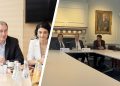
A delegation from northeast Syria visited the UK this week, to discuss Syria’s future.
This high-ranking delegation, led by Ilham Ahmad, co-chair of the Foreign Relations Department of the Autonomous Administration of North and East Syria (AANES), and Hassan Muhammad Ali, co-chair of the Public Relations Office of the Syrian Democratic Council (SDC), has been in the UK for five days, engaging with senior British officials from various political parties. They have emphasised that a federal framework is essential for Syria’s political future, providing a potential pathway to peace and stability.
The dramatic shifts in Syria, following the collapse of Bashar al-Assad’s regime and the rise of the Sunni extremist group Hay’at Tahrir al-Sham (HTS), have significantly heightened the urgency for all involved parties.
The SDC delegation met with British officials to discuss Turkey’s ongoing military operations in northern Syria, which target Syrian Democratic Forces (SDF)-controlled areas. The delegation emphasised the need for international support to safeguard these regions, which are vital to Syria’s stability and security. They presented a vision for a political solution to the Syrian conflict, advocating for a new constitution that ensures the rights of all communities, including Kurds.
The visit aimed to increase global recognition of the Autonomous Administration’s governance model, which promotes local democracy and coexistence. British MPs praised the SDF’s efforts in fighting terrorism and ensuring stability.
During her meeting with Northern Irish MP Sammy Wilson, Ahmad underscored the importance of a federal, decentralised, and multi-party system for Syria’s future, one capable of representing all political forces in the country. Ahmad also stressed the urgent need for international pressure on Turkey to halt its attacks on the SDF and drew attention to the discrepancy between the rhetoric and actions of the transitional Syrian government, led by HTS’ Ahmad al-Sharaa (previously known as Abu Mohammad al-Julani), highlighting the necessity of a comprehensive ceasefire in Syria. Ahmad further pointed out that halting Turkish intervention in Syria could provide a path toward stability, to which Wilson expressed his willingness to send a delegation to visit the northeastern regions of Syria.
In another segment of their diplomatic tour, Ahmad, together with Osman Baydemir, former Kurdish representatives in the Turkish Parliament, met British Minister of Technology Faryal Clarke at the Savoy Hotel during a ceremony marking the tenth anniversary of the liberation of Kobani (Kobanê). Their conversation revolved around the plight of the Kurds in the Middle East, especially in northeastern Syria.
The meeting, attended by Jamal Taher, representative of the Iraqi Kurdistan Regional Government (KRG), Parvin Chakar, a well-known Kurdish singer, Labour peer Maurice Glasman, and UNITE union representative Simon Dubbins, among other political figures, underscored the importance of Kurdish political participation in Syria’s future and stressed the necessity of creating a federal system for Syria’s long-term stability.
Hassan Muhammad Ali spoke to Euphrates News Agency about the delegation from northeastern Syria, stating, “Syria has always been a pluralistic society, with rich cultural, ethnic, and religious diversity. A centralised system is inadequate; a federal structure is essential for Syria’s political stability.” He also pointed out that in the post-Assad era, the UK should use its political influence to prevent further Turkish attacks on Syria.
In conclusion, Ali reiterated that, from the SDC’s perspective, the international community—especially the UK—must acknowledge Syria’s multicultural fabric and prevent Turkey’s attempts to impose a centralised government.
The high-level delegation will continue its diplomatic tour in the UK until 17 January, with a focus on advocating for a federal-democratic system to secure political stability. According to media reports, Ahmad will then travel to Washington, DC to attend US President Donald Trump’s inauguration on 20 January.