

Dicle Müftüoğlu
The sole goal of the hundreds of thousands who filled the Newroz square in Amed [Diyarbakır] with the excitement of a possible video message and in ownership of the historic call from İmralı [the island prison where Kurdish leader Abdullah Öcalan is held], was to celebrate next year’s Newroz with the physical freedom of Abdullah Öcalan.
Newroz is the day of resurrection of a people rising to the surface like a sprout breaking through the soil. It is the rebellion of a people reborn with a renewed fire, like the butterfly that throws itself into flames to grasp the secret, or like the Phoenix reborn from its ashes to reach the truth. Like the flow of the Tigris [Dîcle] growing in abundance to unite with the Euphrates [Ferat], Newroz is the flow of a people towards freedom. It surpasses an ordinary celebration or “national holiday”—each step taken, each slogan, each waved handkerchief, each traditional dance (govend), each sign of victory is a struggle, an act of resistance. The Kurds continue to grow their democratic, equal and free struggle, despite those who say negatively “they’re dancing while people are under arrest,” just as they have for years.
For the last 10 days, the Kurdish people have lit the fire of Newroz in cities, districts, neighbourhoods, villages, historical sites, on mountains and in plains, and welcomed not only spring but also a renewed transformation. After the “Call for Peace and a Democratic Society” made by Kurdish People’s Leader Abdullah Öcalan on 27 February, accompanied by a published photograph of him, people’s hearts blossomed like almond trees. The crowds filled the squares every day. The slogan most often shouted around each fire was “Bijî Serok Apo” [Long live Leader Apo – Apo is Öcalan’s nickname]. Everyone who jumped over the fire or circled around it also demanded Öcalan’s freedom.
Desire to be united with Öcalan
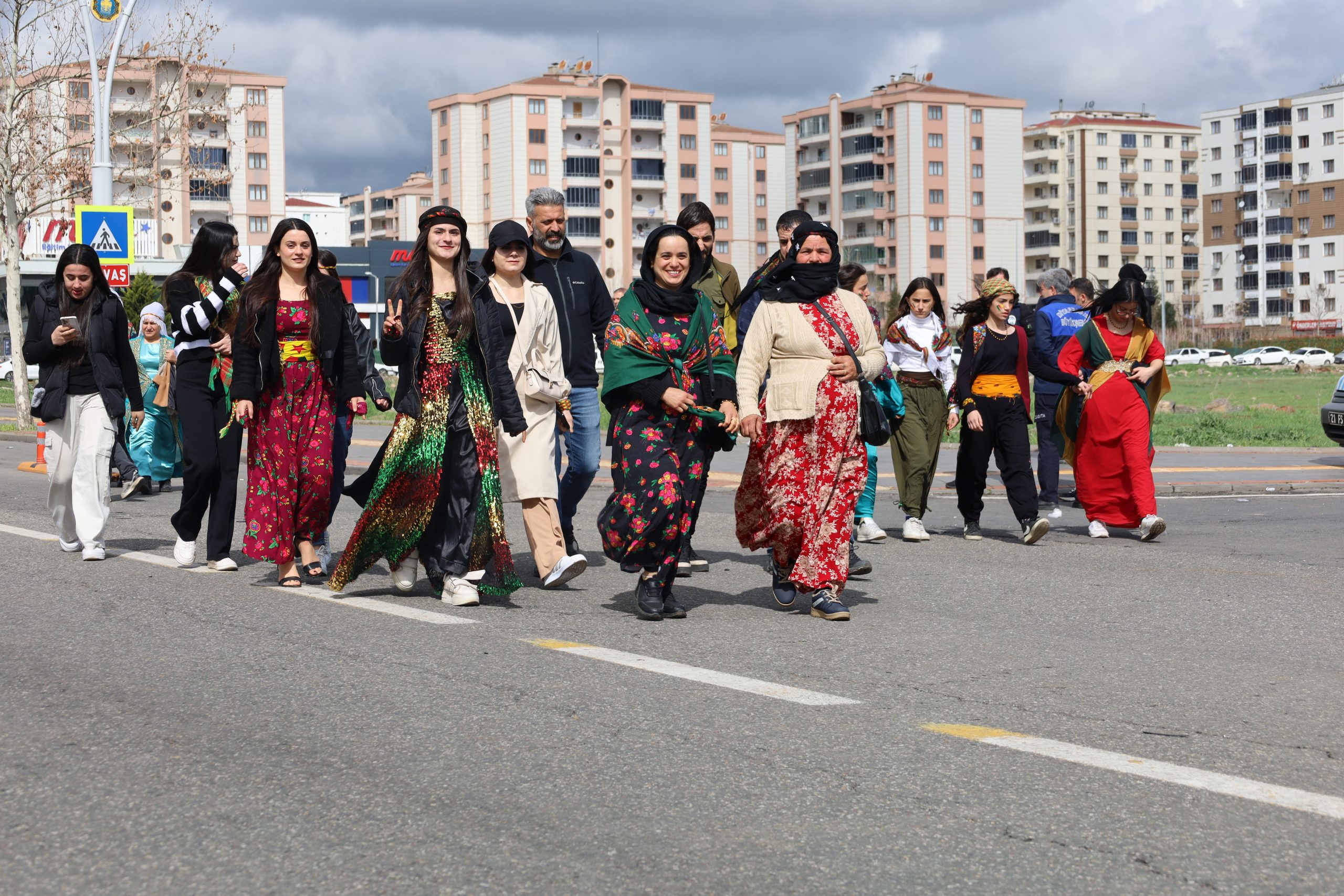
The intersection point of all Newroz celebrations was Amed. From the years when Newroz was celebrated as mass rallies to today, Amed has remained the central site where the Kurdish people’s message is expressed. What distinguished this year’s Newroz from others was Abdullah Öcalan’s historic call and the possibility of a new video or written message from him. Following the call that brought spring to the peoples on 27 February, the world turned its eyes and ears to the possibility of a new message from Öcalan. The people, in turn, flowed into the square to reunite with the one they call “My Leader”. Every step they took towards the square was filled with deep conviction and love. Love for freedom!
As in recent years, all the practices meant to wear people down were in force again this year. As the day began, people in their festive clothes gathered in front of the barricades surrounding the square—some broke into dance accompanied by drum and zurna [traditional wind instrument], while others waited for the gates to open with slogans. Of course, there were also those who chose to arrive late to avoid the congestion at the gates.
Ban on guerilla dressing
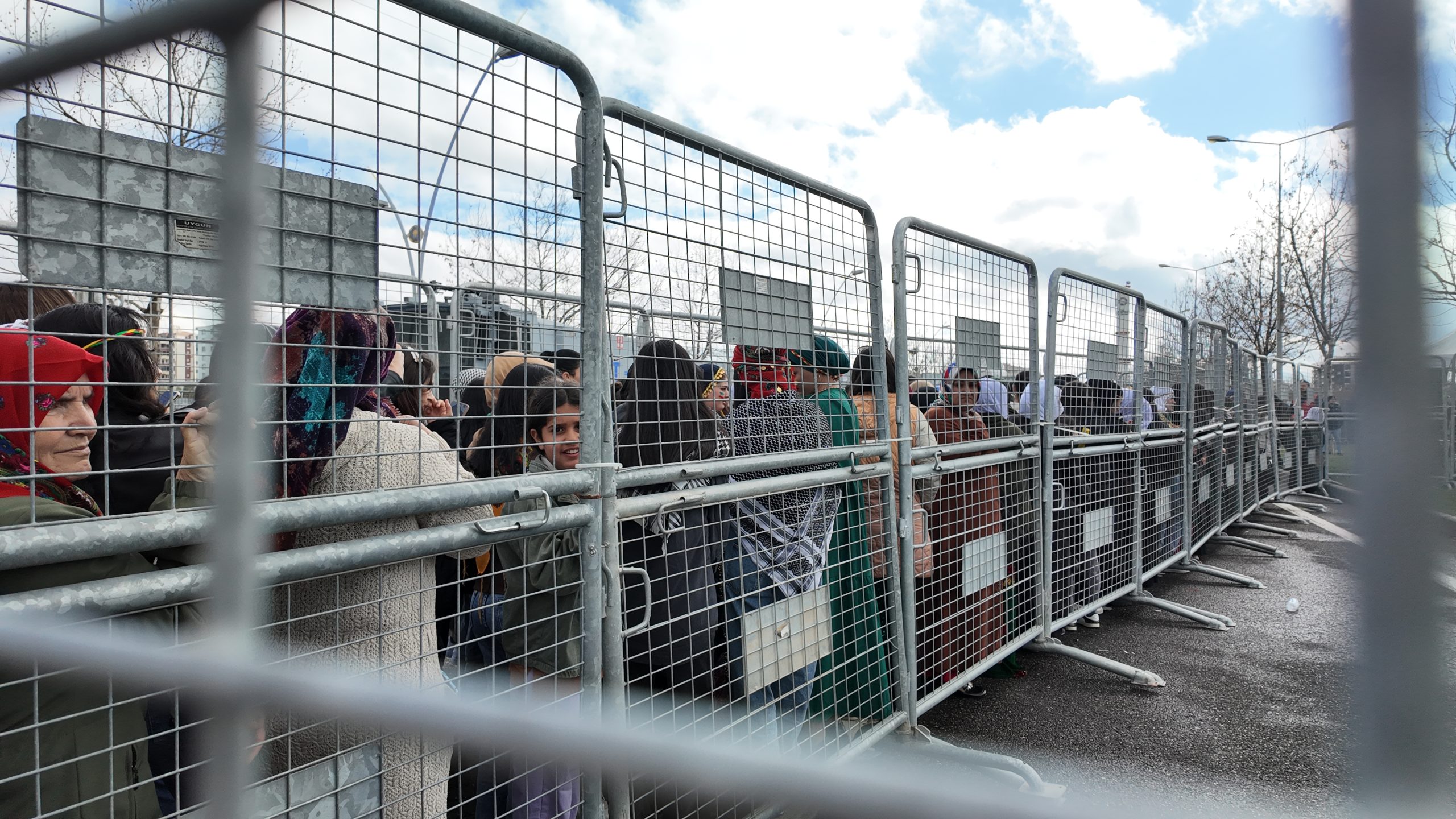
At every entrance point to the square, narrow tunnels made from barriers forced people to wait over an hour. Entry to the square was allowed only after searches at a minimum of four different points, sometimes reaching the level of harassment. What people wore into the square also mattered to the police. Police radio announcements echoed: “Militant-style clothing will not be allowed.” Youth wearing such outfits were turned back, and those under the age of 18 were taken into custody. Those with long hair faced even more difficulty—some were asked, “Are you hiding something in your hair?”
Those waiting to enter sang kilams [traditional Kurdish songs] in unison, and when it came time for slogans, the air was filled with chants of “Bijî Serok Apo.” Though some said, “Even if we stay silent now, we will shout our slogans in the square,” the majority raised their voices even louder. Everyone passing through the gate flowed towards the square like someone running towards a mirage in the desert. As the square filled, words and enthusiasm merged and grew—it became Newrozbuyîn [to become Newroz, a verb used to symbolise embodying the spirit of Newroz].
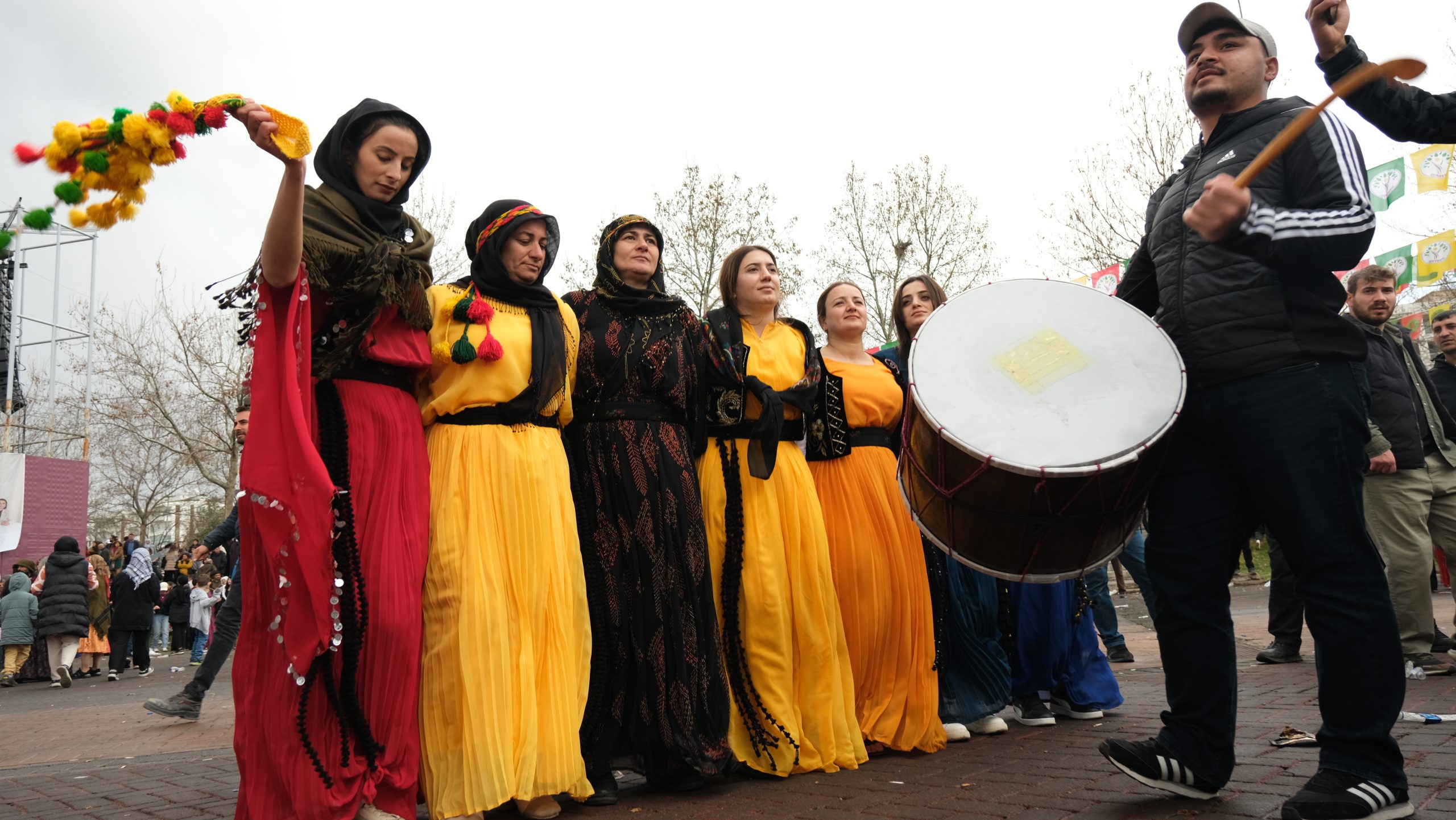
Becoming Newroz in these lands is no easy feat. Reaching the “Freedom Newroz” requires another level of conviction. As Abdullah Öcalan once said, “If freedom were so easy, Ronahî and Berîvan would not have set themselves on fire.” A people who have resisted oppression, arrests, massacres and the burning of cities for years came together, now even more strengthened by Öcalan’s call, to embody democratic transformation through Newroz.
The image from İmralı
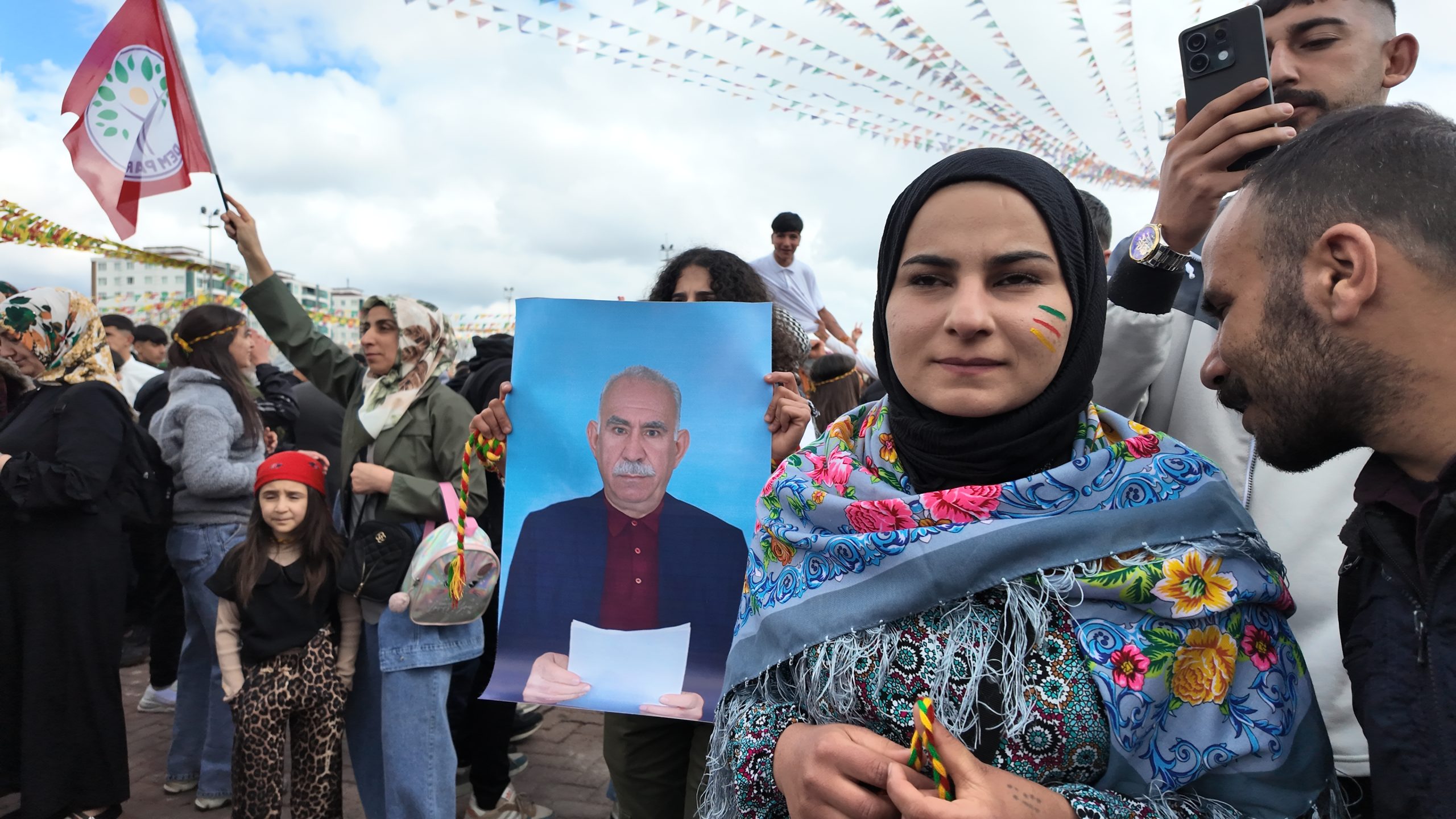
The crowd in the square was greeted by the photo taken on İmralı with the delegation [a recent image of Öcalan during his meeting with officials]. Then, another photo showing Öcalan reading his historic call was displayed. Young people carrying small posters of him were lifted onto shoulders and marched to the front of the stage. The others flowed like a river around them—young people, women—smiling, chanting slogans. Then, from the screens on stage, Öcalan’s past Newroz message was played with his own voice. Although it became clear at that moment that there would be no new video message, the echo of his voice in the square felt like a herald of freedom.
📹 Öcalan’s voice echoed across Amed (Diyarbakır) during Newroz 2025.
This year’s celebration was marked as a “Newroz of Freedom”, inspired by his 27 February call for peace and democracy. Despite hopes for a new message—as stated by DEM’s Pervin Buldan—none arrived.
Instead,… pic.twitter.com/vQ2nHXugAd— Medya News (@medyanewsx) March 21, 2025
The posters were passed from hand to hand. Unlike in past years, people did not feel the need to cover their faces—they took pictures with the poster like they would with a loved one.
The people who believe in Amed, in the love of its mountains, in Abdullah Öcalan’s paradigm and democratic transformation, filled the square to the brim. Those who had illuminated and grown this struggle with their lives were not forgotten during this celebration of democratic transformation. Photos of Commander Agit-Mahsun Korkmaz, who fired the first bullet in the armed struggle, Çiyager, the symbol of the Sur resistance, and Rahşan, Zekiye and Berîvan, who became “Newroz” through sacrifice, were turned into flags and waved.
As fighter jets flew over the square, the people recognised the government’s threat of war—but held onto the call from İmralı, the love for their mountains, and their belief in freedom.
The Almond Tree
The almond trees surrounding the square also told of Newroz, of freedom and of love to the crowd. The poem “My Friend the Almond Tree” by Aziz Nesin, etched into hearts with Halil Dağ’s voice, echoed once again:
“You are the fool among trees / I among people / The weather deceives you / Love deceives me… Even if no love ever reaches its end / Let us still bloom / I side with you, my friend / Bloom your flowers when you feel your season / As I open my heart / Perhaps this time there will be no winter / Perhaps your love won’t end in a dream / As I’ve given myself to my last love / Throw yourself, too, into this beautiful weather.”
Just like the 18-year-old boy selling red, yellow and green bandanas at the gate shouted “Freedom!” to welcome people entering the square, everyone cried out in unison:
Freedom for Abdullah Öcalan!
*Dicle Müftüoğlu is a veteran Kurdish journalist and editor known for her reporting on press freedom, human rights, and the Kurdish political movement in Turkey. She has worked with several Kurdish media outlets and is also a co-chair of the Dicle Fırat Journalists Association. Müftüoğlu has been frequently targeted by the Turkish state for her journalism and is currently imprisoned for her work.


