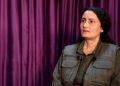
TekoJIN, a movement of young Kurdish and internationalist women primarily active in Europe, have produced ‘My Name is Abdullah Öcalan’, a compelling short film based on a compilation of poetry by Kurdish leader Abdullah Öcalan, imprisoned in Turkey, weaving together memories from his childhood, social and religious commentary, and a historical investigation into the persistence of democratic forms of life in Kurdish regions.
Freedom for Öcalan, a global initiative who released the film in English on X, quoted the Kurdish leader’s own words on the significance of poetic narrative, saying, “The first poets were those who explained the truth before the sages and prophets. Poetry and poetic expressiveness of a society’s language bear witness to how free and meaningful its social reality is.”
One of the first themes Öcalan touches on in the film is that of servitude, and its relation to religion, as he remarks that his name means “servant of Allah”, yet he has not chosen a path of servility to divine powers. He insists on disbelief in the notion of fate, which he relates to his struggle for a free life for humanity.
Occasionally, the poetry shifts from the first person singular to the first person plural, or to the second person. This shifting narrative often coincides with musical developments in the background of the film, the score of which is by renowned Kurdish musician Mehmûd Berazî. Occasionally, Öcalan even presents himself as another person, in an anecdote or historical moment which he describes previously. The multiple narrators reading the poetry, both women and men, reinforce this sense of narrative pluralism and a multitude of subjectivities.
Öcalan describes Kurdistan as a lost country, and compares the pain of being indigenous to a lost country to a curse. Visually, moments of destruction and war are presented when these lines are read. Then he introduces his mother into the narrative, sometimes describing her, sometimes re-enacting her sayings or curses. We see many images of Öcalan, as he eventually settles on a critique of patriarchy “which has diminished the godliness of mothers”. This is a poetry of mourning; his words begin to refer to his mother, now deceased, in the past tense.
From here a natural transition is made to childhood, and to the freedom intrinsic to it. The notion of rebirth is invoked, perhaps to highlight what grounds the adult’s struggle for freedom. Bread and the bread war are used as a metaphor for Öcalan’s socialism. “On the road where wheat turned into bread, I knew the sanctity of the hands that touched it.” This recalls labour and subsistence, but also childhood and motherhood.
As the aridity of Kurdistan is described, so too are its rivers, which are depicted as Öcalan’s poetry continues to reflect his cherishing of basic things, like cold drinking water. Here, rivers are also used as a narrative tool to describe self-discovery. The establishment of the relationship of political and existential concepts to the land of Kurdistan itself is constant and powerful.
Öcalan recalls his father saying “he has the sign of conquest on his forehead”, and remembers the confidence his father had in him, though this did not pursuade him to pursue a similar life path to that of his father. The limitations of the village in which he grew up are described as a barrier he knew must be overcome at a young age. Familial relationships, like the land, are constantly presented as something which bound Öcalan to development in his thinking. Marriage is described as a “tiger cage”, allowing Öcalan to confirm his feminism, albeit reflectively.
“On what soil can society can flourish if the homeland is ignored? Which river irrigates culture if there is no free flow? Who can swim in the void?” Shortly after these questions are posed, the image of Kurdistan Workers’ Party (PKK) co-founder Kemal Pir who died on hunger strike in Diyarbakir Prison, appears on the screen. Metaphors of the flight of birds are abundant here. Öcalan ends by musing on Kurdish music, and how it represented to him the clash of different clans in the region. What seems to be important in the poetic closure of the film is the idea that Kurdish culture and identity have persisted materially and psychologically despite centuries of turmoil, and that this is itself the greatest inspiration for Öcalan: “Kurdishness and free life are the eternal reality.”
A full English version of the film is available to watch on the Freedom for Öcalan campaign’s X (formerly Twitter) account, @Vigil4Ocalan.