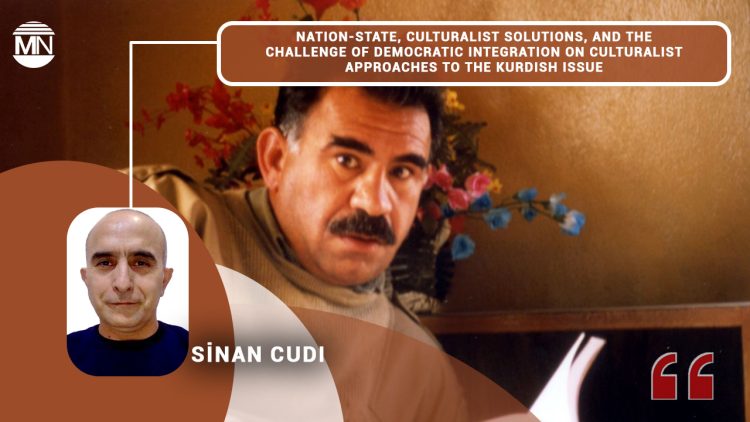
Sinan Cudi
The relationship and contradictions between nationalism, cultural identity, and social cohesion has been one of the fundamental dilemmas of the nation-state system. Emerging as the dominant paradigm in the 19th and 20th centuries, the nation-state model aimed to unite diverse populations under a single national identity. However, in multi-ethnic and multicultural societies, this model has frequently led to assimilationist policies, exclusion, and, in some cases, ethnic conflicts.
In response to the failures of rigid nation-state frameworks, cultural solutions advocating for the recognition and protection of cultural identities within the political system have emerged as an alternative. Yet, while cultural approaches aim to preserve diversity, they do not necessarily guarantee social cohesion or political stability. If a broader democratic framework—including equal citizenship, economic justice, and political representation—does not accompany cultural recognition, it may lead to further fragmentation, identity-based divisions, and social polarisation.
In this context, the fundamental question is: Can cultural solutions provide a sustainable alternative to the traditional nation-state without leading to separatism or deepening social divisions?
Nation-state and the dilemma of cultural diversity
First, let us recall the nation-state; it is built on the assumption that a political and social order should be based on a single, unified national identity. However, this idea contradicts the realities of diverse societies, where multiple ethnic, linguistic, and cultural groups coexist. Historically, attempts to impose a homogeneous national identity have resulted in numerous challenges.
Many nation-states have adopted policies aimed at erasing linguistic and cultural differences to create a uniform national identity. This has often led to the suppression of minority languages, cultural practices, and historical narratives. In its broadest definition, ethnic structures outside the dominant nation have been subjected to assimilation policies to be made ‘one’. Groups that did not conform to the dominant national identity have been excluded, deprived of political representation, or subjected to systematic discrimination.
When cultural and ethnic groups feel politically and economically alienated, they often demand greater autonomy, federalism, or even full independence—which, in turn, leads to conflicts with the dominant nation-state and national identity, separatist movements, and, in some cases, civil wars.
Such dynamics can be observed in Catalonia in Spain, Québec in Canada, and Scotland in the United Kingdom.
Thus, while the nation-state has historically been presented as a solution to political stability, in many cases, it has failed to address the legitimate cultural and political aspirations of different ethnic and minority groups. This failure has led to the search for alternative models, including federalism, administrative autonomy, and culturalist approaches.
What is culturalism?
Culturalism is an approach that explains individuals’ and communities’ identities, behaviours, and social processes primarily through cultural factors. Culturalism often treats culture as static, homogeneous, and an insurmountable distinction between societies.
Its key features can be summarised as follows:
• Culture is seen as the key to social behaviour.
• It argues that an individual’s identity, worldview, and behaviour are determined by the culture into which they are born.
• It explains differences between societies based on cultural structures.
• It asserts that historical and cultural heritage, rather than economic and political factors, determine a society’s current situation.
• It tends to view culture as unchanging or closed within itself.
• It often ignores interactions between cultures, internal transformation processes, or class contradictions.
• It attributes economic and political processes to cultural factors.
For example, Western economic development is sometimes attributed to cultural factors such as the ‘Protestant work ethic’, while political instability in the Middle East is explained through ‘Islamic culture’.
Theoretical foundations of culturalism can be found in the works of:
• Edward Said, who exposed how Western discourse on the East produces a colonial narrative based on cultural differences.
• Samuel Huntington, who defined global politics as a ‘clash of civilisations’ based on cultural identities.
• Clifford Geertz, who saw culture as a ‘web of meanings’ and sought to explain social phenomena through cultural symbols.
Critiques of culturalist approaches
Before bringing the discussion into the present, let us outline some of the main historical and sociological critiques of culturalism:
1️⃣ Economic determinism vs. culturalism:
In the second half of the 20th century, culturalism emerged as a reaction against classical Marxist economic determinism (the base-superstructure dualism). Scholars such as Raymond Williams and Stuart Hall argued that culture is not a passive superstructure but an active site of social production. However, in some cases, this emphasis on culture as an active force has neglected the determining role of economic and political structures.
• When culturalism fails to account for class relations and economic processes, social inequalities may be naturalised as cultural norms.
• Neoliberal globalisation, when analysed only through cultural change and identity conflicts, may obscure the underlying mechanisms of capitalist exploitation.
2️⃣ Historical materialism vs. cultural analysis:
Culturalist perspectives often develop analyses based on identity, values, and norms, while ignoring the structural framework provided by historical materialism, production relations, and class struggles.
• Postmodern culturalist approaches tend to explain societies solely through discourses, images, and symbols, disregarding material conditions.
• By prioritising cultural identity over historical context, culturalism may overshadow imperialist interventions, economic interests, and state policies.
For example, conflicts in the Middle East are frequently explained purely through cultural and ethnic identity, while the roles of imperialism, economic exploitation, and state strategies are pushed into the background.
3️⃣ Essentialism and conservative approaches:
Some culturalist approaches, particularly when merged with conservative and right-wing ideologies, treat culture as a fixed and essentialist category.
• Huntington’s Clash of Civilisations theory, for instance, portrays societies as static cultural blocs, ignoring historical change and cross-cultural interactions.
• Culturalist approaches may create false dualities, such as ‘East vs. West’, ‘Islam vs. the West’, or ‘modern vs. traditional’, which fix cultural identities and obscure social dynamics.
• This tendency can feed both Orientalist and essentialist narratives, reducing complex social processes into simplistic cultural categories.
Culturalism as an ideological tool
Culturalist perspectives, when used to exalt cultural identities and differences, can become an ideological instrument for political projects.
• Neoliberalism often embraces cultural differences while skilfully concealing the structural inequalities within the capitalist system.
• Culturalist perspectives may obscure the structural roots of problems, preventing real solutions.
• Anti-immigrant policies in Europe, for example, frame Muslim communities as a threat to Western culture, presenting cultural differences as the primary issue while ignoring economic exclusion, racism, and structural inequalities.
Ultimately, culturalist approaches risk obscuring the fundamental structural causes of social and political crises.
Are culturalist solutions a sustainable alternative?
Yes, culturalist solutions advocate for the recognition and protection of the cultural, linguistic, and historical identities of different groups within a political system. Yes, they reject assimilationist policies and attach vital importance to cultural recognition. However, they are not sufficient to ensure genuine social cohesion and democratic participation.
Why?
If a solution is developed solely through cultural rights without establishing a shared political and civic identity, societies may become more fragmented. Groups may turn inward, prioritising ethnic or cultural particularity over collective democratic participation.
If economic and social inequalities are ignored and an approach is developed only through the recognition of cultural rights, certain ethnic or cultural groups may face economic exclusion. The mere recognition of identities will not improve their social and economic conditions; on the contrary, it will exacerbate contradictions and increase social polarisation by placing them in an even more marginal position.
Furthermore, while cultural rights may affirm the existence of different identities, they do not automatically create a functional and inclusive political system. This is precisely the core criticism of culturalist solutions. If there is no inclusive democratic framework to integrate ethnic and cultural groups into a shared political space, tensions will continue to escalate.
The cultural and linguistic divide between the Flemish and Walloon communities in Belgium, despite extensive cultural rights and autonomy, has led to political stagnation and a deeply divided electoral system. Similarly, in post-war Bosnia and Herzegovina, the system provided strong cultural recognition for different ethnic groups, yet ethnic political parties continued to dominate the political landscape, reinforcing divisions rather than overcoming them.
Thus, while culturalist solutions help prevent cultural oppression, they must be accompanied by strong democratic institutions to avoid becoming a tool for further fragmentation and political instability.
Effects of culturalist approaches to the Kurdish issue
One might ask, ‘What could be wrong with granting cultural rights to a people who have been subjected to policies of denial and destruction since the 1920s?’
However, without the long struggle for the Protection of Existence and Attainment of Freedom—as Abdullah Öcalan defines it—even the physical survival of the Kurdish people would not have been possible. In a reality where extermination and genocide policies are in place, it is evident that cultural rights alone hold little significance. Moreover, as will be discussed below, many culturalist solutions have in fact functioned to complete the cultural dimension of genocide.
Culturalist perspectives, by reducing the Kurdish issue to a matter of identity and culture, may overlook the political, economic, and structural factors underlying the problem. The negative effects of the culturalist approach in the Turkish Republic’s (TR) policies towards the Kurdish issue can be examined under several headings:
1️⃣ Reduction of the Kurdish issue to cultural rights
When the culturalist approach reduces the Kurdish issue solely to language, folklore, and identity, it can obscure political and legal demands.
Since the 2000s, the Turkish state has introduced symbolic measures related to the Kurdish language, such as the launch of TRT Kurdi (a state-run Kurdish TV channel) and the right to elective Kurdish language courses. However, this approach sought to contain the problem within a framework of cultural rights rather than addressing fundamental political demands.
Moreover, the granting of cultural rights has been presented as a state concession rather than a legitimate recognition of Kurdish rights. As a result, Kurds have been kept within an assimilationist system, and the state’s fundamental policies have remained unchanged.
For instance, despite the establishment of Kurdish television channels, Kurdish-language education remains banned. Not only is constitutional protection for mother-tongue education absent, but even expressing it as a demand is considered problematic. This demonstrates that culturalist policies offer only superficial solutions and are, in essence, designed to suppress Kurdish demands for political status.
2️⃣ Marginalisation of political and economic demands
By defining the Kurdish issue as a question of identity, culturalist approaches may marginalise the political and economic demands of the Kurdish movement.
This approach is particularly prevalent in liberal and conservative circles. Over the decades, such narratives have sought to frame the Kurdish struggle merely as a ‘minority movement demanding cultural rights’, severing it from its political context.
The PKK [Kurdistan Workers’ Party] and other Kurdish political structures have often been depicted not as representatives of a national political movement, but as groups with radical cultural demands.
The demand for national status for the Kurds has been confined to debates over local cultural rights.
For example, in 2017, Russia and Bashar al-Assad’s Syrian constitution draft proposed ‘Cultural Autonomous Regions’ for the Kurds—and even this was conditional on a referendum.
Similarly, during the AKP’s [Turkey’s ruling Justice and Development Party] so-called ‘Kurdish opening’, the state appeared to acknowledge Kurdish cultural identity, yet it entirely excluded political proposals such as self-governance, strengthening local administrations, or democratic confederalism. This revealed that the culturalist framework serves to maintain the status quo rather than provide a real solution.
3️⃣ Depoliticisation of the Kurdish identity
Culturalist perspectives may at times depict Kurds as an exotic people, thereby ignoring their political demands.
This narrative is often propagated by Western academics and certain liberal circles within the state.
By defining Kurds not as a people, but as a community with a rich cultural heritage, these circles have sought to frame the Kurdish struggle through folklore, music, and traditions, downplaying its political dimension.
Kurds have been represented as a culturally oppressed yet resilient people, while their concrete political demands and struggles have been consistently pushed into the background.
This approach allows the state to continue its assimilationist policies under a soft integration model.
External actors such as Europe and the United States, rather than seeking a fundamental solution, have often engaged with the Kurdish issue purely within the framework of cultural rights, creating a temporary formula that preserves the status quo.
4️⃣ Neoliberal culturalist approaches and state control
Neoliberal culturalist approaches, while recognising Kurdish cultural rights, still propose a system that keeps them under state control.
The discourse ‘Turkey is a multicultural country, and everyone has cultural rights’ can be used to conceal assimilationist policies.
Granting cultural rights does not equate to democratisation. If the political status remains unchanged, cultural rights become a tool to reinforce state legitimacy.
Under the guise of cultural pluralism, Kurds are treated not as a national people, but as an ethnic colour, and their claims to national rights are denied.
This can be compared to the Ottoman Empire’s ‘millet system’, where Armenians, Greeks, and Jews were granted cultural recognition but denied political autonomy. Similarly, the Turkish Republic recognises Kurdish culture while blocking Kurdish political status.
Conclusion: The limits of culturalist solutions
Cultural rights are important in resolving the Kurdish issue, but presenting them as a final solution only deepens the problem.
The core demand of the Kurdish people is not just the recognition of their cultural existence, but also the determination of their political and legal status. Culturalist approaches, instead of offering a genuine solution, can be used as a means to neutralise the issue through superficial reforms.
Thus, the solution to the Kurdish issue must be based on:
*Democratic autonomy
*Strengthening local administrations
*Recognising Kurdish identity in the constitution
*Enhancing political representation mechanisms
Cultural rights may be part of this process, but they must never be presented as the sole solution.
What is the solution?
If neither the nation-state model nor the federal and administrative autonomy demands triggered by cultural solutions alone can provide a sustainable framework for multi-ethnic and multicultural societies, then what is the alternative?
The answer is a democratic society and political system that guarantees cultural recognition and collective participation.
In essence, we call this Democratic Autonomy. Democratic autonomous organisation is a governance model outside the state and power structures.
Since administrative autonomy and federalist approaches generally reflect the state and power systems, they fail to fully represent the will and diversity of societies and may even contain a radicalism that could lead to separation.
However, the democratic autonomous governance model, without entirely excluding the state, seeks to reconcile the will of the people with state administration through the formula of ‘state + democracy’.
Local democracy organises itself as a local governance model that aims to make the state sensitive to democracy.
In his Call for Peace and Democratic Society, Öcalan states:
"Respect for identities, their free expression, and democratic organisation, along with the socio-economic and political structures they base themselves on, are only possible through the existence of a democratic society and political sphere."
This statement must be considered a deeper and more comprehensive formula for a solution.
Thus, peoples, communities, and cultural groups would have the right to freely express their identities with constitutional guarantees. At the same time, their participation in a shared political framework that promotes unity rather than division would remain open through democratic preferences.
In other words, as forces of local democracy, they can preserve their geographical, cultural, and ethnic existence, while establishing a stronger and more structured relationship with the state as free citizens.
A democratic framework preserves a coherent political and civic identity while allowing for the coexistence of multiple cultural identities. This prevents both forced assimilation and excessive fragmentation.
All peoples, communities, and groups within the country must have access not only to cultural autonomy but also to active roles in all decision-making processes.
Genuine participation means ensuring that all components of society have a say in governance, policy-making, and resource distribution.
All geographical regions must have equal access to cultural rights, education, employment, and economic opportunities, in accordance with their specific characteristics. Without addressing material inequalities, cultural recognition alone remains symbolic rather than transformative.
Conclusion: a democratic alternative
In conclusion, neither the nation-state model nor the federal administrative autonomy models triggered by culturalist solutions alone can effectively address the challenges of multi-ethnic and multicultural societies.
Instead, a democratic framework that integrates cultural diversity into a shared political and social sphere must be the foundation.
The only way to overcome the destruction caused by capitalism and the nation-state is through the people’s direct self-organisation and self-determination.
Democratic Autonomy is neither merely a struggle for cultural rights nor simply an administrative reform.
This model paves the way for building a free society by not separating class struggle from identity politics, while also preventing identities from being instrumentalised by the capitalist system.
The system of life being built today in Rojava on the basis of Democratic Confederalism demonstrates that this model is practically possible.
The socialist movement must no longer fall into despair but instead acknowledge that there is no way out from within the capitalist system and focus on creating a genuine social alternative.
The Democratic Autonomy model does exactly this:
It creates an alternative.
It presents a new and viable form of socialism.
In summary, Democratic Autonomy proposes a revolutionary transformation.
This transformation is the most realistic model for enabling the people to govern themselves, socialise the means of production, and break free from the constraints imposed by capitalist modernity.
In this sense, despair and exhaustion within the socialist movement today are major problems that must be overcome.
The global dominance of capitalism and the power of neoliberalism to absorb social struggles into the system have led many revolutionaries to give up.
However, the Democratic Autonomy model does not propose small reforms within the existing system. Instead, it calls for the radical reconstruction of society from the ground up.
*Sinan Cudi is a seasoned journalist and political analyst who has been reporting on Kurdish struggles and Middle Eastern politics for over two decades. Since the liberation of Rojava, he has been based in North and East Syria, covering key developments and offering in-depth analyses on the region’s political and social dynamics.