

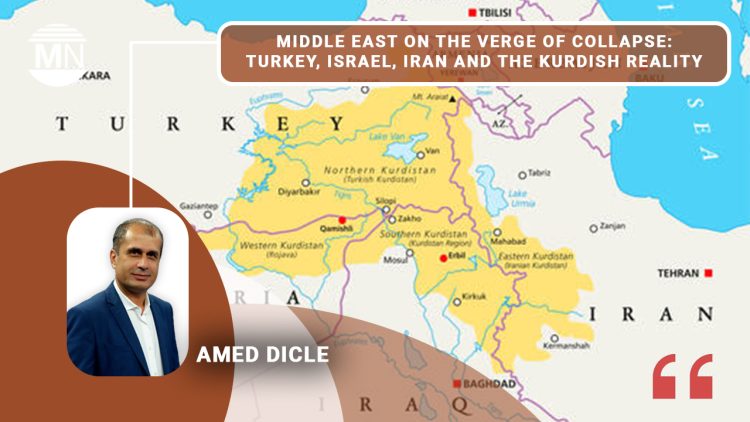
By Amed Dicle
The Middle East once again stands at the threshold of a period in which geographical borders as well as historical truths are being rewritten. The collapse of the Baathist regime in Syria, the attack on Iran’s regional influence, Israel’s expansionist security strategy and Turkey’s struggle with multi-faceted crises have initiated not only a war of balance between states, but also a new process in which the fate of so many peoples of the region is to be determined.
One fact that stands out in this great wave of restructuring is the following: The Kurdish people are no longer the passive subject of this geography, but its active constituent power. This position, which has been achieved through more than half a century of organised struggle, sacrifice and resistance, directly affects the strategies of not only Turkey but also Iran, Iraq, Syria, Israel and other regional states.
Concerning the tension in Israel-Turkey relations, the regional siege against Iran and the Kurdish gains in Syria have made the Kurdish issue not just an ‘ethnic problem’ but a central equation in the restructuring of the Middle East. This situation has shaken hegemonic calculations and demonstrated the need for alternative political visions. In this context, the political vision and the democratic society paradigm developed by Mr. Abdullah Öcalan offers an alternative perspective that should be taken into consideration not only for the Kurdish people but also for all the peoples of the region.
Israel-Turkey tensions: conflict over hegemony
Although relations between Turkey and Israel fluctuate on the surface with economic and diplomatic moves, the main contradiction is much more strategic: the struggle for hegemony over the future of the Middle East.
While Israel is expanding its military presence northward, particularly in the Golan Heights and the south of Syria, it is forging new alliances to break Iran’s regional influence and is trying to liquidate proxy forces in areas such as Lebanon, Yemen and Iraq. This strategy is based on a security doctrine directly supported by the US and the UK and positions Turkey as a limiting power.
Israel’s efforts to shape the security architecture of the region creates and will create direct tensions not only with Turkey but also with Iran. In fact, this issue will become more heated in the coming days.
Iran: besieged regime and forced confrontation with Kurds
Iran has taken an active position in many conflicts in the Middle East with its Shia-oriented expansion strategy. Today, however, both internal social discontent and the external siege have pushed the regime further into its defensive reflexes.
Israel and the US are now targeting not only Iran’s nuclear programme but also the entire Shiite influence stretching from Iraq to Yemen. Another strategic pillar of this siege is the peoples of Iran, especially the Kurds. The Iranian regime continues its repressive policies against the Kurdish people, as it does against the Baloch and Arab peoples within Iran. However, in this period of intensifying external pressure, the possibility of Iran developing more flexible policies in its relations with the Kurds of Rojhilat is growing stronger.
Turkey’s strategic squeeze: necessity of coming to terms with Kurdish issue
Turkey has been trying to consolidate its regional influence through its de facto occupation lines in northern Syria, its military presence in the Federal Kurdistan Region of Iraq and its military diplomacy along the Qatar-Somalia line. However, this expansionist strategy has ceased to be sustainable due to the resistance it has encountered on the ground, social and economic attrition at home, and isolation in foreign policy.
This situation is particularly embodied in Turkey’s perception of the Rojava Revolution as a threat. This perspective is a contemporary manifestation of the historical Kurd-phobia that is embedded in the mind of the state. This reflex prevents Ankara from responding to regional dynamics with rational and flexible policies and leads Turkey into a deepening strategic impasse.
Launched in 2015, the security strategy known as the ‘collapse plan’ aimed to liquidate the Kurdish freedom movement. However, this strategy failed in the face of Kurdish resistance. While the total cost of the last 40 years of war has exceeded four trillion dollars, Turkey has not only left the Kurdish issue unresolved, but has also deepened its own internal crisis.
All this obstruction shows that Turkey’s strategy of responding to the Kurdish issue by attempting to suppress it has reached its limits.
It is in the midst of this multifaceted deadlock that Mr. Abdullah Öcalan’s call on 27 February is historic in terms of both content and timing. By suggesting that the conflict be brought to the grounds of law and politics, Öcalan offered a vision of a solution beyond the armed dimension of the problem. This proposal is a strategic opportunity not only for Turkey but also for all states in the Middle East.
This call not only means the start of a new solution process, but also points to a line through which Turkey can overcome its political deadlock at home and its strategic isolation abroad. However, in order for this call to find an addressee, the isolation must first be lifted and Öcalan’s physical freedom must be ensured. This is not only an ethical but also a political and historical obligation. However, no concrete step has yet been taken in this regard.
Conclusion: Kurdish issue at the heart of regional transformation
The Middle East is in the midst of a great transformation, with borders dissolving on the one hand and regimes trying to be rebuilt on the other. The role of the Kurdish people in this transformation is no longer secondary, but decisive. The reality Turkey is facing is too deep and historical to be suppressed by the rhetoric of the ‘fight against terrorism’.
Therefore, the choice facing Ankara is more than a simple preference, it is a historical necessity: Either it will come to a solution, or it will disintegrate into non-solution. The organised power of the Kurdish people and the paradigm presented by Abdullah Öcalan continue to be the carrier ground for this solution. And this reality can no longer be overcome by denial, but only by confrontation.
Amed Dicle was born and raised in Diyarbakır, Turkey. He has worked for Kurdish-language media outlets in Europe, including Roj TV, Sterk TV and ANF. His work has taken him to Rojava, Syria, Iraq and many countries across Europe. Follow him on X (twitter).


