

Desmond Fernandes
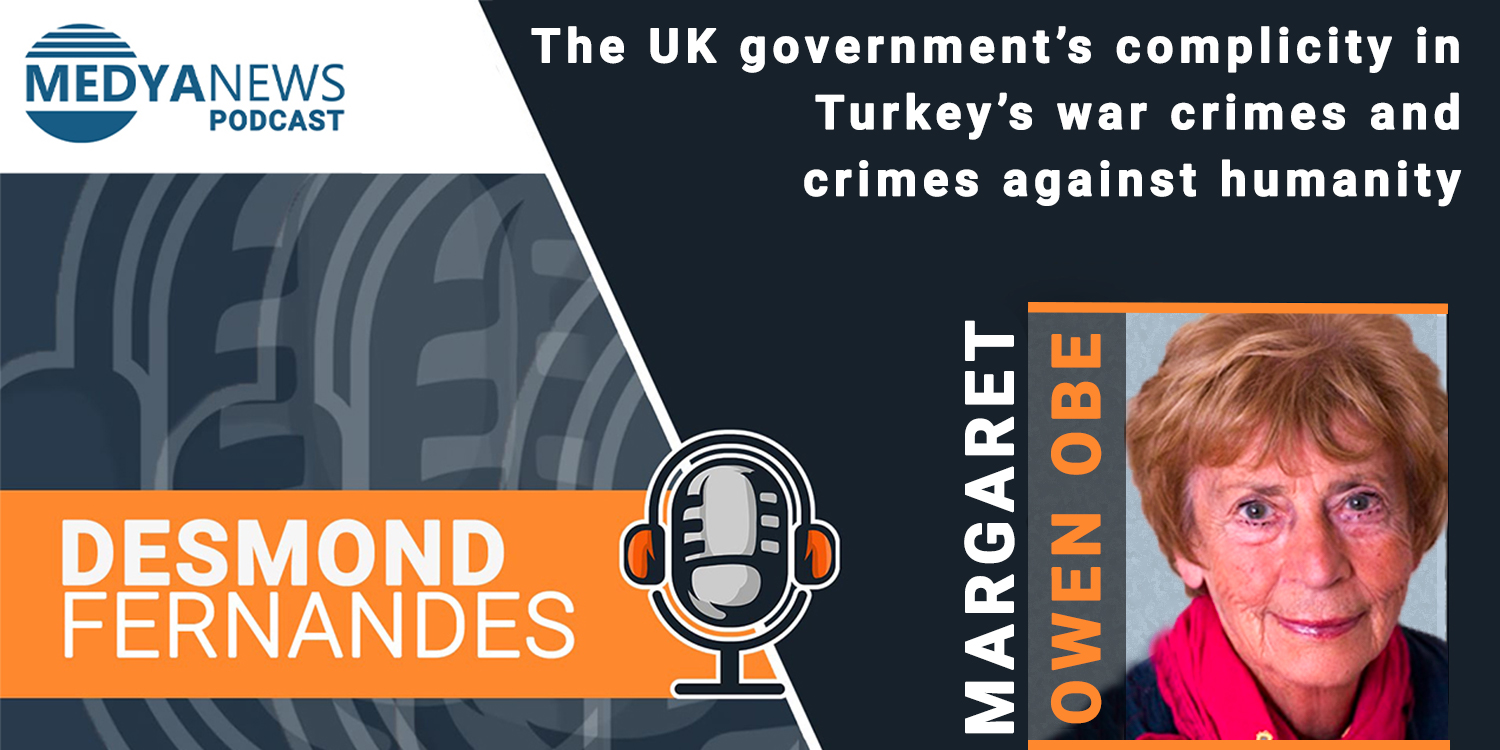
Margaret Owen is the director of Widows for Peace through Democracy (WPD). WPD works to make sure widows of all ages, irrespective of religion, class or nationality, are protected from discrimination and violence and can enjoy their full human rights. Margaret is also a patron of Peace in Kurdistan, a UK barrister and an international women’s human rights activist.
WPD has “ECOSOC status at the UN, which focuses on the human rights of widows and wives of the disappeared. She is also a founder member of GAPS-UK (Gender Action on Peace and Security) that addresses implementation of UNSCR 1325 and subsequent UNSCR gender-related issues in the Women, Peace and Security agenda.”
Margaret Owen had already, earlier this year, publicly questioned the nature of the UK government’s “arms sales and trade deals to racist, misogynist and authoritarian regimes, whose wars create unaccounted millions of widows of all ages, [and] violate the UN’s arms trade treaty.”
In a podcast interview with Medya News, she raised concerns about the UK government’s ‘special relationship’ with Turkey, which has seen it extend diplomatic support to the Turkish government whilst facilitating a significant arms trade with a state whose armed forces have been implicated in severe human rights violations – for example, in Iraqi Kurdistan (where they have been involved in cross-border military operations that have led to displacement of Kurdish villages, extensive deforestation and ecocide of some regions, and bombardment of Kurdish regions, where reports have even suggested that white phosphorus and chemical weapons might have been used).
Gökay Akbulut, a German politician and a social scientist currently serving as a member of the Bundestag for the Left Party (Die Linke), for example, recently indicated that the German Government even had knowledge concerning use of chemical weapons and asked whether the government also had any information on how Turkey could have been provided with such weapons.
Akbulut referred to various news articles in the media including Yeni Özgür Politika, Mezopotamya News Agency (a report on symptoms seen in 548 individuals from the Kanî Masî village within a month) and Medya News (reporting on the images of green gas).
Less than three weeks ago, “the Christian Peacemaker Teams (CPT) also published an update on the impact of Turkey’s military operation ‘Claw-Lightning’ in Iraqi Kurdistan, with a significant note referring to reports suggesting that chemical weapons or white phosphorus had been used by Turkey in an attack targeting farmland on 4 September.”
“The Co-Presidency of the KCK (Kurdistan Communities Union) Executive Council” has also “published a statement criticising the international silence in the face of the continuous use of chemical weapons by the Turkish state against the guerrilla forces in South Kurdistan.”
“On behalf of the KCK Foreign Relations Committee, Roni Serdem” recently “sent a letter to the representatives of many countries, including the US, Germany, France, Canada, England, the Netherlands and Russia, and to the EU representative office in Hewlêr, to the UN Secretary General Antonio Guterres, the Arab League, the political parties in the region and the Organisation for the Prohibition of Chemical Weapons (OPCW) about Turkey’s use of chemical weapons. (…)
“The letter says: ‘With this letter, we would like to draw your attention to an urgent issue: the use of chemical weapons by Turkey. The use of these weapons, which are banned by your institution, is clearly in violation of OPCW standards, norms and agreements.’ The letter draws attention to ‘Turkey`s use of white phosphorus during its occupation attack on the North Syrian city of Serekaniye in October 2019,” noting that “as a result of this silence of the international community” – inclusive of the UK government – “and the OPCW, Turkey has been encouraged to use chemical weapons against the Kurdish resistance forces HPG (People`s Defence Forces) and civilians in South Kurdistan since 23 April 2021.”
The KCK Foreign Relations Committee added: “Since the beginning of the Turkish invasion into South Kurdistan, (…) the Turkish army has been using chemical weapons systematically to annihilate the guerrilla forces and force the civilian population out of their homes. Despite this reality, not a single state or responsible international organisation has taken action so far (…) due to Turkey being their partner. For this reason, the many crimes committed by Turkey have so far been ignored and no action has been taken against the country. (…) The AKP-MHP (Justice and Development Party – Nationalist Movement Party) government has committed an endless number of crimes against humanity and war crimes, such as the use of chemical weapons.”
The Turkish state has also been involved in cross-border military operations in Syria and supported militias that have been accused of war crimes, crimes against humanity and forced displacements of Kurdish and ‘Othered’ populations. In a report covering the first half of last year, alongside concerns raised from several human rights organisations and the Autonomous Administration of North and East Syria (AANES), also known as Rojava, the UN Commission of Inquiry on Syria had also concluded that, “In Afrin, Ras al-Ain and the surrounding areas, the Turkey-backed Syrian National Army may have committed the war crimes of hostage-taking, cruel treatment, torture and rape.”
Gregory H. Stanton from Genocide Watch, which exists to predict, prevent, stop, and punish genocide and other forms of mass murder, emphatically concluded last year that “Turkey is committing war crimes and crimes against humanity in Syria. In areas under Turkey’s control, civilians have been subjected to horrific crimes against humanity committed by Turkish forces and Turkish supported militias. Kurdish towns have been bombed and destroyed, some with white phosphorus, a war crime.
“Hundreds of civilians have been summarily executed. Kurdish and Yazidi women have been kidnapped and subjected to sexual slavery. Secret prisons hold hundreds of Kurds who are routinely tortured.
“Massive amounts of property have been expropriated and turned over to thousands of Syrian Arab refugees, resettled from Turkey. Many Christians and Yazidis have fled to Europe or Iraqi Kurdistan. Turkey is forcing the displacement of hundreds of thousands of civilians from their homes. Turkey is perpetrating the full ethnic, religious, and demographic destruction of northern Syria.
“Forced population transfers are war crimes under Articles 8 (2)(a)(vii)-1 and 8 (2)(b)(x)-1 of the Statute of the International Criminal Court. They are also crimes against humanity under Article 7 (1) (d) of the ICC Statute. They are crimes of universal jurisdiction in most of Western Europe. Torture and genocide are also crimes of universal jurisdiction in the US, Australia, New Zealand and Senegal. Perpetrators of these crimes could be arrested and tried if they ever set foot in countries with universal jurisdiction.”
The Sunday Times: ‘Concerns … over Britain’s sales of phosphorus products to Turkey’
In October 2019, The Sunday Times reported that “concerns” had been raised over “Britain’s sales of phosphorus products to Turkey, amid evidence the incendiary chemical has been used against Kurds in northeast Syria. Ministers have issued more than 70 export licenses for military products that can contain phosphorus to Ankara in the past two decades, The Times understands.”
In the same month, it again reported that “the terrible wounds that had all but flayed the 13-year-old Mohammed Hamid Mohammed’s skin from his torso, penetrating deep into his flesh, suggested his injuries were caused by something far worse than blast alone. They added to the growing body of evidence that suggests Turkey, a NATO member, is using white phosphorus against Kurdish civilians in its eight-day offensive into northern Syria.”
Turkey’s armed forces have also been involved in ongoing human rights violations and ecocidal actions in Turkey. As judges noted in a Turkey Tribunal, a civil society-led international tribunal that was held last month, “the torture and abductions perpetrated by Turkish state officials since July 2016 could amount to crimes against humanity in an application lodged with an appropriate international body. (…) The tribunal, set up under the initiative of Belgian-based law firm Van Steenbrugge Advocaten (VSA), met in Geneva between 21-25 September.
“Presiding judge Françoise Barones Tulkens stated that the opinion was not legally binding but may serve as a source, with moral authority, for raising awareness. Tulkens said the tribunal received credible accounts of torture, adding that the abduction cases before the judges amounted to enforced disappearances.”
Elsewhere, in relation to the recent Nagorno-Karabakh conflict, David L. Phillips, Director of the Programme on Peace-building and Rights at the Institute for the Study of Human Rights at Columbia University, has asserted that “human rights abuses and violations of international humanitarian law were widespread after Artsakh was attacked. Mercenaries and jihadis were deployed from Syria and Libya under Turkey’s command.
“These perpetrators were responsible for horrific crimes, which are ongoing despite the ceasefire agreement. Columbia University’s Artsakh Atrocities Project has been documenting events. We hope that the information we’ve compiled can be used to hold Turkey and its cohorts accountable for its wanton abuse of civilians, including women and children, as well as cultural crimes.”
Owen: Turkey is ‘conducting a genocide against the Kurds’
As Margaret Owen noted in her podcast interview with Medya News, “We have, since 2005, an international arms treaty in which over 153 UN members agreed that they would not sell arms to regimes that violated human rights.” Turkey is clearly violating human rights in an extreme fashion and yet the UK government continues to promote an arms trade with it and extend extensive diplomatic support to it.
Turkey is “conducting a genocide against the Kurds. And when it entered Syria, supported by NATO, that is questionable as Turkey was not being attacked by Syria. It went in rhetorically to fight ISIS. But, in fact, it went in to attack the Kurds. And there is much evidence of how it was actually supporting jihadist militias including ISIS.”
And “just in the last few weeks, we hear that Turkey, not only in Syria but in northern Iraq, is using chemical weapons, and is attacking Sinjar, the homeland of the Yazidis. (…) It is attacking schools and hospitals, the Maxmur refugee camp, home to 12,000 Kurdish refugees.”
And yet, despite this, noted Owen, Turkey remains “one of the UK’s greatest allies. Extraordinary, with all the evidence of what Turkey has been doing both in southeast Turkey/northern Kurdistan, in Southern [Iraqi] Kurdistan (…) and in Syria, in violation of international law. Turkey is not even on the list of ‘countries of concern’ that the Foreign Office keeps. As for the arms trade, ever since Brexit, this government is keen to go anywhere to find countries that we can sign trade deals with and sell arms to.”

Owen: ‘Turkey is not’ on the ‘lists of concerns’ in the UK Ministry of Defence
Owen added: “We, along with the US, are two of the biggest sellers of arms to Turkey. And yet, in the Ministry of Defence, which also has a committee to monitor and identify regimes that we should not be selling arms to – I think there are hardly any women on these committees – somehow, Turkey is not on their list of concerns.”
She added: “When I think about what Turkey is doing in Syria, it is attacking Rojava, that is the Autonomous Administration of North and East Syria (AANES), which is home to the most miraculous, unique, extraordinary women’s liberation movement – the Kurdish women’s liberation movement which is a model for, I think, every country in the world, including our country, because it puts women’s empowerment and gender equality absolutely central.”
Yet, strengthened and empowered by its arms trade with countries like the US and UK, and the silence of the ‘international community’ – inclusive of the UK government – regarding Turkey’s extensive human rights violations, war crimes and crimes against humanity, Owen notes that Rojava – the centre of this “most miraculous, unique, extraordinary women’s liberation movement” – “is exactly where Turkey is attacking and the UK government is silent.
“It is unbelievable that we should be supporting” a government “which is so overtly misogynist, which is cracking down in Turkey on women’s NGOs, which is imprisoning women lawyers, women journalists, women’s rights organisations and we are silent even when it is going into northern Iraq.”
In this regard, she also pointed to the UK government’s support of, and arms trading links with, the repressive Saudi Arabian regime, that has extended to even placing UK ‘boots on the ground’ in Yemen, where the UK is complicit in the crimes consequently taking place there: “We now know that the British are with Saudi Arabia, even in Yemen, where women are being raped, killed, made homeless and yet we have British troops in Yemen near the airport – where parliament was lied to when it asked if we had British troops in Yemen.”
The nature of the UK arms trade, surveillance and diplomatic support for the Turkish government
In the podcast, Owen noted how she found it “extraordinary that we continue to support a country like Turkey which is conducting such massive war crimes and crimes against humanity on such a massive scale not just in Turkey but in Syria and in Cyprus and in northern Iraq, also in Libya.” Such support was being extended at a time when those being targeted by the repressive Turkish state should be supported.
“We should be supporting Rojava,” she stated. “We should be supporting the Kurds in their call for self-determination. We should be stopping doing Turkey’s dirty work” even “in this country,” she took pains to point out. “You know, in this country, we also persecute and harass Kurdish activists here. And people who have gone to Syria to fight, to support the People’s Protection Units (YPG) and the Women’s Protection Units (YPJ). When they come back, they are also prosecuted, charged with supporting ‘terrorist organisations.’”
The criminalisation, covert monitoring and surveillance of the Kurdish diaspora in the UK as a consequence of the ‘special relationship’ the British establishment has with the Turkish state (combined with their NATO ‘relationship’) is a scandalous issue in itself, as I have documented at length elsewhere (most recently in the ‘Routledge Handbook on the Kurds’) and as Mark Campbell in Medya News examined in a recent podcast.
But the nature of surveillance and targeting of the Kurdish researcher and academic Dilar Dirik under ‘Prevent’ is instructive in the sense that it reveals the extent to which even academic and educational British institutions are being ‘obliged,’ significantly because of this NATO and ‘special relationship’ with Turkey (where Turkey has been keen to get its allies to criminalise the Kurdistan Workers’ Party, the PKK) to legally (and often covertly) monitor and report on ‘academic/activist’ Kurds in the UK within a ‘counter-terrorism’ strategic framework and extend covert surveillance over even academic discussions about Rojava and state repression of Kurds (by Turkey and other states and non-state entities) and women’s liberation issues when intertwined in the above context.
As the UK government clarifies, “the Prevent strategy, published by the Government, (…) is part of our overall counter-terrorism strategy, CONTEST. The aim of the Prevent strategy is to reduce the threat to the UK from terrorism by stopping people becoming terrorists or supporting terrorism. (…) In fulfilling the duty in section 26 of the Act, we expect all specified authorities to participate fully in work to prevent people from being drawn into terrorism.”
 Currently the Joyce Pearce Junior Research Fellow at Lady Margaret Hall, University of Oxford (a post held in conjunction with the Refugee Studies Centre), Dirik is internationally renowned for her research work into Kurdish revolutionary women’s struggles, feminicide, the Rojavan revolution, freedom concepts and radical democracy in Kurdistan. She is the author of ‘The Kurdish Women’s Movement: History, Theory, Practice’ (shortly to be published by Pluto Press) and has written the book chapters ‘Only with you this broom will fly: Rojava, magic, and sweeping away the state inside of us,’ ‘Overcoming the Nation-State: Women’s Autonomy and Radical Democracy in Kurdistan’ and ‘The Revolution of Smiling Women: Stateless Democracy and Power in Rojava.’
When completing her PhD at the University of Cambridge, she co-organised a panel for the Cambridge Kurdish Society on Kurdish political struggles at St. John’s College at the university in November 2016. As Varsity reported: “Barzan Sadiq and Dilar Dirik, who organised the event, told Varsity that they had not been aware of its referral through the Prevent process prior to being contacted as part of this investigation. What they described of their experience, however, appeared remarkably similar to how a Palestinian Society event was handled by the University one year later.
“Shortly before the event was due to take place, they were told that Dirik, whom they planned to co-chair the panel, could not do so because she was judged not to be a ‘neutral person who can fairly chair the session’ after checking her ‘speeches and texts online.’ Though they eventually managed to negotiate Dirik’s presence on the panel in order to assist an external speaker with English, she was not permitted to contribute to the discussion herself. A University proctor also sat in on the event ‘to observe that freedom of expression [was] guaranteed’” – clearly, as long as freedom of expression was not granted to Dilar Dirik – “although no reasons were given as to why this was deemed necessary.
“They described the measure as ‘a very petty form of harassment and a blatant case of Orwellian politics,’ and drew links to the ‘criminalisation of the Kurdish freedom movement’ by European governments. They added: ‘It is absolutely shocking, distressing and also frustrating to see that we have been subjected to this controversial process, especially in such an opaque and secretive manner, without any explanation, justification or information. It says a lot about the scheme that we were not even aware that we were subjected to it.’
“Issuing a ‘demand [for] transparency, explanation and an apology from St. John’s College and the University,’ they also alleged that the University was not applying its Prevent duty fairly: ‘It is not surprising that this scheme is targeting vulnerable communities such as Muslims in times of Islamophobia, or Kurds in the context of massive genocidal attacks in the region.’”
Alongside Margaret Owen and several human rights campaigners and organisations, the Campaign Against the Arms Trade (CAAT) has also criticised the UK government’s stance. The UK government has also been criticised from several quarters for not decriminalising the Kurdistan Workers’ Party (PKK) and for not attempting to promote a peace process between the Turkish government and the PKK. Such a peace process, however, would threaten the profits to be made from the ‘arms trade’ that the British government seeks to promote with Turkey, particularly post-Brexit, at all cost.
With regard to the UK government’s recent security, defence and foreign policy review, Margaret Owen noted in the Guardian this March that “austerity cuts, Brexit, the reduction in our foreign aid, and our arms sales to authoritarian and misogynist regimes have irrevocable impacts on women and girls worldwide. But there is far too little reference in this review to women, peace and security concerns, despite brief mentions of girls’ education and the UK’s work with the African Union.
“The reality,” she noted, “is that we support or engage in armed conflicts, and our refusal to condemn states that target women for rape, murder and bereavement is shameful, so there is also hypocrisy in the review. Who on earth do we think we are? No longer in Europe, we have lost our moral compass, and we used to lead the world on women’s empowerment and gender equality.”
Regarding the UK’s ‘special relationship’ with Turkey, despite its armed forces and government being accused of perpetrating war crimes and crimes against humanity, TRT World in March this year reported that “the recently published UK defence review singles out Turkey as one of the important pillars of Britain’s global strategic vision. (…) The document by the country’s Minister of Defence follows [the] Integrated Review of Security, Defence, Development and Foreign Policy, which outlined Britain’s priorities following Brexit in the years to come.
“In the document, the UK Ministry of Defence states that Turkey is a ‘crucial NATO ally’ essential to regional security. After the US, Turkey has the largest standing army in NATO. (…) The UK government sees Turkey” – rather than a state perpetrating ‘state terrorism,’ war crimes and crimes against humanity nationally and internationally – “as playing a role ‘in many aspects of wider regional security, including the fight against terrorism.’”
Regarding Turkey, TRT World quotes the UK Ministry of Defence stating, “‘We will work” with Turkey “to cement a long-term relationship on operations (including NATO reassurance measures), capabilities and industrial co-operation.’ The review underscores the importance the UK places on Turkey to provide security for the wider alliance and ensure that emerging security challenges can be tackled together.
“Turkey will likely see the report as a confirmation,” TRT World reported, “of the unique relationship between the two countries that, while present before Brexit, has taken on even more importance after the UK’s departure from the European Union.”
In January this year, Sir Dominick Chilcott, British Ambassador to Turkey, “recalling that Turkey and the UK are both NATO members,” asserted that “defence cooperation and defence industry cooperation are important components of the bilateral relationship. ‘In the defence industry sector, there is no doubt that the collaboration on the TF-X fighter project is an extremely important project. The UK is very committed to work with Turkey in the defence sector and pursue our defence industry sectors,’ he stated.”
The Campaign Against the Arms Trade (CAAT) noted in an update in June this year that “Turkey is a major customer for UK arms, which have supported its repressive regime and brutal war against the Kurds. The UK has approved £1.3 billion worth of arms sales to Turkey since 2013. UK arms companies helped Turkey develop armed drones, and BAE Systems is helping Turkey develop its own fighter aircraft.
“Since the failed coup in July 2016, and the crackdown against opposition groups that followed, the UK has approved permanent, Single Individual Export Licences (SIELs) export licences worth £806 million for arms exports to Turkey. Since the outbreak of the protests in May 2013, the figure rises to £1.3 billion.
“In addition, 114 Open Individual Export Licences (OIELs) were issued for exports to Turkey, allowing for unlimited deliveries of the equipment specified in the licence. Turkey remains a ‘priority market’ for the UK government’s arms export unit.”
Indeed, CAAT confirms that “most UK exports of equipment for the A400M, the F35, and the TF-X programmes are covered by Open General Export Licences (OGELs), which are even more expansive than OIELs, allowing the licence-free export of a wide range of equipment, specified in each licence, to countries listed in the licence. OGELs are valid indefinitely, until revoked.
“Therefore, it is likely that a large proportion, and possibly a majority, of UK arms exports to Turkey are not revealed in the available data on arms exports to Turkey, including the figures discussed above.”
The British government continues to support an arms trade with Turkey, as part of this ‘special relationship’ and in the post-Brexit period, despite being fully aware that, as CAAT confirms, “in recent years, Turkey has become a major player in the production and use of unarmed aerial vehicles (UAVs, or drones), including armed drones. Turkey has deployed” many of these “armed drones extensively in its wars against the Kurds, as well as its intervention in the civil war in Libya.
“Research in 2019 by Ceri Gibbons, an activist with Brighton Against the Arms Trade revealed how Turkey’s development of armed drones was helped by the supply of technology and components from Brighton-based arms company EDO MBM, now a subsidiary of US company L3Harris.” And despite the fact that, “in October 2019, following the Turkish offensive in Rojava in northern Syria, the UK government announced a halt to new export licences for arms sales to Turkey. However, existing export licences remain valid for use.”
As the Campaign Against the Arms Trade noted with considerable concern, “Turkey severely represses its Kurdish minority. (…) Turkish military assaults on the Kurdish-majority Rojava autonomous region of northern Syria have killed hundreds of civilians and displaced hundreds of thousands.”
Yet, in April this year, “Defence Secretary Ben Wallace (…) hosted Turkish Defence Minister Hulusi Akar on board the UK’s aircraft carrier HMS Prince of Wales.” Akar “was welcomed to the UK with a Guard of Honour from the Coldstream Guards at Horse Guards Parade, ahead of a bilateral meeting at the Ministry of Defence.”
Owen on Erdoğan: ‘Here we have a war criminal, who should be prosecuted at the ICC’
Margaret Owen, in commenting on the UK government’s ‘special relationship’ with Turkey and its government, concluded by saying, “Our silence is shameful, we should be leading the world in stopping all arms manufacture and arms trade to countries like this.
“About five years ago, President Erdoğan was invited to 10 Downing Street and then he was invited to have tea with the Queen. (…) There we are, Erdoğan was treated as though he was a real celebrity: he was honoured with a visit to Downing Street and tea with the Queen. Here we have a war criminal, who should be prosecuted at the International Criminal Court (ICC) for crimes against humanity, and what we should be doing is looking at what is happening in Syria.”
Yet, President Erdoğan was treated to tea with the Queen even as the UK government ostensibly states that “it is UK Government policy that the United Kingdom should not provide a safe haven for war criminals or those who commit other serious violations of international law. We are committed to ending impunity for such crimes, and will encourage action to be taken to bring such individuals to justice wherever possible.”
“After all,” noted Margaret Owen, “it was the YPG and the YPJ – those defence forces of the Kurds – that were the only local troops on the ground fighting ISIS [at the key time]. We allowed Turkey to come in to take Idlib, to take Afrin. (…) They were using ethnic cleansing, they were supporting ISIS: thousands of Kurds had to flee, flee Afrin that was Kurdish, and many of them are now internally displaced persons (IDPs) or in refugee camps. (…) And we are silent.
“Why are we silent? Because Brexit is the problem. Brexit is the cause, I think, that we are no longer interested in this country in human rights. (…) Now what matters is trade and arms sales and this government doesn’t care about human rights at all, and it certainly doesn’t care about women’s rights.”
Margaret concluded by saying: “In Turkey, there are so many women now in prison, women who were MPs, women who were co-chairs, mayors, lawyers, journalists. (…) And when women are in prison, (…) they can be tortured in all sorts of other ways, (…) and these are things that are going on in Turkey’s prisons all the time. (…) And we’re going to see many more deaths [in prison], of men as well. Women on hunger strike seem to be even more vulnerable than men. (…) So it is extraordinary that we continue to support Turkey. (…)
“We have to keep speaking up. (…) Our silence over these arms sales makes us, the UK government, complicit in war crimes and crimes against humanity, so it’s important that we keep up the struggle and we keep up speaking and asking our government to change its policy.
“But I don’t think it is going to happen very quickly, now that we have Liz Truss as our Foreign Secretary, who clearly doesn’t seem to have a concern at all, even though she is also the Minister for Women and Inequalities. She doesn’t seem to address or show any concern for the injustices in our policies.”
*Desmond Fernandes is a former Senior Lecturer in Human Geography at De Montfort University and the author of ‘The Targeting and Criminalisation of Kurdish Asylum Seekers and Refugee Communities in the UK and Germany’ (2001) and ‘The Kurdish and Armenian Genocides: from Censorship and Denial to Recognition?’ (2007, 2013 – Turkish edition). He has written a number of articles and book chapters focusing upon the criminalisation of the Kurdish diaspora in the UK, Germany and the EU, most recently for ‘The Kurdish Question’ and for the ‘Routledge Handbook on the Kurds’ (2019).


