

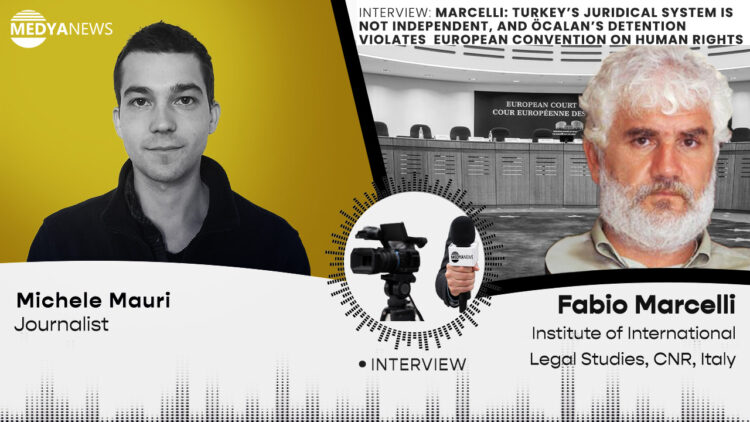
Marcelli: Turkey’s judicial system not independent, Öcalan’s detention violates ECHR
🔷International law expert Fabio Marcelli talks to Medya News: Turkey’s legal system is not independent, Öcalan’s detention violates the European Convention on Human Rights. Follow link for… pic.twitter.com/T05LW8h9sg
— MedyaNews (@medyanews_) November 22, 2024
International law expert Fabio Marcelli spoke to Medya News about the lack of judicial transparency in Turkey and the isolation of Kurdistan Workers’ Party (PKK) leader Abdullah Öcalan, addressing the need for the European Court of Human Rights (ECtHR) to re-examine Öcalan’s case. Marcelli also offered a positive outlook for Turkey’s future if it embraces the path of democratisation.
Marcelli is director of the Institute for International Legal Studies (ISGI) at the National Research Council (CNR) in Italy and also a member of the Centre for Research and Elaboration for Democracy (CRED). He and his research team have visited Turkey several times as international observers to follow the trials of politicians and journalists.
Commenting on the Turkish legal system, Marcelli said that the judiciary lacks independence, because there is direct control of judges by those with political power. “It cannot be considered a system in which the rule of law operates,” he said.
When asked about Öcalan’s case, Marcelli commented on the imposition of a new three-month ban on contact with family, following a short visit from his nephew last month. He said that, although the circumstances of the ban were not clear, “it seems to be a blatant contradiction within the Turkish legal and political system”.
Marcelli, focusing on the PKK leader’s isolation, noted that a 2014 ruling by the European Court of Justice (ECJ) found Öcalan’s detention, at least until 17 November 2009, to violate Article 3 of the European Convention on Human Rights (ECHR). “If there is solitary confinement, as I believe there is, then there is a violation and Turkey should take a different line in this regard,” Marcelli said.
He also expressed hope that a fresh appeal to the ECtHR on Öcalan’s case will lead to a new decision, to “improve the conditions of Mr Öcalan’s detention and make them compatible with the ECHR, in particular Article 3”.
The international law expert then referred to violations of international humanitarian law during the Turkish states ongoing wars. Faced with the “catastrophic situation”, he recommended that states and alliances of states jointly exert pressure by calling for the “re-establishment of an international order based on law”. Marcelli added, “I think that international pressure […] should be exerted on a combined legal and political level.”
Marcelli concluded his interview by offering his perspective on the future of Turkey. He described it as a country that should take “another path”, leaving behind “repression, human rights violations and internal war” and turning towards “mutual recognition of the rights of the different parts of the Turkish population”, including civil society organisations, professionals and trade unionists.
Marcelli called for every effort to be made to solve the problems of democracy, repression and the Kurdish question, to “pave the way for a new Turkey”.
Read the full interview transcript below, or watch it here.
Medya News: Welcome Fabio Marcelli, thanks for taking part in our interview with Medya News, let’s go with the first question, you had contact with the Asrin law office and other law NGOs in Turkey, based on your experience and based on those contacts, how would you evaluate the current state of legal protection in Turkey, particularly concerning prisoners’ rights and freedom of the press?
Fabio Marcelli: Yes, I had many experiences in the Turkish legal systems, me and my colleagues of our association, the Centre of Research and Elaboration for Democracy (CRED), had the opportunity to visit Turkey on many occasions and to observe trials as international observers. We observed the trials against the lawyers, the trials against some politicians, especially members of the party, which at the time was the HDP party [the now obsolete pro-Kurdish Peoples’ Democratic Party] – now I think the name has changed [HDP’s successor is the Peoples’ Equality and Democracy Party].
We observed trials for the murder of lawyers, like the trial in Diyarbakir [Amed] for the killing of the president of the Diyarbakir Bar Association, Tahir Elçi, so we have a record, a considerable record of experiences concerning the Turkish legal system. And of course our evaluation is very negative, because we think that the Turkish legal system, and in particular the Turkish judicial system, lacks independence.
There is direct control by the political power on judges, because judges can be changed whimsically by the political power in every occasion, so they don’t have a real power to decide following the norms to be applied. So it lacks this essential feature of independence of the judiciary, and of course for this reason it cannot be considered as a system where rule of law operates.
Moreover there are other aspects which concern the possibility to also judicialize freedom of expression. There is a strict control on freedom of expression which should be following the United Nations Covenant on Civil and Political Rights, a fundamental element of all legal system, and Turkey of course decided to enter in this covenant of 1966 on civil and political rights, as well in the European Convention for Human Rights and Fundamental Freedoms, and other international treaties concerning human rights, and in particular the freedom of expression, which are constantly misattended by the Turkish authorities which judicialize people only for expressing their opinion, and this is a violation of international law of course.
Thank you very much for your answer, let’s go on with the second question. A new three-month disciplinary sanction was imposed on Abdullah Öcalan following a recent prison visit from his nephew Omer Öcalan, who is also a DEM Party member of the Turkish parliament. This visit was the first visit to happen since March 2020. The solitary confinement imposed on the PKK leader is incompatible with Turkey’s law. How do you assess this illegality?
Well, I have to say that this situation is completely new to me.
I didn’t know that this three-month disciplinary sanction was imposed on Öcalan following the visit by his nephew, and I find it very strange and puzzling because I suppose this visit was authorised by the Turkish authorities, otherwise it would have been impossible for the nephew of Öcalan to reach İmralı [the high-security prison island where Öcalan has been detained since 1999] and to have the meeting with his uncle. So I wonder why this sanction was imposed, clearly illegal sanction. In my view it could be, I don’t know, I would have to assess more precisely the circumstances of the case, but it appears to be a blatant contradiction inside the Turkish legal and political system.
This is to say that there are divergent views inside the government, inside the political parties which oppose the government of Mr. Erdoğan [Turkish President] and so on. There are different views on the relationship with Mr. Öcalan, and therefore there are these kind of strange attitudes. I repeat, it’s very strange.
I don’t know very much on this case, but it seems absolutely unbelievable that a visit is allowed and after the prisoner is imposed a disciplinary sanction because of the visit. It seems to be a completely schizophrenic attitude by the Turkish state. We should understand better why there is such a schizophrenic attitude.
Thank you very much. Let’s go on now with the third question. In a recent interview you addressed the conditions of Öcalan’s detention and said that a new appeal to the ECHR, the European Court of Human Rights, is necessary in Ocalan’s case. Recently the Council of Europe requested Turkey to reform in its law on life imprisonment and implement the right of hope, giving a deadline of one year for legislative amendments. Do you think that the increased pressure on Turkey could lead to results concerning the rights of prisoners and Öcalan’s isolation?
Yes, we hope that a new decision of the European Court of Justice will contribute to improve the situation. On the other hand, I think that this decision is necessary because if you refer to the decision adopted in 2014 by the European Court of Justice, this decision said that there had been a violation of the European Convention on Human Rights, Article 3, prohibition of human or degrading treatment as to the conditions of Mr. Öcalan’s detention up to 17 November 2009, and that there had not been a violation of this article as regards the condition of his detention during the period subsequent to 17 November 2009.
So far, I know the conditions now are rather similar to those existing before 17 November 2009, so there were many steps back, especially concerning the fundamental issue in this case, which is the issue of solitary confinement, which is caused also by the case of the recent visit of the nephew about which we have now talked. So these conditions should be newly accessed in the light of the present situation to verify if there is a violation of Article 3.
I repeat, substantially the issue in discussion is the issue of solitary confinement, which, following the jurisprudence of the court, is in violation of Article 3. If there is solitary confinement, as I think there is, there is a violation and Turkey should adopt a different line to this regard. So we hope that this new decision of the court to be requested through an appeal will change the situation and will improve the condition of detention of Mr. Öcalan, rendering them compatible with the European Convention on Human Rights, especially its Article 3.
Thank you very much for this answer. Let’s go on to question number four. We can see in conflict zones around the world that human rights are rapidly being eroded and international laws of war violated. Israel’s war in Gaza and the Turkish army’s use of chemical weapons against Kurdish guerrillas are two examples. Although the violations are deemed illegal according to international humanitarian law, they continue. Juridical pressure is important, but what other activism would enforce court decision and respect of human rights?
Yes, of course, we are facing now a catastrophic situation in many places of the earth. Probably the worst situation of the genocide of the Palestinian people, which is being executed by the Israeli government of [President] Netanyahu.
But there are also other cases of violation of the law of war, violation of international humanitarian law. I think that every effort should be made in order to change the situation, to restore the application of international humanitarian law. I think that an important role could be played in this situation by international alliances of different states.
For instance, there is now the coalition of BRICS, to which also Turkey is a candidate, which adopted recently a very important declaration in its meeting at Kazan a couple of weeks ago, in which they attribute importance also to this kind of question concerning international humanitarian law and human rights.
I think that the pressure should also be exerted politically, asking all the states and states coalitions which are interested in re-establishing an international order based on law to demand by United Nations and by the states which are violating these laws to adopt a different attitude. I think international pressure is very important, it should be exerted combined at legal and political level.
And of course also movements of opinion and so on have a great importance if they are able to stimulate such positions by the states.
Thank you very much. In order to close our interview, I would ask if you have a final message, topic or statement that you would like to leave.
Yes, I have been following the situation in Turkey for a long time, referring to the problem of democratic forces, to the repression of lawyers, to the Kurdish questions and many other aspects. I think that Turkey could offer us today an example of a country wishing to take another path, which is not a path of repression, it’s not a path of violation of human rights, it’s not a path of internal war, civil war, but it’s the path of dialogue, peace and mutual recognition of the rights of the different parts of the Turkish population, of the different organisations and of the very important role played by professionals like lawyers, but also for instance physicians, intellectuals, academics, trade unionists and other sectors of the society. So I think every effort should be made in order to give a solution to this very important and very old question in order to pave the way for a new Turkey, which will be an example also for many other countries in the world.


