

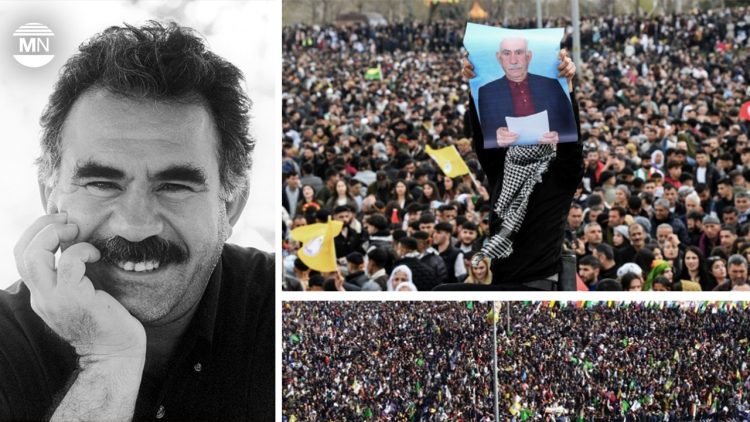
A majority of respondents in a new survey conducted by the Sosyo Politik Field Research Centre said that jailed Kurdish leader Abdullah Öcalan should play a central role in resolving Turkey’s Kurdish question. The survey, carried out from 22–26 March across 16 predominantly Kurdish provinces, asked 1,509 participants about Öcalan’s 27 February call for ‘Peace and Democratic Society’. It found that 54.6% of respondents viewed the call positively, while 42.5% said that, if freed, Öcalan could contribute to building peace in the country.
Öcalan, founder of the Kurdistan Workers’ Party (PKK), has been held in isolation since 1999 by Turkish authorities on the high-security prison island of İmralı. Despite a communication ban, a message was relayed on 27 February through intermediaries, calling for the PKK to disarm in pursuit of political reconciliation with the Turkish state. The poll, conducted across areas such as Diyarbakır (Amed), Şanlıurfa (Riha), Gaziantep (Dîlok), Van (Wan), Mardin (Mêrdîn), and Batman (Êlih), reveals growing interest in a renewed peace process, a decade after the previous initiative collapsed in 2015.
When asked about key reforms for lasting peace, respondents overwhelmingly supported a series of legal changes. These included the recognition of the ‘right to hope’ – legislation seen as crucial to securing Öcalan’s release after 26 years of imprisonment (68.9%); the release of seriously ill prisoners within the wider judicial system (68.5%); an end to politically motivated trustee appointments in municipalities (71.2%); and the repeal of Turkey’s anti-terror law (60.4%).
Despite strong support for peace initiatives, 62.3% of respondents still listed economic crisis and unemployment as the country’s biggest problems, followed by the Kurdish issue (23.7%).
Public trust in state institutions also remains low. Just 6.2% expressed confidence in the justice system, and over 75% rated freedom of expression and press in Turkey as ‘poor’ – a view also shared by more than half of ruling Justice and Development Party (AKP) voters.
The research also tracked political trends in the southeast region since the May 2023 general elections. Support for the pro-Kurdish Peoples’ Equality and Democracy (DEM) Party rose to 51.2%, up 1.9 points, while the AKP lost 9.5 points, dropping to 15.7%.
The survey comes amid ongoing police operations targeting opposition municipalities and civil society organisations. Over 60% of respondents said these operations would negatively impact any future peace efforts, reflecting growing scepticism about the government’s handling of dissent.
The findings signal a rising public demand for inclusive dialogue and a peaceful political solution, with Öcalan’s role once again at the heart of public debate.


