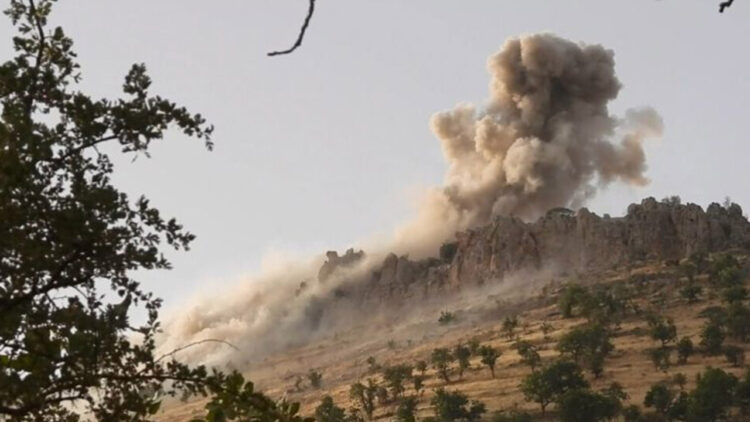
A Turkish bombardment on the Metina (Metîna) mountain range and the surrounding areas of Goharza village in the Amedi (Amêdî) region of Dohuk (Dihok) province resulted in substantial damage to civilian property on 22 July. Reports confirm that the attacks have caused extensive harm to local infrastructure and homes.
Over the past 37 days, Turkish forces have maintained a military presence in Dohuk province, particularly in areas controlled by the Kurdistan Democratic Party (KDP). Hundreds of soldiers and tanks have been deployed, escalating military activities and intensifying assaults on residential areas and villages, according to local resources.
Despite these ongoing attacks, the Kurdistan Regional Government (KRG) has yet to issue an official response to the Turkish occupation. Similarly, the Iraqi government has not taken effective action, even though Qasim al-Aarji, advisor to the Iraqi National Security Council, has visited Erbil (Hewlêr) and Suleymaniyah (Silêmanî).
Ghayath Suorchi, a member of the Patriotic Union of Kurdistan (PUK) in Mosul, told Alahad News Agency that Turkey’s military operations in Iraqi Kurdistan region are driven by Turkey’s expansionist regional goals, at the expense of neighbouring countries.
He asserted that mere condemnation and diplomatic protests were insufficient. Sorchi further noted that Turkish forces have advanced some 40 kilometres into Iraqi territory. The positions of both the Iraqi government and the KRG remain ambiguous. Turkish aerial operations, using combat drones and fighter jets, have destroyed agricultural lands, burnt trees, and devastated pastures. The attacks have severely impacted residents, forcing many to flee their homes.
Qadir Nader, a critic of the Kurdistan Democratic Party (KDP), confirmed that the KDP is cooperating with Ankara and supports Turkey’s military operations in Iraqi Kurdistan. Nader stated, “Our intelligence indicates that the KDP is aiding the Turkish army, as corroborated by statements from the Turkish Defence Minister regarding KDP support.”
He added that neither the KDP, Masoud Barzani, Nechirvan Barzani, nor any regional government officials have condemned the Turkish attacks, including the destruction of homes and agricultural lands, or the displacement of villagers. This absence of condemnation suggests tacit approval of these actions.
Waad al-Qado, a member of the Iraqi Parliament’s Security and Defence Committee, criticised the silence of Iraqi officials, noting that Turkey’s intervention in Iraq has been ongoing since the previous regime and is now occurring with increasing brazenness. He stressed the urgent need for action to address this escalation.
Ali Hossein, a member of the Fatih coalition in the Iraqi Parliament, highlighted that Turkey’s support for certain Kurdish political parties, particularly the KDP, has contributed to their silence regarding the ongoing military operations in the Kurdistan Region. Hossein expressed concern over the Iraqi government and parliament’s lack of response to Turkey’s violations of Iraqi and KRG sovereignty.
He argued that the KRG should have been more proactive in using its own forces to respond to these attacks rather than remaining passive. Hossein also emphasised that Turkey’s ongoing destruction in northern Iraq, despite existing trade and oil agreements with the KRG, indicates complicity in Ankara’s regional ambitions.
Nevertheless, it appears KDP authorities, to maintain control over a portion of the Kurdistan Region, have disregarded the criticisms levelled against them.