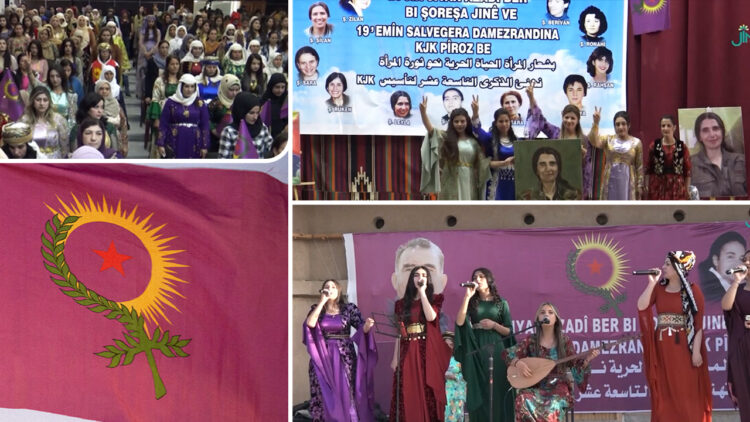
The Kurdistan Women’s Communities (KJK) celebrated the 12th anniversary of the Rojava Revolution in northern Syria, recognising it as a significant women’s revolution. On 19 July, the KJK underlined the importance of the revolution and called for a united defence against fascism, colonialism, and betrayal in Kurdistan.
In a statement, the KJK stressed that the Rojava Revolution, born through the efforts of Kurdish leader Abdullah Öcalan and developed under the paradigm of democratic, ecological, and women’s liberation, has demonstrated that a democratic and free life is possible.
The KJK honoured the memory of thousands of martyrs of the Rojava revolution, including prominent figures such as Arin Mirkan, Revan, Avesta Xabur, Barin, Aylan, Polat, Aqide Ana, Ebu Leyla, Ayşe Deniz, Helin İngiliz, Sorxwin Rojhilat, Jiyan, and Sosin. They also paid tribute to the 33 revolutionary young people from Turkey, who lost their lives in the Suruç Massacre on 20 July 2015 on their way to Kobani (Kobanê). The statement reaffirmed their commitment to continue the struggle for freedom and honour the legacy of the martyrs.
The KJK emphasised the historical and cultural significance of the Middle East as a mosaic of coexisting peoples, disrupted by nationalism and the regressive nation-state system. The statement pointed to Öcalan’s democratic national system as an alternative that initiated the decline of nation-states. Women, reclaiming their lost essence through Öcalan’s project, have worked tirelessly to reconnect with the ancient tradition of freedom in Mesopotamia. Women have been at the forefront of the Rojava Revolution, making significant sacrifices and increasingly seeking a free life, proving their strength and commitment through the resistance of the Women’s Protection Units (YPJ) and the Free Women’s Units (YJA Star).
The KJK statement highlighted the rise of fascism worldwide and how the Rojava Revolution, led by women and governed through a democratic state model, serves as a beacon of hope for coexistence and collective defence. Despite continuous fascist attacks, the revolution has shown how different communities can live, govern, and defend together against oppressive forces.
The KJK stressed the importance of defending the revolution, especially against the intensified occupation and annexation efforts of Turkish fascism in the whole of Kurdistan. The statement called for a united struggle in Rojava, Iraqi Kurdistan and southeast Turkey and urged all Kurdish people, revolutionary and democratic organisations, individuals, and freedom-loving women to embrace and defend the spirit of the revolution.
The KJK’s message is a call for solidarity and unity in the face of ongoing threats and aims to inspire and mobilise a broad coalition to defend the gains of the Rojava Revolution and secure its future.