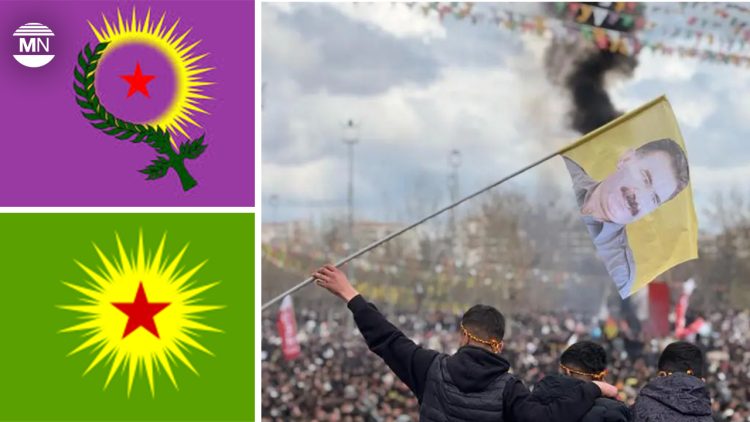
The Kurdistan Women’s Communities (KJK) and the Kurdistan Communities Union (KCK) have issued statements on the 4 April, the 76th birthday of imprisoned Kurdish leader Abdullah Öcalan, calling for increased democratic struggle for the freedom of Öcalan, which they consider a precondition for the developing of democratic means to find a peaceful solution to the Kurdish question in Turkey.
In the statements, the KJK and KCK congratulate Öcalan on his birthday and send their greetings to him, explaining the importance his life and work has had for the Kurdish people.
The KJK emphasised that 4 April should be celebrated with the demand for the immediate freedom for Öcalan, and sent greetings to the youth march organised by the Peoples’ Equality and Democracy (DEM) Party Youth Council, which took off from Diyarbakır (Amed) yesterday to head towards Öcalan’s birth village Amara, where a birthday celebration will be held on 4 April.
“This 4 April, Leader Apo’s [Abdullah Öcalan] 76th birthday, has gained a great value for Kurdistan, Turkey, the Middle East and women in terms of paving the way to peace and democratic society,” the KJK emphasised. They explained the circumstances into which Öcalan was born:
“When Leader Apo was born in the village of Amara on 4 April, he was born in a Kurdistan which was subjected to the brutal genocide policies of the 20th century, denied and destroyed, and which could no longer even recognise itself.”
In its statement, the KJK also mentioned what Abdullah Öcalan himself refers to as his second and third birth, explaining that the foundation of the Kurdistan Workers’ Party (PKK) is considered as his second birth, as the KJK considers the emergence of the PKK the “defence of the [Kurdish people’s] identity to the death, the resurrection and uprising of a people who denied themselves and were made ashamed of themselves.”
The paradigm shift of the PKK, which refers to the strategic re-orientation of the PKK with Öcalan’s “Declaration of Democratic Confederalism” in 2005, is considered as the third birth, which took place after Öcalan was arrested and brought to Imrali prison island on 15 February 1999. The KJK called Öcalan’s ‘Call for Peace and a Democratic Society’, issued on 27 February, the “crowning and manifestation of the third birth”.
KJK also called on people to join this year’s celebrations in Amara village and to plant trees and flowers on this occasion:
“Every tree planted this year should be planted for the physical liberation of Leader Apo with the wish of the tree of life of Peace and Democratic Society, all Kurdistan, all nature should flourish with this.”
The Kurdistan Communities Union (KCK) also issued a statement titled “April 4th Stands for the Resurrection of the Free Kurds”, in which they highlighted that the freedom of Abdullah Öcalan means the “solution of the centuries-old Kurdish question, and the solution of the Kurdish question means the democratization of the whole of Turkey and the Middle East.”
The KCK congratulated Öcalan on his birthday and explained his far-reaching significance, saying that his works have led to a resurrection of the Kurdish people:
“The Kurdish people had been condemned to a fate of genocide until the emergence of Leader Apo. They were subjected to cultural and physical genocide and alienated from their own history. Based on a policy of denial and extermination enforced by the ones that dominated Kurdistan, the Kurds were left with nothing but their bare lives, and even that was often not left to them.”
KCK explains that Öcalan’s works have led to a resurrection of a democratic Kurdish society and this is why the Kurdish people, and especially women and youth attach such deep meaning to his birthday, as they define it as a day of rebirth for themselves. Putting emphasis on the need for the freedom of Öcalan, the KCK also called on “dear international friends to join the struggle for the physical liberation of Leader Apo, to increase their level of organisation, and to make their democratic actions even more effective.”
The statement also highlighted that the paradigm developed by Öcalan has “brought out this spirit and culture of living together and fraternally that our people carry in their own historical social reality” and that this spirit of peace and brotherhood has started to resurrect in the Middle East and is leading towards a democratisation and a peaceful coexistence of different peoples in the Middle East:
“Today, under the leadership of the Kurdish people, this historical social and cultural spirit and understanding, which has begun to build itself as a democratic society and according to the paradigm of the democratic nation, is beginning to melt the black winters caused by nation states in favour of peoples, cultures, and beliefs.”