

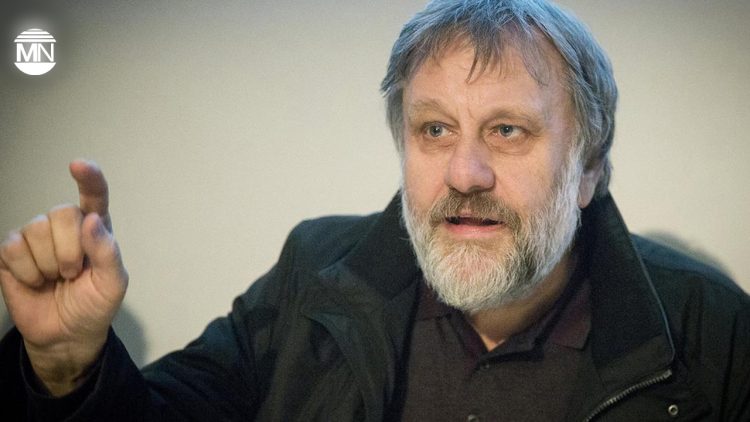
In an article titled ‘Abdullah Öcalan is the Mandela of our time’, published on 24 May, Slovenian philosopher Slavoj Žižek explains the transformation of the Kurdish struggle over the last decades and how it has become a source of hope amidst the wars and conflicts in the Middle East.
Earlier, Žižek had expressed his full support for the call for ‘Peace and Democratic Society’ made by the jailed Kurdish leader Abdullah Öcalan, and for the subsequent decision of the Kurdistan Workers’ Party (PKK) to dissolve itself following its 12th congress. To mark the 25th anniversary of Öcalan’s forced departure from Syria, which led to his capture and imprisonment, Žižek shared a video message reiterating his solidarity, saying, “His struggle is my struggle.”
In a public message shared after a visit by a pro-Kurdish political delegation to İmralı Island on 18 May, Öcalan extended his gratitude to leftist thinkers, including Žižek and French philosopher Alain Badiou, saying that he hopes they can “come together through internationalist and socialist efforts”.
In his article, Žižek begins by outlining the current global situation, describing it as a ‘dark period’, and stresses that the historic decision of the PKK to disband and cease the armed struggle should be regarded as a ‘sign of hope’ in such times.
Žižek explains that the PKK started out as an armed guerrilla movement that followed the ‘general rule of resistance’, which he describes as the idea that ‘if one is to be taken seriously, one has to begin with the threat of violent resistance.’ He gives the examples of the African National Congress (ANC) in South Africa and the protests led by Martin Luther King in the United States, saying that ‘the victory of peaceful negotiations occurred because the establishment feared violent resistance’.
Outlining the development of the PKK’s struggle since its foundation in 1978, Žižek says:
“Although the PKK initially sought an independent Kurdish state, in the 1990s its official platform changed to seeking autonomy and increased political and cultural rights for Kurds within Turkey. In recent decades, the PKK has moved closer to a peaceful solution, and Öcalan himself has engaged in deep reflections on issues like feminism and philosophy while studying in prison. In short, the PKK has become a movement that is fully part of the modern left.”
Žižek explains that this ideological transformation of the PKK has also impacted Kurds outside Turkey, as evidenced by the ‘Woman, Life, Freedom’ revolution in Iran that began in response to the death of 22-year-old Kurdish woman Jina (Mahsa) Amini in September 2022. According to Žižek, the emerging protests found a broad base in the Iranian population by ‘directly linking the struggle for women’s freedom with the struggle of women and men against ethnic oppression, religious fundamentalism and state terror’.
Highlighting the fate of the Kurdish people, who are divided between Iran, Iraq, Syria and Turkey, Žižek says:
“Do we still remember Saddam’s mass bombing and gas-poisoning of Kurds in the north of Iraq in the early 1990s? More recently, when ISIS dominated large parts of Syria and Iraq, Turkey played a well-planned military-political game, officially fighting ISIS but effectively bombing Kurds who were really fighting ISIS.”
In conclusion, Žižek stresses the importance of supporting the Kurdish struggle, describing it as a ‘glimmer of hope’ amidst the ‘gradual descent’ by the surrounding sovereign states into ‘new barbarism’.
To end the article, he asks, “What will come of the PKK’s self-dissolution depends on the Turkish government – will it embrace the offer with a sincere counter-gesture?” He stresses the need for international pressure on the Turkish government to take practical steps towards peace following the PKK’s dissolution.


