

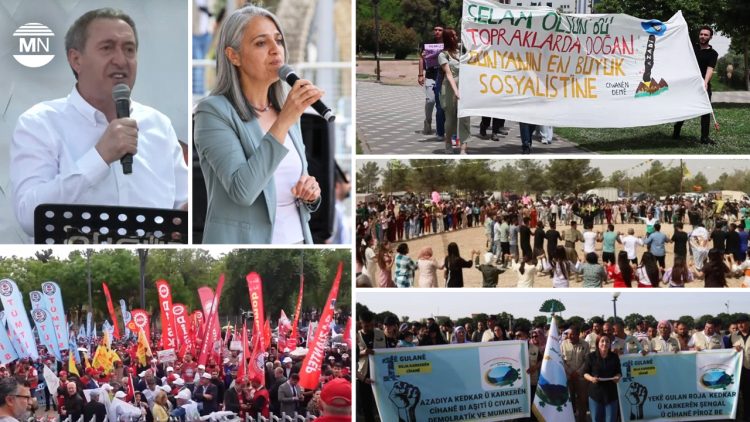
Large-scale rallies were held across Kurdish-majority provinces in Turkey and parts of northern Syria and Iraq on Thursday to mark International Workers’ Day, with participants linking the labour struggle to broader demands for peace, recognition and democratic autonomy.
Events in Diyarbakır (Amed), Mardin (Mêrdîn), Van (Wan), Şırnak (Şirnex) and Urfa (Riha) drew thousands, as did commemorations in Sinjar (Şengal) and the Autonomous Administration-controlled areas of North and East Syria (also known as Rojava).
Speakers across nearly all locations referred to the recent message from Abdullah Öcalan, the jailed leader of the Kurdistan Workers’ Party (PKK), who called for a renewed focus on “democratic society and peace” in a statement conveyed on 27 February.
In Diyarbakır, co-chair of the pro-Kurdish Peoples’ Equality and Democracy (DEM) Party, Tuncer Bakırhan, addressed the crowd by citing Öcalan’s words: “Capitalism is stealing our hope.” Bakırhan argued that the path to a peaceful and democratic Turkey must go through recognition of Kurdish rights and a fairer economic system.
“Peace cannot exist without labour, and labour cannot exist without peace,” he said. He urged workers to support the call for a peaceful resolution of the Kurdish issue and criticised the diversion of public funds toward military policies.
In Mardin, demonstrators marched behind banners reading “Freedom of labour requires peace and democratic society,” chanting slogans in Kurdish such as Bijî Serok Apo (Long live Leader Abdullah Öcalan) and Jin, Jiyan, Azadî (Woman, Life, Freedom). Speakers called for a general amnesty for political prisoners and recognised Öcalan’s appeal as a roadmap for de-escalation.
At the rally in Şırnak, DEM Party MP Zeki İrmez stated: “The root of many crises in Turkey lies in the unresolved Kurdish question. Supporting Öcalan’s call is supporting justice for all.” He also demanded legal reforms to improve Öcalan’s prison conditions and facilitate renewed negotiations.
In Van, Democratic Regions Party (DBP) co-chair Çiğdem Kılıçgün Uçar described the economic crisis as inseparable from the state’s ongoing military expenditure. “Democratic society cannot be built without workers, and peace cannot come without ending war policies,” she said.
In Urfa, young demonstrators held placards that read: “The working class cannot be free until the Kurdish people are free.” The gathering featured slogans against Turkish military operations in Syria and Iraq, and songs commemorating historic Kurdish resistance figures.
Outside Turkey, 1 May was also marked in Sinjar, the Yazidi-majority region of northern Iraq, where local officials tied their struggle for autonomy to the global workers’ movement. Elmas Nayîf, co-mayor of Sîba Şêx Xidir, cited Öcalan’s phrase “Labour is freedom” and described the day as one of “resistance against exploitation and injustice.”
In North and East Syria (Rojava), gatherings were held in towns such as Dêrik and Qamishli (Qamişlo). Speakers from Kurdish-led institutions reaffirmed their commitment to what they described as a grassroots, worker-led democratic system, emphasising the role of women and youth in building autonomy.
The unifying theme across the region was a belief that labour rights, peace and democratic recognition are intertwined. While Turkey’s central government continues to treat expressions of solidarity with Öcalan as criminal, participants at the May Day rallies called for dialogue over repression.


