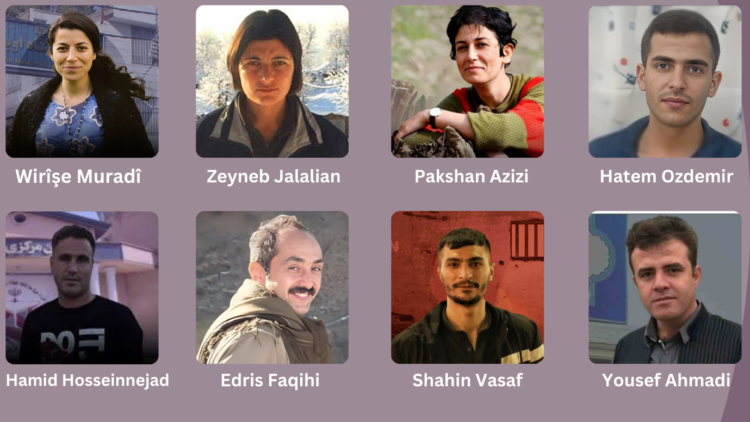
In Iran, at least eight Kurdish political prisoners, including activists and human rights defenders, face execution, life imprisonment or enforced disappearance, reflecting systemic repression and human rights violations targeting Kurdish communities and political voices. Read this urgent report by Zegrus Enderyari.
Zeynab Jalalian: A symbol of resistance amidst systematic repression
Zeynab Jalalian, the longest-serving Kurdish prisoner of conscience in Iran, has been serving a life sentence for years. Arrested and prosecuted for alleged affiliation with the Free Life Party of Kurdistan (PJAK), her trial has been repeatedly criticised by human rights organisations for its lack of due process. Despite suffering from multiple health problems, she has been denied medical leave and adequate medical care. Jalalian has also been illegally transferred between prisons on several occasions, which amounts to psychological torture. Her resilience has made her a powerful symbol of Kurdish women’s resistance to state repression.
Warisheh Moradi: The second Kurdish woman sentenced to death in recent months
Warisheh Moradi, a Kurdish prisoner of conscience and member of the Free Women’s Organisation of East Kurdistan (KJAR), has recently been sentenced to death for ‘rebellion’ (baghi). Her case is the second death sentence handed down to a Kurdish woman in recent months, a development that underscores the increasing persecution of women activists—especially those associated with women’s movements or Kurdish political groups.
Pakhshan Azizi: A social worker targeted by political repression
Pakhshan Azizi, a social worker and political prisoner, is another woman facing the death penalty. Accused of being a member of PJAK, Azizi has spent years doing humanitarian work in refugee camps in Syria and Iraq. Despite no evidence linking her to any military operations, Iranian authorities have accused her of ‘armed group affiliation’, a vague charge often weaponised against human rights defenders.
Hatam Özdemir: Torture and a death sentence for a Turkish citizen
Hatam Özdemir, a Kurdish citizen of Turkey, was arrested near the border regions of Iran in 2019 and sentenced to death for “enmity against God” (moharebeh) for alleged membership of the Kurdistan Workers’ Party (PKK). Özdemir endured over 50 days of severe torture in prison. His case exemplifies Iran’s harsh treatment not only of its own citizens but also of foreign nationals accused of political activism.
Hamid Hosseinnezhad: Another activist sentenced to death
Hamid Hosseinnezhad Heidaranlou, a political prisoner from Chaldoran, has been sentenced to death by the Revolutionary Court of Urmia for alleged membership of the PKK. This sentence is part of a broader strategy to repress Kurdish activists and opposition members in the region.
Shahin Wasaf: Death sentence on espionage charges
Shahin Wasaf, a 27-year-old Kurd from Salmas, was arrested during the Jin, Jiyan, Azadi (Woman, Life, Freedom) movement and sentenced to death on charges of ‘spying for Israel’. Wasaf was an active participant in the movement, which advocates for women’s rights and equality for marginalised communities in Iran. The use of espionage charges to suppress dissent remains a worrying trend in Iran’s judicial practices.
Yousef Ahmadi: Five years in prison, now a death sentence
Yousef Ahmadi, a 39-year-old political prisoner from Baneh, was sentenced to death for ‘rebellion’ (baghi) due to his alleged membership of the Democratic Party of Iranian Kurdistan. His case is emblematic of the Iranian judiciary’s use of unfair trials and politically motivated charges to suppress opposition voices.
Idris Faqihi: Victim of IRGC enforced disappearance
Idris Faqihi, a member of PJAK, disappeared in 2021 after being injured by IRGC forces. Despite repeated attempts by his family to obtain information, the authorities have provided no clear answers about his fate. Such enforced disappearances are a gross violation of international human rights law and a chilling method of silencing dissent.
Nayeb Askari: Sentence commuted on appeal
Notably, Nayeb Askari, who was initially sentenced to death for ‘rebellion’ due to alleged membership of PJAK, had his sentence overturned by the Supreme Court. Instead, he now faces a 15-year prison term and a significant fine—a small yet rare victory in Iran’s justice system.
These cases highlight the Iranian government’s deliberate and systematic human rights violations against Kurdish political activists. Executions, life sentences, and enforced disappearances are wielded as tools of political repression. The international community must act now to address these injustices and demand accountability from Iranian authorities.
Zegrus Enderyari is a Kurdish activist from Eastern Kurdistan and a member of the “No to Execution, Yes to Free Life” campaign.