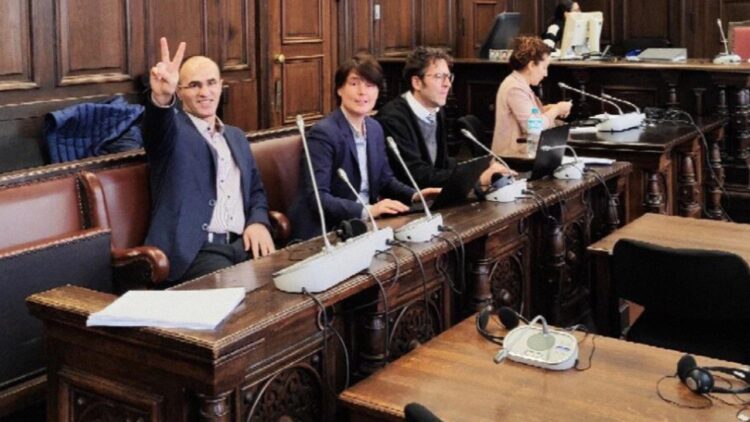
On 2 September, Kurdish political activist Kenan Ayaz was sentenced by a court in Hamburg, Germany to 4 years and 3 months in prison on charges of ‘membership of a terrorist organisation’. Ayaz is accused of carrying out work for the Kurdistan Workers’ Party (PKK) in Germany between 2018 and 2020.
He is alleged to have been involved in the organisation of ‘propaganda events and gatherings’ such as demonstrations and festivals, and in fundraising. The judgement is not yet final. Ayaz has already spent 12 years in prison in Turkey.
The court process has been an ordeal for Ayaz, as he was first arrested in Cyprus in 2023 and extradited to Germany that June, having gone on a hunger strike in May to protest against the extradition. His extradition to Germany came after a decade of political asylum in Cyprus. He has since been imprisoned in Germany for more than a year. His trial for alleged PKK membership began in November 2023.
Ayaz read out the first part of his two-part final statement in a hearing on 17 July, giving an overview of the history of the Kurdish people, showing the centuries of oppression on one side and the ongoing resistance against this oppression on the other.
He read out the second part of his final statement in the hearing of 2 September. In this part he shone the spotlight on Turkey’s support for ISIS during the genocide of the Yazidi people in Sinjar in 2014 and the subsequent ISIS attacks on the city of Kobani (Kobanê) in northern Syria. He noted that only the female-led Kurdish armed forces had been able to defeat ISIS, with the support of the international coalition.
Ayaz expressed his condolences to the victims of the ISIS attack in Solingen and wished the injured a speedy recovery. He referred to the threats that Erdoğan had made against Europe and the subsequent ISIS attacks in Paris and Brussels.
He continued to describe the close relations between the German and the Turkish states, asserting that Turkey has used its strategic geopolitical position to put pressure on Germany and that as a result, “democratic and peaceful protests in Germany to make the public aware of the attacks and brutality of the Turkish state against the Kurds are being prevented.”
He added that the PKK being on the ‘terror list’ of Germany and the EU is “indirect legitimisation and approval of the barbarism, massacres and genocidal policies of the Turkish state”.
Referring to the recent letter signed by 69 Nobel prize laureates demanding the freedom of Abdullah Öcalan, he said, “Germany could play an essential role both in the implementation of universal law and in the development of Turkey into a secular constitutional state by taking up the appeal of these Nobel Prize winners as the conscience of humanity and using its close relations with Turkey towards a political dialogue on the Kurdish question”.
Public voices have criticised the court ruling, with Left Party MP Cansu Özdemir calling it a “fatal signal for the rule of law and the opposition movement in Turkey and Kurdistan”. The legal aid AZADÎ fund also criticised the sentence and called it “another link in the shameful chain of condemnations of Kurds who are engaging themselves against the oppression and exploitation of Kurdish society”.
Kenan Ayaz is one of 13 Kurds who are currently in German pre-trial or criminal detention on charges of being members of the PKK.