

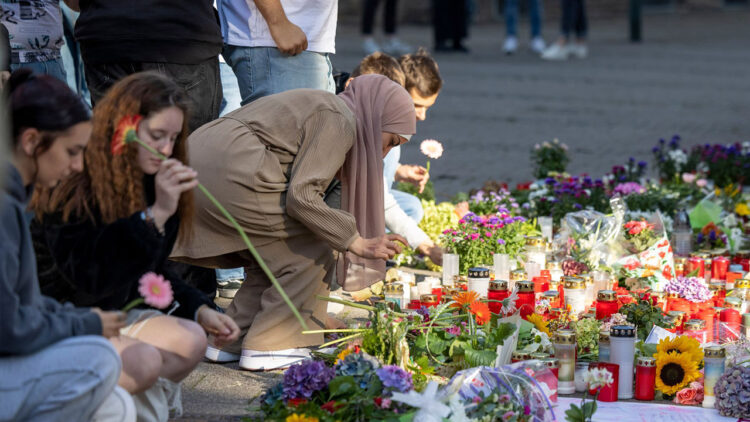
Kurdish organisations and human rights activists have issued a series of warnings against Turkey, accusing the NATO member of supporting Islamic State (ISIS) militants and contributing to regional instability. The condemnation comes in the wake of a knife attack in Solingen, Germany, where three people were killed and eight others injured. The incident has intensified concerns about Islamist extremism across Europe.
The Confederation of Kurdistan Communities in Germany (Kon-Med) expressed deep concern over the attack, offering condolences to the victims’ families while criticising the rise of violence in Europe. “As Kurds, whose history has been severely shaped and destabilised by Islamist and racist violence, we have been warning for many years about the strengthening of right-wing ideologies and Islamist structures in Germany as well,” Kon-Med stated, Junge Welt reported.
Kon-Med highlighted the crucial role that Kurdish forces have played in the battle against ISIS in Syria and Iraq, often at a high human cost. The organisation accused Turkey of facilitating ISIS operations, alleging that “NATO member Turkey… has demonstrably become the most important transit country for fighters of the terrorist militia.”
These claims are bolstered by reports that senior ISIS figures, including former leader Abu Bakr Al-Baghdadi, were killed in operations conducted in areas of Syria under Turkish control. Kon-Med also accused Turkey of continuing to employ Islamist militants in military actions against Kurdish self-governing regions in northern and eastern Syria.
Echoing these concerns, the Democratic Autonomous Administration of North and East Syria (AANES) released a statement condemning Turkey’s alleged support for extremist groups. “The dangers of the terrorist organisation ISIS, which are not limited to a specific geography, become clearer day after day,” the Administration warned, calling for stronger international cooperation to combat the ongoing threat.
The Administration pointed to the presence of various extremist factions, including remnants of ISIS and Al-Nusra, within Turkey’s sphere of influence. “We remind the entire world that we were and still are on the front line of the struggle against terrorism and its ideology,” the statement read, urging global powers to intensify their collaboration with Kurdish forces.
Both Kon-Med and the Autonomous Administration criticised the international community for its perceived inaction regarding the thousands of ISIS militants and their families detained in Kurdish-controlled territories. Kurdish authorities have long called for these fighters to be repatriated and for an international tribunal to be established to try them—a plea that has largely gone unanswered.
“Instead of shifting the discourse ever further to the right with debates about tightening asylum laws and mass deportations… it would make more sense to demand that the German security authorities finally focus on consistently combating Islamist actors such as the Islamic State,” Kon-Med asserted, arguing that Germany’s current focus on Kurdish activists detracts from addressing Islamist extremism.
The attack in Solingen has also sparked renewed debate on immigration and asylum policies in Germany. Friedrich Merz, leader of the Christian Democratic Union (CDU), called for a general ban on accepting refugees from Syria and Afghanistan, claiming that the majority of such offences are committed by individuals with Islamist motives. “It should now be clear once and for all: It’s not the knives that are the problem, but the people walking around with them,” Merz stated controversially.
His remarks have been sharply criticised by human rights groups. The Society for Threatened Peoples (STP) condemned his demand as “inhumane and populist,” arguing that it fails to address the root causes of Islamist extremism. “Reflexive demands for deportations and a ban on accepting asylum seekers from Afghanistan or Syria will not combat Islamism,” said Dr Kamal Sido, STP’s Middle East Consultant.
Sido accused Merz of ignoring the persecution faced by ethnic and religious minorities at the hands of ISIS, emphasising that Germany has a duty to protect these vulnerable groups. “A complete ban on admission would not be compatible with the right to asylum,” he added, advocating for a more balanced approach.
Sido also criticised NATO’s broader foreign policy, accusing it of indirectly strengthening Islamist forces through alliances with certain Middle Eastern powers. He highlighted the ongoing support for Turkish President Recep Tayyip Erdoğan’s policies as a significant barrier to effectively combating ISIS. “As long as Erdoğan’s drone terror against the Kurds, who are currently fighting ISIS in the Middle East, is not condemned but supported, ISIS terror will not really be prevented, neither in Solingen nor in Berlin or Paris,” Sido concluded.
As the situation continues to evolve, these warnings highlight the deep divisions and complexities in addressing the threat of Islamist extremism, both in the Middle East and within Europe.


