

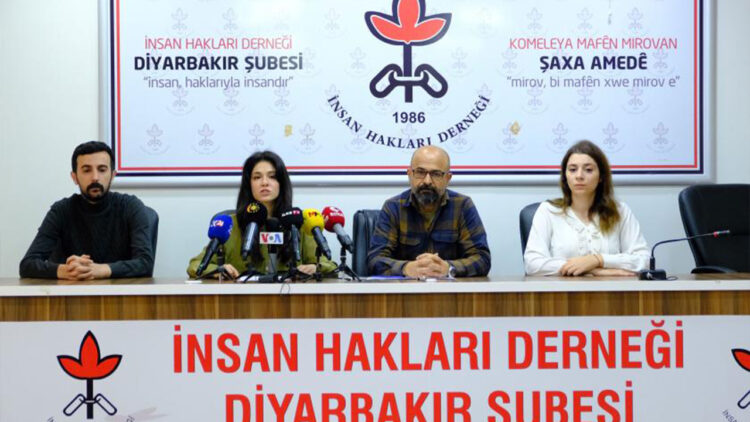
A report by the Human Rights Association (İHD) in Diyarbakır (Amed) has highlighted the severe impact of Turkey’s unresolved Kurdish issue on children in the region. Presented on 19 November, ahead of World Children’s Day, the report details violations that have claimed the lives of at least 36 children between November 2023 and November 2024. The findings were disclosed at a press conference held at the İHD’s Diyarbakır office, with key insights shared by lawyer Berfin Elçi, a member of the organisation’s Child Rights Commission.
Elçi explained that children in Turkey’s Kurdish-majority eastern and southeastern regions face compounded risks stemming from ongoing conflict, systemic discrimination, and societal violence. She emphasised that Turkey’s reservations on critical clauses of the United Nations Convention on the Rights of the Child—which it ratified in 1995—undermine essential protections for ethnic, religious, and linguistic minority children. These reservations restrict their cultural and linguistic rights, depriving them of the chance to grow up in their own cultural environment.
The İHD report sheds light on the dire consequences of such structural inequalities. Four children died due to official negligence, including accidents involving state vehicles and unexploded ordnance left in conflict zones. Another 18 children lost their lives under suspicious circumstances, while nine were killed due to domestic violence. Alarmingly, at least five children were subjected to sexual abuse within their families, with broader societal violence claiming four more lives.
The broader spectrum of violations is equally concerning. At least 81 children were detained in the past year, with 21 subsequently arrested. Fifteen children endured physical abuse and torture, including two in police custody and ten in prison. Schools were not exempt from violence, with at least four children experiencing physical abuse in educational institutions.
Elçi pointed to the ongoing socio-political instability in the region, compounded by the aftermath of the devastating Kahramanmaraş (Maraş) earthquakes in February 2024, as a significant factor exacerbating the vulnerability of children. She cited examples of children being forced to live in prisons with their incarcerated mothers, lack of adequate healthcare, and cases involving criminal gangs, such as the newborn baby traffickers. She also criticised the judicial system’s failure to adequately address crimes against children, which she said perpetuates a culture of impunity.
The report underscores that these challenges are not limited to legal and institutional failings but are deeply rooted in the unresolved Kurdish issue. Elçi argued that the lack of a peaceful and democratic resolution to the Kurdish conflict perpetuates a cycle of violence, poverty, and neglect that disproportionately affects children. She renewed the İHD’s call for a political solution, stating, “Children are among the most vulnerable victims of the ongoing impasse. This reality underscores the urgent need for a peaceful resolution to the Kurdish question.”
The report also highlighted other chilling statistics: 48 children were subjected to sexual violence or assault in public spaces, and at least one child was abducted. Additionally, linguistic and cultural rights violations remain prevalent, with Kurdish-speaking children systematically denied the right to education in their mother tongue, hampering their psychological and social development.
Elçi stressed that Turkey’s reservations on the UN Convention contradict the document’s core principles, which prioritise a child’s best interests, non-discrimination, survival and development, and active participation. She also criticised the ineffectiveness of international oversight, particularly the United Nations Committee on the Rights of the Child, in ensuring that signatory states uphold their commitments.
As Turkey approaches the 35th anniversary of its signing of the UN Convention, the İHD urged the government to lift its reservations, fully implement the convention, and address the systemic issues undermining child rights. The association reiterated its demand for a peaceful resolution to the Kurdish issue, insisting that only through reconciliation and respect for human rights can the conditions for the well-being of all children be secured.


