

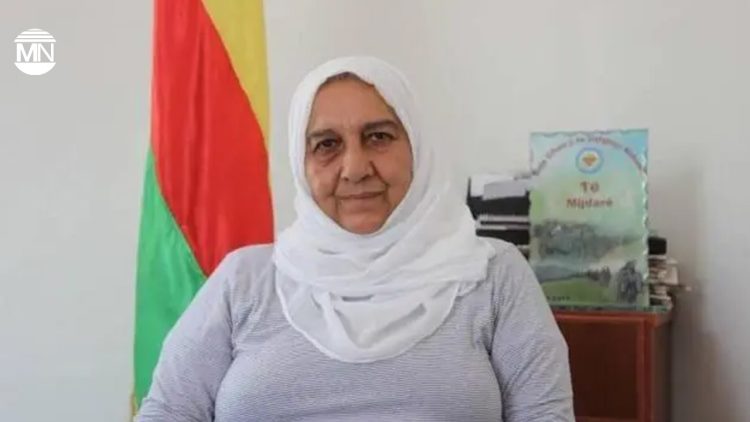
“History is repeating itself. The Kurdish resistance of Kobani (Kobanê) is repeating itself at Tishreen,” Ayşe Efendi, a prominent Syrian Kurdish figure, stated, comparing the Kurdish-led defence against the ISIS siege of Kobani in 2015, to on-going civilian protests against attacks of the Turkish Armed Forces and the Turkish-backed Syrian National Army (SNA) at Tishreen Dam.
Speaking to Mezopotamya Agency on the 10th anniversary of the battle of Kobani, Efendi, known as the ‘Mother of Kobani’, praised the bravery and determination of the Kurdish civilians staging a sit-in at the dam. Residents of North and East Syria (Rojava) have maintained their peaceful protest at the vital Euphrates infrastructure since 8 January to protect it against a possible breach and subsequent humanitarian disaster caused by Turkish bombardments, despite enduring deadly targeted attacks that have killed at least 21 civilians and injured over 200.
“Tishreen is no longer a dam, but a field of resistance,” Efendi said, adding, “People risk death without hesitation to stand guard there.” Efendi, a former co-chair of the Kobani Council, now serves as Co-Chair of the Euphrates Region Martyrs’ Families Assembly, having lost her son during the battle of Kobani. “The dark history of the Kurds found light with the Kobanê resistance,” she stressed, noting the enduring legacy of the historic resistance.
Efendi recalled how Kurds across the region united to join the resistance at Kobani, which marked a turning point in the fight against the Islamic group, leading to their territorial defeat. Celebrating Kobani as a symbol of Kurdish unity, she referenced the Treaty of Lausanne, which divided Kurds among Turkey, Iraq, Syria, and Iran without any formal recognition of their cultural or political rights as a distinct group. “The borders erected between the Kurds 100 years ago became meaningless in Kobani ten years ago… The heart of the four parts of Kurdistan beat for the freedom of the freedom of Kobani,” Efendi said.
Efendi also addressed the widely debated potential peace process between Turkey and the Kurds, accusing Turkey of duplicity. “On the one hand, meetings are being conducted with Leader Apo,” she said, referring to the recent shuttle diplomacy of the Equality and Democracy (DEM) Party with Abdullah Öcalan, the imprisoned leader of the Kurdistan Workers’ Party (PKK). “On the other hand, massacres are being carried out against the Kurds. This is two-faced politics. War and peace cannot coexist,” she declared.
Efendi concluded by emphasising the pivotal role Öcalan’s words played in inspiring the Kobani resistance. “The fall of Kobani will mean the fall of all Kurdistan. Everyone needs to act in accordance with this fact,” she said, quoting the Kurdish leader, and echoing his call for action: “Everyone should speak out against the attacks on Rojava for peace and tranquility.”


