

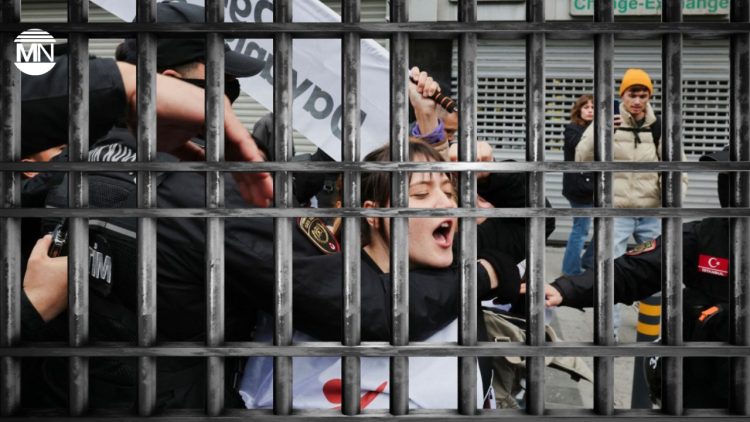
Turkey’s parliament has passed its controversial 10th Judicial Reform Package, formally titled the Law Amending the Enforcement of Sentences and Certain Other Laws, amid growing criticism from human rights groups and Kurdish representatives who warn it entrenches repression and undermines prospects for peace.
The bill, approved in the early hours of 4 June 2025, introduces changes to parole eligibility, sentence enforcement and prison conditions. However, eight contentious clauses — including provisions mandating jail time for participants in unauthorised protests and expanding the censorship powers of Turkey’s telecom regulator — were withdrawn during committee debates following pressure from opposition parties and civil society groups.
Despite these revisions, critics argue the reform remains fundamentally flawed. Legal experts, human rights defenders and opposition MPs say the legislation reinforces inequality in sentencing, particularly targeting Kurdish political prisoners and critics of the government, being the vast majority of those convicted under Turkey’s Anti-Terror Law.
“This is not about justice, it is about scaring people into silence,” said Zülküf Uçar, a pro-Kurdish Peoples’ Equality and Democracy (DEM) Party MP and member of the Justice Commission.
He and his colleague Onur Düşünmez accused the government of codifying “enemy law” — a term used for selectively applied legislation that criminalises dissent.
Under the reform, individuals convicted under the Anti-Terror Law — a statute frequently used against Kurdish politicians, journalists and activists — are excluded from extended options for parole. One clause in the draft, ultimately withdrawn, would have required mandatory prison sentences for unauthorised protests, even for minor offences, eliminating current provisions for parole or sentence reductions.
“You find one magic word — deterrence — and reduce the whole of law to it,” said Uçar. “But real justice means addressing the roots of crime, not just repressing it.”
The bill allows conditional release for those serving ‘aggravated’ life sentences after 39 years, and life sentences after 33 years. However, ‘aggravated’ life imprisonment — a category disproportionately applied to political prisoners — typically involves solitary confinement and limited parole rights, and remains unaffected for many under the new legislation.


