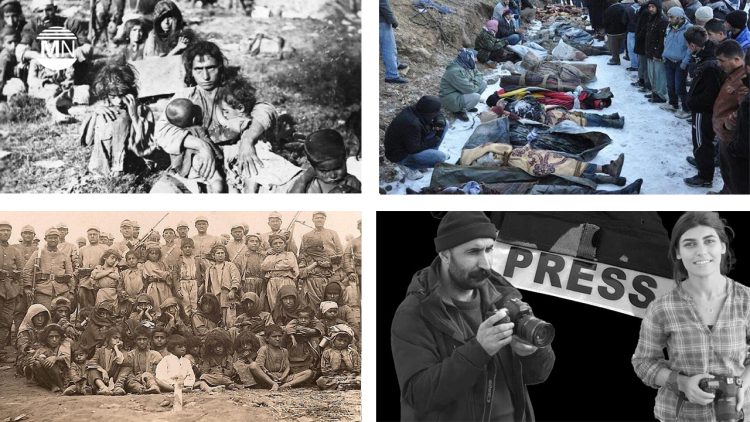
Turkey faces renewed international scrutiny following the deaths of journalists Cihan Bilgin and Nazım Daştan, who were targeted and killed by a drone strike in northern Syria on 19 December. The journalists, travelling in a vehicle clearly marked Press, had been reporting on regional developments in North and East Syria (Rojava). This incident has once again highlighted Turkey’s troubling history of alleged war crimes, including attacks on civilians, destruction of critical infrastructure, and accusations of using banned chemical weapons.
The international community is grappling with the implications of these actions, which appear to violate fundamental principles of international humanitarian law. Principles such as distinguishing between civilian and military targets, proportionality in the use of force and the protection of non-combatants are central to minimising the effects of war. Yet, critics argue that Turkey’s actions, both historical and ongoing, repeatedly disregard these norms.
Accusations against Turkey trace back decades, highlighting a consistent pattern of violence against civilians, particularly Kurdish communities. The Zilan Massacre of 1930 in Erciş (Erdîş), Van (Wan) left thousands dead and entire villages destroyed, marking one of the earliest examples of systematic targeting. Similarly, the Dersim Massacre in 1937–38, which claimed over 13,000 lives, saw widespread forced displacement and atrocities, including the abduction of young Kurdish girls by soldiers. While Turkish officials have occasionally acknowledged civilian deaths, they have frequently framed such actions as counter-terrorism measures.
The Roboskî massacre in 2011 exemplifies the persistent nature of these allegations. During this incident, 34 civilians in Şırnak (Şirnex) were killed in airstrikes by Turkish F-16 jets. Local and international human rights groups condemned the attack, but no substantial accountability measures followed. Critics argue that this lack of justice perpetuates a culture of impunity, enabling further violations.
In recent years, Turkey’s military operations in Rojava have amplified concerns over civilian targeting. Reports indicate that schools, hospitals, and other essential infrastructure have been deliberately destroyed. On 21 December, Turkish forces bombed wheat silos near Kobani (Kobanê), rendering 300 tons of grain unusable. Such acts, targeting food security and healthcare facilities, have drawn sharp criticism from human rights organisations. Syrian Observatory for Human Rights (SOHR) and other monitoring groups have documented widespread devastation, calling for independent investigations into these attacks.
The alleged use of chemical weapons by Turkey adds another grave dimension to the accusations. Historical records reveal their deployment during the Dersim operations, with explicit orders documented in communications from government officials of the time. In recent conflicts, Kurdish armed groups have accused Turkey of employing banned substances during military operations in Iraqi Kurdistan and Syria. In 2022, the PKK released footage purportedly showing casualties from chemical attacks. Although Turkey has denied these allegations, its refusal to allow independent investigations has only deepened suspicions.
The targeting of journalists, including Bilgin and Daştan, underscores the broader risks faced by media workers in conflict zones. Since 2019, at least 13 journalists have been killed in Turkish cross-border operations, with many others injured. Press freedom advocates argue that such attacks are intended to suppress reporting on human rights abuses and war crimes. Bilgin and Daştan’s murders exemplify the dangerous climate for journalists attempting to document the realities of war.
International humanitarian law, particularly the Geneva Conventions, categorically prohibits attacks on civilians, civilian infrastructure, and journalists. The principles enshrined in these laws are designed to minimise harm during armed conflict and ensure accountability for violations. Despite these frameworks, human rights groups argue that Turkey has repeatedly evaded accountability, with its actions going largely unchallenged on the global stage.
The international community’s muted response has drawn criticism from activists and legal experts who warn of the broader implications of inaction. Allowing war crimes to go unpunished risks normalising violations of international law and undermines the global commitment to human rights. Organisations such as Amnesty International and the Kurdish Human Rights Project have called for independent inquiries into Turkey’s military operations and a more robust response from international institutions.
Turkey’s government continues to dismiss these allegations, framing its military campaigns as necessary measures against terrorism. Officials frequently cite the threat posed by the PKK and affiliated groups as justification for their actions. However, critics argue that this narrative ignores the disproportionate impact on civilians and the destruction of essential infrastructure. The European Council’s Parliamentary Assembly, in its January 2024 report, highlighted a sharp increase in human rights violations in Turkey since 2017, including incidents of torture and ill-treatment.
The deaths of Bilgin and Daştan are a stark reminder of the urgent need for accountability. As evidence mounts, the pressure on the international community to act grows stronger. The stakes are not only the lives and rights of those directly affected but also the integrity of the international legal system. Without decisive action, the principles of humanitarian law risk being eroded, leaving civilians and journalists increasingly vulnerable to the horrors of war.
The renewed focus on Turkey’s war crimes presents an opportunity for meaningful change. By addressing these allegations with transparency and fairness, the international community can reaffirm its commitment to justice and ensure that those responsible for violations are held accountable.