

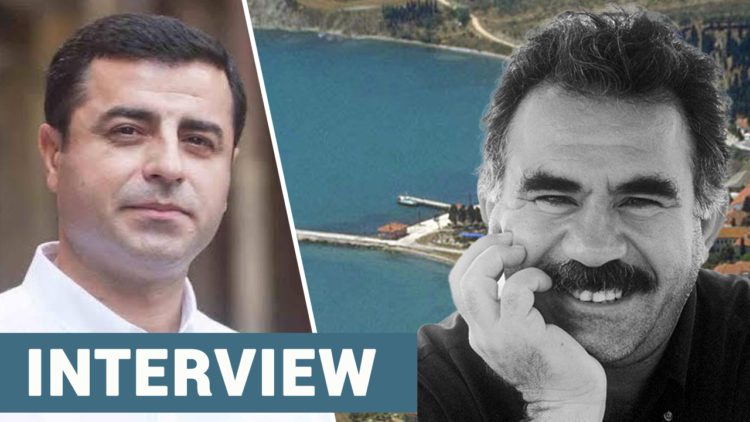
Urgent action must end the isolation of Kurdish leader Abdullah Öcalan to enable him to fulfil his role in resolving the Kurdish issue, Selahattin Demirtaş, former co-chair of the Peoples’ Democratic Party (HDP), said in an exclusive interview with Yeni Özgür Politika on 1 July. Demirtaş underlined the importance of diplomatic efforts to ‘lay the groundwork’ for negotiations.
Demirtaş condemned the isolation policies applied to Öcalan in the Turkish high-security İmralı island prison as “reprehensible, without any moral or legal basis”. He stressed that Öcalan is vital to resolving the Turkish-Kurdish conflict, as the symbolic leader of the Kurdish people and in terms of renewing peace talks between the Kurdistan Workers’ Party (PKK) and the Turkish government. Demirtaş highlighted the necessity of breaking Öcalan’s isolation through sustained efforts to prepare for democratic negotiations, emphasising that Öcalan’s release and renewal of peace talks come hand in hand.
“Anti-isolation actions are important and meaningful,” he noted, “but essentially, the critical thing is to establish the groundwork for the solution. Diplomatic, political, and social planning must be done based on past experiences and implemented decisively.”
A global campaign titled ‘Freedom for Abdullah Öcalan, a political solution to the Kurdish question’ was launched in October last year, following years of similar campaigning efforts, drawing support from prominent intellectuals, including philosopher Noam Chomsky. Despite numerous actions and activities within this framework, no information has been received on Öcalan’s condition for over 40 months. Demirtaş disclosed that he, along with Öcalan’s lawyers, family, and MPs, have repeatedly requested visits, but no responses have been given.
Concerning the Kobani (Kobanê) conspiracy trial, Demirtaş asserted that the trial’s outcome was determined by a “make our move and finish it” attitude rather than a legal process. He described the trial as an attempt to liquidate democratic politics as part of the “Collapse Plan” adopted by the National Security Council in October 2014. The goal, according to Demirtaş, was to divide, diminish, and ultimately eliminate the HDP. Despite the severe costs and wounds inflicted, he emphasised that their struggle thwarted this goal and highlighted a significant recovery in democratic politics and social opposition.
When asked about his reaction to the sentences, Demirtaş was unsurprised and undeterred, maintaining that politicians chosen by the people will not step back due to sentences, threats, or blackmail. He acknowledged the government’s fear of the solidarity between the Kurdish people’s freedom struggle and Turkish socialists and democratic forces, noting that this common bond was a target in the trial.
Demirtaş explained that the government’s obsession with Kobani stems from it being the starting point of the Islamic State’s (ISIS) defeat, which disrupted their plans and angered the government. He believes the solidarity and resistance shown in Kobani were pivotal moments that the government seeks to avenge.
On the agenda for his upcoming meeting with the main opposition Republican People’s Party (CHP) leader Özgür Özel, Demirtaş plans to discuss various issues within the framework of his party’s program, with a particular focus on the Kurdish issue. He also expects to address fundamental issues such as the economy, foreign policy, and justice.
Despite his circumstances, Demirtaş remains hopeful for a peaceful and democratic solution. He dreams of reuniting with his family outside the prison confines. He sent heartfelt greetings and love to the people, urging them to remain resilient and determined in their struggle for justice.


