

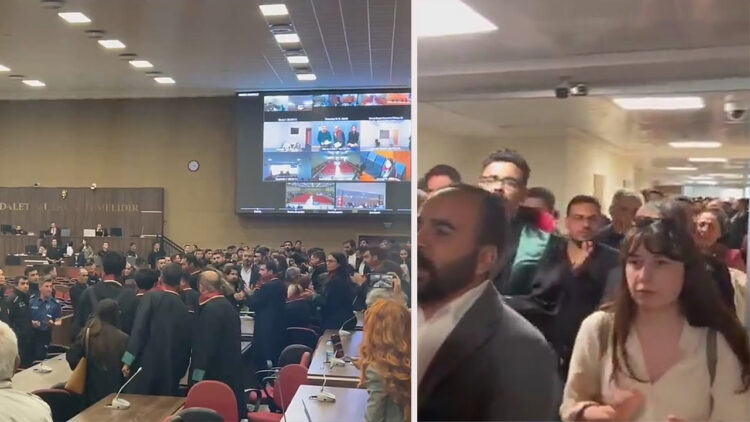
A long-awaited verdict is expected to be heard on 16 May in the high-profile Kobane case in Turkey against 108 Kurdish politicians, persecuted for protesting against the Turkish government’s failure to defend Kurdish Syriacs against an ISIS siege in 2014. Of the 18 remaining behind bars, the majority refused to attend Thursday’s hearing.
Eight imprisoned defendants, all women, shared a joint message through their lawyers condemning the Turkish government for its policy of isolation used in Turkish prisons, with regards to Abdullah Öcalan, pioneer of the contemporary Kurdish freedom movement. Öcalan was captured in 1999 and imprisoned on Turkey’s İmralı island in a specially designed high-security detention centre. For the last three years of his confinement, prison authorities have refused any contact with the outside world, including family and legal representatives.
Sebahat Tuncel penned the message, jointly signed by Ayla Akat Ata, Zeynep Ölbeci, Zeynep Karaman, Aynur Aşan, Ayşe Yağcı, Meryem Adıbelli and Pervin Oduncu, from Sincan Prison in Ankara.
“All constitutional and legal rights of Mr Abdullah Öcalan and his fellow prisoners have been usurped in İmralı F Type prison, which has no place in the democratic legal order and where a special law is applied. The policy of absolute isolation and incommunicado has become a systematic practice,” the signatories stated.
Lawyers and human rights defenders worldwide have condemned the practice of isolation as torture, which the Kobane defendants pointed out in their statement, is systemic and ignored by international institutions responsible for holding governments responsible for international human rights law, such as the Council of Europe’s Convention for the Prevention of Torture.
Furthermore, the tactic of isolation used against Öcalan and other political prisoners in Turkey is viewed by the pro-Kurdish opposition as a deliberate attempt to prevent a democratic resolution to the Kurdish issue in the region. Freedom for Öcalan, leader of the Kurdistan Workers’ Party (PKK), is hailed by supporters as the key to renewed peace talks.
The PKK is an armed political movement seeking self-determination for the Kurdish people stripped of their homeland, Kurdistan, a century ago with the establishment of the Turkish Republic. Brief negotiations between the Turkish government and the PKK were abruptly halted in 2016 by the administration and hostile political and military operations subsequently restarted from the Turkish state against Kurdish freedom fighters and pro-Kurdish politicians.
“This system of torture in İmralı Prison does not only mean the usurpation of rights and freedoms, but also leads the Kurdish question to being left unresolved, keeps it on the ground of conflict, and prevents democracy and peace in Turkey and coexistence on the basis of equal and free citizenship,” Tuncel wrote.


