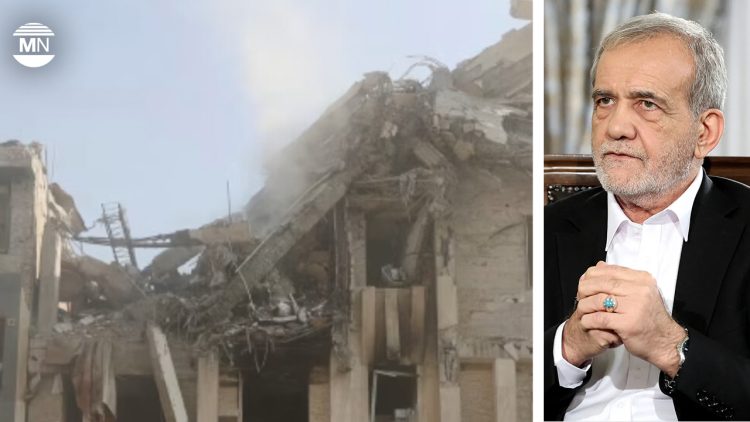
At least 78 civilians were killed and over 300 others injured in Israeli airstrikes on multiple locations in Iran, with residential areas among the targets, according to Iranian state media reports citing emergency officials. No independent confirmation of these figures was immediately available.
Iran’s Foreign Minister Abbas Araghchi has written a letter to the United Nations condemning Israel’s air strikes as a “blatant violation of Iran’s sovereignty and territorial integrity”. He stated that Israel, “as the most brutal terrorist regime, has crossed all red lines” and urged the international community not to let the attack go unpunished.
In the letter, Araghchi called for an emergency session of the UN Security Council, stating that the Council must fulfil its obligations under the UN Charter, “strongly condemn this invasion”, and adopt measures to hold Israel accountable. He reaffirmed Iran’s right to self-defence under Article 51 of the UN Charter and warned that Iran would deliver a “crushing response” to the attacks.
Iran’s Armed Forces Chief of Staff issued a stark warning, declaring that there are no longer any limits on how the country will respond to what it describes as Israeli “terrorist crimes”. In a statement carried by Iran Press, the military said: “There are no limits to our response. With God’s support and the backing of the brave Iranian nation, the hand of divine vengeance will strike down the terrorist regime and its supporters.”
The armed forces mourned the deaths of senior commanders—Major General Mohammad Bagheri, Major General Gholamali Rashid, and Major General Hossein Salami—along with scientists and civilians, including women and children, calling the Israeli assault an “aggressive attack”.
Mohammad Baqer Qalibaf, Speaker of the Iranian Parliament and a former IRGC commander, condemned the Israeli strikes that killed civilians, senior military commanders, and nuclear scientists. He asserted that Israel “started the war but it is Iran that will decide its end”.
Qalibaf vowed that Iran would avenge the attack “at any time and place, and with every tool”, and declared that those who provided military and financial support to Israel were “complicit” in the crime.
President Masoud Pezeshkian condemned the Israeli airstrikes as “stupid acts” and asserted that the Iranian nation would not remain silent. He described the attacks as a “savage aggression” by the “criminal Zionist regime” on Tehran and other cities, which led to the deaths of civilians, military commanders, and nuclear scientists. Pezeshkian labelled the strikes a breach of international commitments, portraying them as further proof of what he called the “criminal and illegitimate” nature of Israel. He emphasised that Iran would deliver a “tough, rational and powerful” response.
At least 20 senior Iranian commanders, including the head of the Islamic Revolutionary Guard Corps’ Aerospace Force, Amir Ali Hajizadeh, were killed in Israeli strikes targeting nuclear and military sites, according to two regional sources cited by Reuters on Friday. In a developing situation, additional reports indicate that a second wave of strikes occurred later the same day, targeting locations previously hit during the initial bombardment. The full extent of the damage and casualties from this second round has yet to be officially confirmed.