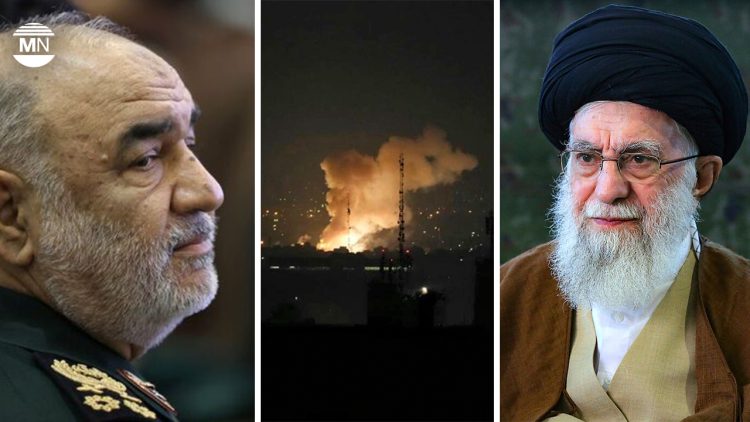
Israel launched a large-scale aerial offensive against Iran overnight, targeting several nuclear and military sites across the country in what it described as a preventative strike aimed at curbing Iran’s nuclear capabilities.
Explosions were reported in multiple Iranian cities, including the capital Tehran and its surrounding areas, as well as Natanz, Tabriz, Isfahan, Arak, and Kermanshah. Strikes targeted infrastructure sites such as the uranium enrichment facility in Natanz, military installations near Tabriz, and nuclear and missile-related facilities across central and western Iran.
The strikes reportedly killed key figures within Iran’s military and nuclear establishment. Iranian state media confirmed the death of Islamic Revolutionary Guard Corps (IRGC) chief Hossein Salami. The deaths of armed forces head Mohammad Bagheri, senior IRGC commander Gholamali Rashid, nuclear scientists Fereydoun Abbasi-Davani and Mohammad Mehdi Tehranchi, and former national security adviser Ali Shamkhani were reported by international media outlets, but have not been officially confirmed by Iranian authorities. Iranian state media also reported that Israeli strikes in and around Tehran resulted in civilian casualties. Reuters further noted that Iranian outlets reported both civilian and senior official deaths, though without specifying identities.
The aerial offensive, initiated in the early hours of Friday, included five waves of airstrikes, with footage showing fireballs and smoke rising above the capital, Tehran. According to The Guardian, the operation involved approximately 200 Israeli aircraft and targeted over 100 sites.
The Wall Street Journal reported that Mossad operatives smuggled explosive drones into Iran to disable radar systems ahead of the strikes. This was followed by the use of decoy drones and air-launched standoff missiles to suppress Iranian radar arrays and command infrastructure, opening gaps in air defences before the jets entered Iranian airspace.
Additional reports indicated that Israel targeted key military and nuclear infrastructure in a coordinated effort, supported by pre-planned intelligence gathering. These included facilities connected to Iran’s nuclear program, missile production, and command-and-control networks, according to publicly available satellite imagery and operational assessments.
Reuters described the strikes as unprecedented in both scale and precision. Regional military sources said Israeli fighter jets took off from airbases including Negev and Tel Nof, striking over 100 targets across Iran in an operation lasting just under three hours. Most aircraft reportedly returned safely to their bases. The offensive focused on nuclear facilities, missile production sites, and air defence infrastructure, including the destruction of dozens of radar installations and surface-to-air missile systems.
Iran’s Supreme Leader Ayatollah Ali Khamenei condemned the strikes and vowed a “harsh, bitter and painful response”. Iranian media reported that around 100 Shahed drones were launched in retaliation towards Israel, most of which were intercepted.